Updated every Monday!   Subscribe to free weekly newsletter.

Product Dilution: Breyers Lightens More Ice Cream

Last year, we reported that Breyers “cheapened” many varieties of their ice cream by reducing the amount of butterfat content to the point where the product could no longer legally be called “ice cream,” but rather had to be renamed “frozen dairy dessert.”

Some stalwart flavors, like MrConsumer’s beloved lactose-free vanilla, remained untouched until now. To MrConsumer’s horror and surprise, Breyers quietly converted that ice cream variety to “light ice cream.”

*MOUSE PRINT:

Breyers old - new front
Click to enlarge

In the new packaging, the “All Natural Ice Cream” claim is replaced with the phrase “Quality Since 1866.” Of course, it doesn’t say the same quality. And the words “ice cream” are replaced with “light ice cream.”

What exactly is “light ice cream?” According to FDA rules:

“Light” ice cream contains at least 50% less total fat or 33% fewer calories than the referenced product (the average of leading regional or national brands).

Looking at the nutrition panels of the old Breyers lactose free ice cream and the new one reveals only a minor reduction in calories.

*MOUSE PRINT:
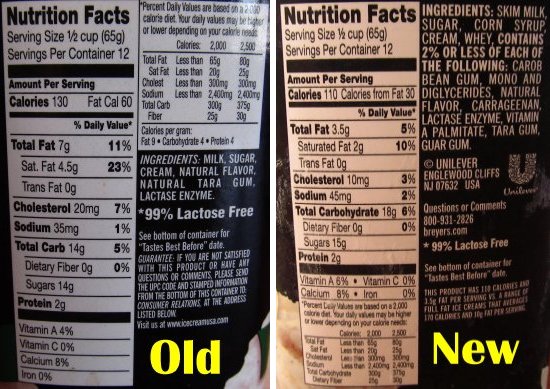
Breyers old-new

The old “ice cream” product had 130 calories and the new “light” one has 110 calories, only 20 fewer calories. It does however have half the fat. And, the federal law says that light ice cream must have EITHER half the fat OR 33% fewer calories.

There is just one problem, though. The front of the package claims very clearly that the new light ice cream has BOTH half the fat and 1/3 fewer calories.

Breyers fat-cals

Clearly, this new lactose free light ice cream does not comply with that representation when compared to their old regular lactose free ice cream. So how do they get away with this claim?

*MOUSE PRINT:

breyer one-third fewer

Tucked away on a side panel is that tiny disclosure. They are not comparing this new light ice cream with THEIR old regular ice cream, but rather with some super premium brands like Ben & Jerry’s and Haagen Dazs as well. Those have been thrown in to up the average amount of fat and calories in “full fat” brands, and thus make Breyers’ reduction seem more impressive than it really is. (Haagen Dazs has 250 calories and 17 grams of fat per serving, while Ben & Jerry’s has 230 calories and 14 grams of fat.)

Mouse Print* asked the PR firm representing Breyers three times to explain why they cheapened some of their products, and they provided no response.

If you spot a new example of “product dilution,” please send complete before and after details to edgar [at symbol] mouseprint.org .

Updated every Monday!   Subscribe to free weekly newsletter.

Inside the NY-AG’s Lawsuit Suing Donald Trump Over “Trump University”

Last week, the New York Attorney General sued Donald Trump and others claiming a host of illegal practices engaged in by Trump University, the Donald’s real estate education program.

Among the AG’s allegations (and some things you didn’t hear in the news):

  • Students were induced to sign up for classes under the belief they would be taught Donald Trump’s personal strategies and techniques for investing in real estate. The material in the courses was never reviewed by Donald Trump and actually came from other seminars and courses about real estate. It also did not include some of the topics specifically advertised.
  • Trump’s free education seminar was really a sales pitch for a $1495 three-day course. His three-day program was itself in part an upsell sales pitch for an elite course costing up to $35,000. Trump University claimed this was a philanthropic endeavor that Trump would not profit from. In fact, they took in $40 million in sales, and Trump himself pocketed some $5 million in profits.
  • Trump University was repeatedly told by the New York State Education Department as far back as 2005 that it needed to be licensed and could not use the term “university” in its name. They didn’t change the name, however, until 2010.
  • Trump claimed in advertisements that he handpicked the instructors/mentors in the program, when he never did.
  • There were claims that the instructors were real estate experts, when some of them had just filed for real estate-related bankruptcies.
  • Students were told they would easily and quickly make back the money they spent on courses because mentors would in essence hold their hand through their first transaction. Mentors, however, disappeared after the course was over in some cases and students were left with significant credit card debt for the classes.
  • After the lawsuit was filed, Donald Trump defended the educational program saying that students filled out an evaluation and 98% said they were satisfied. What Trump didn’t say, and what the NY-AG alleges in his complaint, is that students filled out the non-anonymous evaluations before the course was over, were pressured to give the course good grades, and in some cases negative evaluations were changed to positive ones by staff.

And it goes on and on.

*MOUSE PRINT:

Here is a link to the actual complaint filed by the New York AG, with great detail about the promises made, and what was really going on behind the scenes. For example, most of the instructors/mentors were paid commissions based on the number of students they convinced to pay for the advanced seminars.

It is fascinating reading beginning to end. [Click the icon in the bottom right corner below to see the complaint full screen.]

Updated every Monday!   Subscribe to free weekly newsletter.

Product Dilution: Cheerios Decreases Vitamin Content

In a move rarely ever done, General Mills actually reduced the quantity and number of vitamins (and therefore the nutritional value) of one of its cereals — MultiGrain Cheerios.

*MOUSE PRINT:

MultiGrain Cheerios

The nutrition label on the left shows that one serving provides 100% of the daily requirement of nine vitamins and minerals. The one on the right shows that these were reduced to only 25% of the daily requirement in most cases, and two were actually eliminated completely from the product.

We asked the company why they reduced the vitamin content.

“The change in vitamin levels brought MultiGrain Cheerios in line with the Cheerios family of cereals. MultiGrain Cheerios now delivers an excellent source of 8 vitamins and minerals for our all-family consumer base.” — General Mills spokesman.

As consumers, we are used to having to check the price of a product to see if it has changed. Readers of Mouse Print* have learned that you also have to check the net weight of a product to see if it has been downsized. And, who would have believed it, but now we have to check the nutrition label to see if we are getting fewer vitamins.

We are nicknaming this phenomenon of a product being reforumulated and watered down as “product dilution.” Another example of product dilution was when many flavors of Breyers ice cream had the amount of milkfat reduced to below 10% requiring it to be renamed “frozen dairy dessert.”

If you spot a product that has been diluted, please email details to edgar (at symbol) mouseprint.org .

Thanks to Nancy W. for discovering the Cheerios product dilution, which the company says actually occurred in 2011.