Updated every Monday!   Subscribe to free weekly newsletter.

Do Political Influencers Have to Disclose Paid Posts?

More and more political campaigns are trying to get their messages out to younger generations. How do they do this? Both major parties are paying internet influencers to create content, usually video messages, in various social media like TikTok, Instagram, YouTube, X, and others.

So the question is, do these influencers have to disclose to viewers when they were paid to espouse a particular point of view (which probably was there own anyway)? Here’s what one influencer says:

And here’s what the law says. The Federal Trade Commission has specific rules requiring infuencers to clearly disclose material connections they have with companies if they were paid for their opinions. In a commercial context, they believe that since this is a kind of paid advertising, anyone seeing it has a right to know what they are seeing or hearing may have been influenced by the money the person was paid.

But the FTC regulates trade and commerce and opinions spouted by internet influencers about politcal issues and figures is not within their jurisdiction.

The Federal Election Commission (FEC) oversees political advertising. Last December they endeavored to modernize regulations governing internet communications, but decided not to require internet influencers to disclose to viewers and readers if they were paid by a political entity. Some of commissioners at the FEC disagreed saying this was a missed opportunity.

Some states have begun requiring social media influencers to disclose if they were paid to espouse a particular political opinion on a candidate or issue. Last year, California passed such a law. And in June, the Texas Ethics Commission passed a requirement that influencers have to disclose if a post or video is a paid political advertisement.

Various social media platforms have their own rules that posters must follow.

*MOUSE PRINT:

TikTok has the strictest policy — banning political advertising entirely, including branded political content from creators. Instagram and Facebook, owned by Meta, allow for paid political ads and sponsored political content from creators as long as the group is registered in its ad library. … And X, formerly Twitter, lifted its political ads ban last year. — Politico

What is your opinion? Should influencers who are paid to espouse a particular political point of view disclose that fact, whether the law requires it or not?

[Please do not turn the comments into a Trump vs. Harris, or democrats vs. republicans discussion.]

Share this story:


ADV
Updated every Monday!   Subscribe to free weekly newsletter.

Robitussin Puts Non-Drowsy Lawsuit to Bed

In 2022, two different consumers sued the makers of Robitussin alleging that package claims of the products being non-drowsy were false and misleading. (See complaint.)

In particular, the suits said that one of the active ingredients in these cough suppressants, dextromethorphan (DXM), was actually known to cause drowsiness. Further, the complaints alleged that the “drug facts” disclosure on the back of the boxes did not warn about possible drowsiness.

*MOUSE PRINT:

Robitussin DM

The plaintiffs also cited various medical studies supporting the fact that DXM could make one sleepy, and pointed out that the Federal Aviation Administration advised pilots not to fly if they have taken it.

In 2023, the case was decided in favor of the manufacturer on the theory that the state law consumer violations cited were pre-empted by the federal Food, Drug, and Cosmetic Act governing drug products like this. The consumers appealed.

Despite that, the parties negotiated with each other since the court decision, and came to a settlement of the claims for $4.5-million. The company has agreed to discontinue the non-drowsy claims. Purchasers as far back as 2016 may be entitled to between $1.50 and $4.75 per claim. More details will be available after a judge signs off on the agreement.

Share this story:


ADV
Updated every Monday!   Subscribe to free weekly newsletter.

How Skimpflation Works in Restaurants

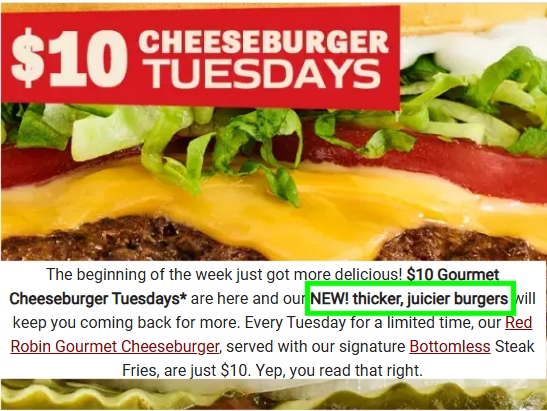
In October last year, Red Robin announced an upgrade — that it had a “new and improved lineup of gourmet burgers” that were “juicier and more flavorful.”

This August, Red Robin further announced a limited time promotion for a gourmet cheeseburger and unlimited fries for $10. No doubt, this is a pretty good deal given fast food prices and portion sizes today.

Red Robin $10 promotion

One Red Robin regular, WiseSofa1748, commented on their burgers in the following post, saying they are not as good as they used to be because the reason they are juicier is that they are fattier.

The new burgers they use suck. The old ones they had for years and years were so good. I asked the store manager when I last went and she told me it was really to cut costs, they went to a less lean, cheaper cut of beef that allowed it to be “juicier” aka more fat and slightly bigger bc its a crappier cut. It doesn’t taste near as good. Same for the bun and cheese she said, both were swapped out and Red Robin claimed it was for taste but as always it was to save a buck.

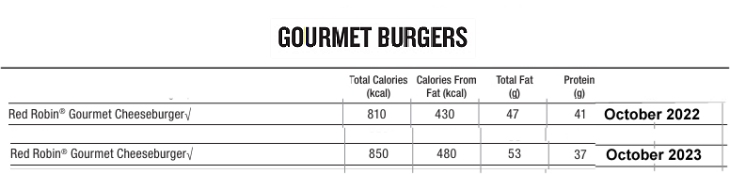
Are the consumer and the manager right? We did a little detective work to compare the current nutritional disclosures for their gournet cheeseburger with the previous listing from a year earlier, excerpted below.

*MOUSE PRINT:
Red Robin Nutritional comparison

Indeed, the amount of fat content went up, while the amount of protein went down. Since the company announced that it was making its burgers bigger and juicier last year, that could account for the increase in fat. However, the amount of protein should have gone up too if the company maintained the same lean to fat ratio.

We made multiple requests of the company to find out if they made the alleged changes to their burgers, but they did not respond.

While the media focuses on shrinkflation a lot these days, skimpflation is even more insidious. With shrinkflation, at least you can objectively discover when a product shrinks. But with skimpflation, product tweaks or reformulations are not generally announced or easy to discern.

We don’t know the recipes used by restaurants, the exact portion size you normally get, the grades of meat they buy, the quality or quantity of all the ingredients used in a dish, etc. So it is even easier to tinker with these things and most consumers would be none the wiser.

If you spot an example of skimpflation, please send the details and any proof you can unearth to Edgar (at symbol) MousePrint.org. Thanks.

Share this story:


ADV