Updated every Monday!   Subscribe to free weekly newsletter.

Smart for Life Diet: Just Eat Cookies?

If you live in one of the cities where Smart for Life has offices, no doubt you have seen their TV commercials touting their cookie diet. “I lost 35 pounds in three months by eating cookies,” says one now slender client.

They say their cookies are made from extracts of fruits, vegetables, wheat and dairy, and their commercials show all those produce and grain ingredients being loaded into their cookies. But, they only provide ingredients listings for three of their six cookies on their site. Here is their recipe for blueberry cookies.

*MOUSE PRINT:

Triple Filtered Water, Vegetable Glycerin, Doctors Protein BlendTM (Milk Protein, Egg Protein, Organic Whey Protein), Hydrolyzed Collagen (Gelatin), Organic Whole Oats, Organic Crisp Rice (Organic Brown Rice Flour, Organic Molasses, Calcium Carbonate), Organic Invert Sugar, Organic Dried Blueberries, Organic Whole-Grain Wheat Flour, Vegetable Gum, Organic Soybean Oil and/or Enriched Organic Golden Flax Meal (Organic Flax, Fish Oil), Vegetable Gum, Organic Fractioned Palm Oil, Raw Organic Oat and/or Wheat Bran, Organic Oat Flour, Organic Pure Tahitian Vanilla Extract, Baking Soda, Baking Powder, Sea Salt, Natural Flavoring, Organic Nutmeg. Contains at least 60% Organic Ingredients.

Yum. Notice that water is the first ingredient, meaning there is more of it by weight than another other ingredient. And the only “vegetable” listed for the three cookies online is “vegetable glycerin” and “vegetable gum”. No wonder some people around the country are selling 12 days’ worth of leftover cookies on Craigslist. Worse, the cookies are not particularly nutritionally dense considering they will account for most of the food you will be eating daily.

The diet requires you to eat six cookies a day instead of breakfast, lunch and snacks. For dinner, you are only allowed six ounces of protein and two half-cup servings of vegetables. According to one of the company’s doctors who is interviewed, clients generally eat only about 800 calories a day. So, at 105 calories per cookie, that would only leave 170 calories for dinner. Eat hearty!

The commercial also claims “it will save you a fortune over other plans.”

*MOUSE PRINT: A two week supply of cookies is $129!  That is over $1.50 per cookie. (NutriSystem says their real food is about $10 a day, or about $140 for two weeks.)

In addition to the cost of the cookies, there is an initial evaluation and program fee,  including medical tests, and vitamins. That adds hundreds more to the cost.

The company’s website does, however, have good news for would-be clients:  “No exercise needed to lose weight” and “Eating habits improve automatically and permanently”.

Sure.
Share this story:


ADV
Updated every Monday!   Subscribe to free weekly newsletter.

Pay Your Taxes with Plastic — and Get Rewarded?

chasetax.jpg

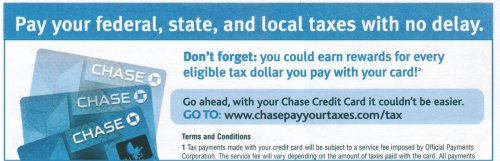
With tax day less than a month away, cash-strapped consumers may be tempted to charge the balance they owe to a credit card, such as through the offer above (or via the electronic payment services approved by the IRS that accept credit cards).

The promotion says you could earn rewards for every dollar you charge. The fine print, however, says:

*MOUSE PRINT: “Tax payments made with your credit card will be subject to a service fee…”  How much of a service fee?  It is 2.49 percent, or about $25 per $1000 charged.

But what about the rewards they promised?  Most reward credit cards only offer 1% back, so that would reduce your service fee to 1.49 percent or about $15 per $1000 charged. The good news is that most credit card companies will treat this tax payment as a purchase rather than a cash advance (thus giving you a 20-25 days grace period with no finance charges or cash advance charges if you pay in full every month). If you don’t pay it in full, regular finances charges will accrue on top of the 2.49 percent fee.

Some credit cards like Citi’s CashReturns card offer 5% back on everything for the first three months. Were you to use this card, you would actually make 2.5% on your tax payment.

A little known alternative to charging your taxes to your credit card is to put that charge on your debit card through a company called Link2Gov.

*MOUSE PRINT:  The fee is only $2.95, but your card must be a member of the NYCE, Star or Pulse networks.

Don’t charge more than is your bank account, or that will trigger overdraft fees, and/or finance charges from your bank.

Most experts, however, suggest paying your taxes the old fashioned way — by check. You will enjoy a week or two of float, and not pay a penny extra in fees or finance charges.

Share this story:


ADV
Updated every Monday!   Subscribe to free weekly newsletter.

Airborne’s Legal Remedy: Nothing to Sneeze At

airborne.jpgEveryone has probably seen the commercials for Airborne — the cold remedy “developed by a school teacher who was sick of catching colds in class and on airplanes.”

Clearly, this sounds like a product that one would take to prevent catching a cold.

Even their website back in 2001 gave that impression and more:

“Crowded environments like Airplanes, Offices, and Schools are spawning grounds for germs that cause colds and sickness! AIRBORNE’S unique natural formula of seven Herbal Extracts, Antioxidants, Electrolytes, and Amino Acids, offers maximum vitamin and herbal protection for hours! Plus its natural ginger component helps fight nausea caused by motion sickness. Take at the first sign of a cold symptom or before entering crowded, potentially germ-infested places!  [It then quotes a user as saying:] A miracle cold buster!”

And a few years later they touted the results of a clinical trial on their website.

*MOUSE PRINT: Though there is page after page of mumbo jumbo, it does suggest a reduction in symptoms by those who took Airborne. However, only 48 people actually took the product.

Fast forward to 2006. ABC reported that Airborne’s clinical trial was conducted neither by scientists nor doctors, but rather by two guys hired to conduct this particular test. The company then dropped references to it on its website.

Fast forward again to 2008. Airborne just settled a class action lawsuit claiming that the company misrepresented the product, and it agreed to pay over $23 million back to purchasers. [Get claim form here.]

The settlement agreement is lacking at least one key provision, however:

*MOUSE PRINT: There is no requirement that they refrain from making unsubstantiated claims in the future.

August 2008 Update: The FTC just entered into a settlement with the company to prevent them from making unsubstantiated health claims in the future, and to pay a total of $30 in settlement to aggrieved purchasers.

Share this story:


ADV