Updated every Monday!   Subscribe to free weekly newsletter.

Act Fluoride: Twice the Size, Half the Strength

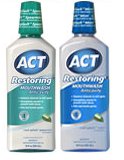
actsmall.jpgWhen MrConsumer’s dentist advised him that a new cavity might be in its earliest stages of development, he checked out fluoride rinses that claim to restore minerals to weak spots in tooth enamel and prevent cavities.

The granddaddy of brands is Act, formerly owned by Johnson & Johnson, and recently acquired by a company called Chattem.

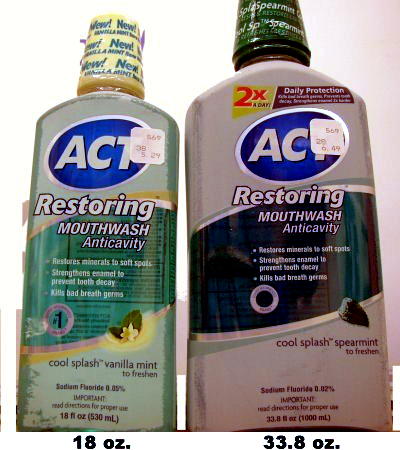
Act comes in two sizes: 18 ounce and 33.8 ounce. Luckily for MrConsumer, Rite Aid had the large size on sale last week, and there was a rebate. It was a seeming no-brainer to buy the big size.
actmedium.jpg

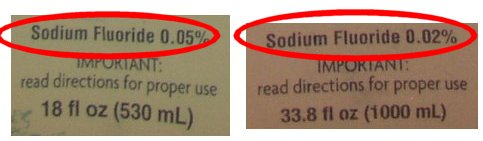
Upon closer examination of the ingredients label, MrConsumer found a shocker:

*MOUSE PRINT: The larger bottle has less than half the strength of fluoride compared to the smaller one.
actstrength.jpg

Now who would ever expect that a different size bottle would have a different strength of the active ingredient? In fact, if you look at the larger bottle, there is a “2x” on it. Without reading carefully, one might assume that “2x” means twice the strength or twice the size, but certainly never half the potency. A closer examination reveals that is says “2x a day”. Okay, so you can use the product twice daily.

As it turns out, the company says the smaller bottle is a once a day product, and the larger one is a twice a day product. Apparently you get the equivalent amount of fluoride using the diluted version two times a day.

Nonetheless, with such an inconspicuous but important difference, countless customers in the habit of using the product once a day may buy the large size, rinse as usual, and unwittingly not get the protection they expect.
Share this story:


ADV
Updated every Monday!   Subscribe to free weekly newsletter.

LifeLock: Just Say You’re a Victim

LifeLock is a service that aims to protect your personal information from ID theft for $120 a year and they back up their claim with a $1 million guarantee (discussed last week here).

What are some of the things they do to protect you? They order a copy of your credit report annually from the major credit bureaus. They opt you out of pre-screened offers of credit. And they put a fraud alert on your credit reports.

Of course, these are all things you could do yourself for free. And to their credit, after they mention each of these things on their website, they indicate you could do these things too for free but why bother with the hassle. (It frankly is so surprising to see this level of candor, that it makes MrConsumer suspicious that some Attorney General somewhere didn’t require this of them in the past for this company or a prior company.)

Now, as to their putting a fraud alert on your credit report, depending on the circumstances, this may or may not be kosher. Under federal law, only victims of ID theft or those who believe they are about to become a victim of fraud may place such an alert into their credit report:

“Upon the direct request of a consumer, or an individual acting on behalf of or as a personal representative of a consumer, who asserts in good faith a suspicion that the consumer has been or is about to become a victim of fraud or related crime, including identity theft, a consumer reporting agency described in section 1681a (p) of this title that maintains a file on the consumer and has received appropriate proof of the identity of the requester shall— (A) include a fraud alert in the file of that consumer …”

So how in the world can this company represent to the credit bureaus that you have been victim or are about to be?

*MOUSE PRINT: Buried in LifeLock’s terms and conditions is this provision:

“18. … You additionally agree that you have a good faith suspicion that you have been or are about to become a victim of fraud or related crime, including identity theft, that you want to obtain fraud alerts under 15 U.S.C. § 1681c-1, and that you will notify LifeLock immediately if and when you no longer have such a good faith suspicion.”

Unless you read the fine print, you probably would not have known that you were being asked to attest to something that may not be true — that you are a current or imminent future victim of ID theft.

This bit of duplicity has not gone unnoticed. Just a few days ago, Experian, one of the big three credit reporting agencies filed suit against LifeLock for this very practice.

Share this story:


ADV
Updated every Monday!   Subscribe to free weekly newsletter.

LifeLock: Don’t Do As We Do

lifelocksign.jpgWith stories about identity theft, stolen social security numbers, and compromised account information filling our newspapers weekly, no wonder a number of companies have sprung up to help protect you.
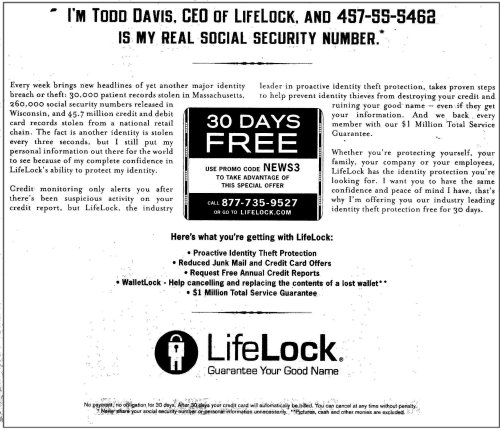
LifeLock is one such outfit. Unlike ID Vault , previously mentioned in Mouse Print* as a service to protect your online login information, LifeLock aims to protect your personal information from being used to commit ID theft for $10 a month.

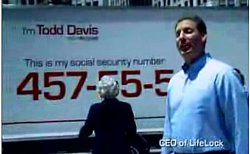
In a full page newspaper ad [Boston Globe, Feb. 13, 2008], as well as in TV, radio and web ads, LifeLock’s CEO, Todd Davis, publishes his own real social security number to show how confident he is in his service being able to protect him. And they even offer a $1 million dollar service guarantee.

lilfelocknewsp.jpg

The asterisk after “social security number” goes to this fine print disclosure:

*MOUSE PRINT:

“*Never share your social security number or personal information unnecessarily.”  

So besides doing exactly what he counsels prospective customers not to do — putting personal information out there for all to see – he has also voided his own $1 million guarantee.

*MOUSE PRINT:

“18. … In addition, you agree that you will not purposely engage in behavior that will put your personal information at unnecessary risk, such as leaving your PIN or passwords in obvious places or publishing your Social Security Number. “

And, in the irony to end all ironies, Todd Davis had his social security number stolen last year after publicizing it in advertising. It was used to fraudulently obtain a $500 loan. [see story]  Apparently the company found the guy who did it and because they allegedly coerced a confession from him, no prosecution could go forward.

That doesn’t exactly create the type of first person testimonial he might have been hoping for.

Next week: We will look deeper into what services LifeLock offers, and the questionable way part of it works.

Share this story:


ADV