Updated every Monday!   Subscribe to free weekly newsletter.

Verizon FiOS: Price Increase Masks Upgrade

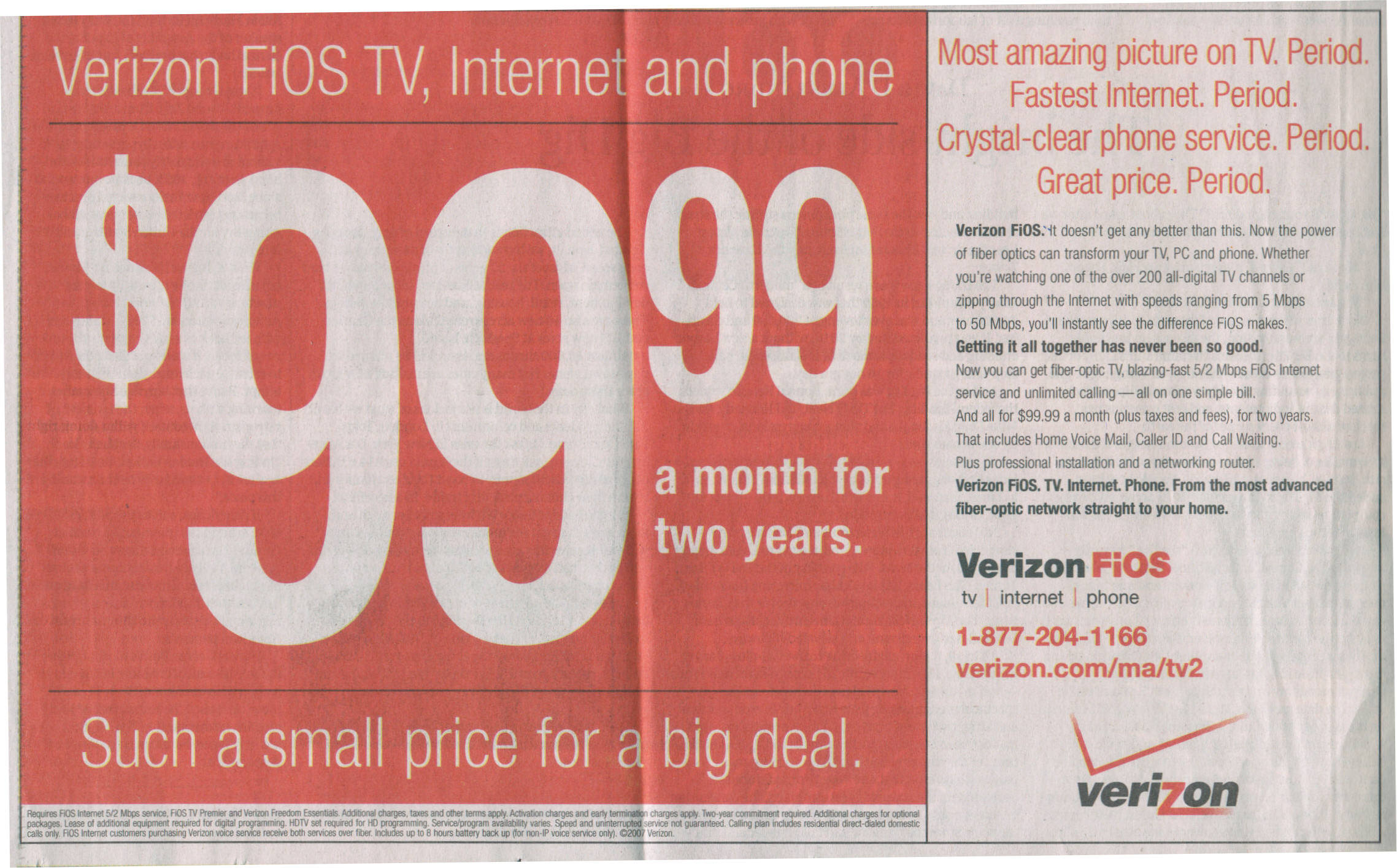
Verizon has been rolling out its FiOS fiber optics service and has touted its benefits in advertising. Like other providers, the company has been offering a “triple play” — telephone, TV, and Internet services in one package for only $99.99 a month.

Last year’s ads typically looked like this:
fios07s.jpg

While in the big print it claimed “fastest Internet, period”, the package they were advertising actually  provided the slowest speed FiOS offered:

*MOUSE PRINT: “blazing-fast 5/2 Mbps.”

A download speed of 5 Mbps is nothing special (except compared to dial-up and slow DSL speeds). In fact, Comcast’s standard download speed is 6 Mbps. So, some people not knowledgeable about comparative speeds could have been misled.

Fast forward to 2008. Sharp-eyed consumers may have been dismayed to see Verizon’s current advertising for the triple play because the price was no longer $99.99 but rather $109.99.

fios3.jpg

This time, the company made no superiority claims about the “fastest Internet”, but buried the most important fact in the fine print:

*MOUSE PRINT: “20/5 Mbps blazing-fast Internet”

Verizon actually quadrupled the download speed and more than doubled the upload speed for only $10 more a month (plus a “free” HDTV), when you sign a two-year contract.

For once, the mouse print had good news for customers.

Disclosure: Consumer World, the publisher of Mouse Print*, is a member of Verizon’s Consumer Advisory Board, and receives a small contribution from Verizon to carry out its consumer education mission.

Share this story:


ADV
Updated every Monday!   Subscribe to free weekly newsletter.

Lipitor: Reduces Bad Cholesterol, But…

We have all seen the Lipitor commercials with Dr. Robert Jarvik (he is not licensed to practice medicine in any state, but went to medical school) touting the cholesterol lowering benefits of that drug.

In fact, the company claims it will lower bad cholesterol by 39-60%:

lipitor3960.jpg

The average consumer reading this rightfully thinks this is a good thing for your health. The question, though, is what is the real significance of lowering bad cholesterol.

Another Lipitor ad helps explain this too:

lipitor2.jpg

So, for people at risk, taking Lipitor lowers your chances of having a heart attack by 36%. This certainly sounds like a big benefit for most people considering taking this drug, until you look at the fine print:

*MOUSE PRINT:

lipitordisclose.jpg

The company apparently conducted a test whereby high risk people were divided into two groups,  one of which got Lipitor, and the other got a placebo. Out of every 100 subjects tested, only three people who in essence took nothing to lower their cholesterol suffered heart attacks. On the other hand, two out of 100 Lipitor takers had a heart attack. The difference, according to the study, is that for every 100 people who take Lipitor, only one additional person will be spared a heart attack compared to those who do nothing.

So despite the big percentage claims made in advertising — 39% to 60% reduction in bad cholesterol, and 36% reduction in risk of heart attacks — if the risk the pill is reducing is very small to start with, very few people will actually be spared that heart attack by taking Lipitor (but the company will make a lot of money in the process).

Of course, for the one person in a hundred who is spared, the pill is priceless.

For more information on the math used in drug advertising, read this Business Week story.

Share this story:


ADV
Updated every Monday!   Subscribe to free weekly newsletter.

Quicken: The Software That Becomes Crippleware

quickendeluxe.jpgSince the beginning of January, owners of Quicken 2005 have been bombarded with reminders (via pop-ups when starting up the software, and by mail) that on April 30, 2008 many important features of the program will stop functioning. Mouse Print* this week will examine the stark contrast between these current elaborate disclosures and how poorly new customers are warned before purchase that the software will become substantially disabled in three years.

In a January mailing to Quicken 2005 customers, the company warns:

quickenwarn.jpg

When starting up the software in 2008, this pop-up warns of the forthcoming crippling:

quickenpopup.gif

For many users, the ability to download statements from their bank and stockbroker monthly, get stock quotes, as well as being able to pay bills and transfer money online, are key reasons to use Quicken.

After presenting the bad news, Intuit, the maker of Quicken, offers the solution: buy an upgrade to Quicken 2008. In the past, for many users this has not been a huge issue because Quicken Basic has always been free after rebate when purchasing the company’s tax preparation software, TurboTax. This year, as noted in last week’s edition of Mouse Print*, the company discontinued Quicken Basic and made its substitute product (Starter Edition) incapable of importing existing Quicken files. That forces customers to buy an upgrade for $59.99 (less during promotions) to Quicken Deluxe.

Incidentally, the company says it is costly to support prior versions of Quicken, and that is why they discontinue these critical functions every three years. They apparently have not changed the technology they use to communicate with banks and brokerage firms, however. That would have been an understandable reason for the nonfunctionality. It appears that the company just deliberately disables the online functions to enable it to generate more income from current owners.

Okay, so Quicken has a three year life for certain important functions. How do they convey that critical limitation to prospective customers?

*MOUSE PRINT: On the spine of the 2008 box, buried within the copyright notice, in type so small the actual notice is less than an inch wide, it says (enlarged below):

quickensunset.jpg

The disclosure merely says that online features are subject to change in accordance with the “discontinuation policy” (previously called their “sunset policy”) listed on their website. The “subject to change” language also appears in a tiny footnote on the back of the box. Similar non-specific notices appeared on the 2005 Quicken box.

In no way, shape, or form is this adequate notice that the Quicken product you are about to buy will have key features of the software disabled/crippled in April three years after the date on the box. The essence of consumer protection (and fair dealing) is to provide the customer with all the relevant facts before purchase so they can make a more informed buying decision.

Share this story:


ADV