Updated every Monday!   Subscribe to free weekly newsletter.

Is Ninja Nonstick Cookware Fired to 30,000°?

SharkNinja, the maker of Ninja cookware, claims that the nonstick coating sprayed on their pots and pans is heated to 30,000 degrees so that it won’t stick, chip, or flake.
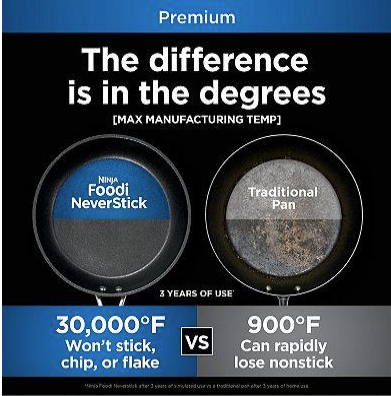
Ninja 30,000 degrees

There’s just one problem with that claim according to the consumer who is suing the company. Her complaint says in part…

*MOUSE PRINT:

The “difference is in the degrees” and 30,000ºF claim is as deceptive as it is preposterous. According to NASA, as presented at the Triennial Earth-Sun Summit, “the surface of the sun is a blisteringly hot 10,340 degrees Fahrenheit…”. Defendant would have the average consumer believe that their nonstick pans are manufactured at a temperature that would vaporize the aluminum pan base metal into gas.

This is not the first time that Ninja’s nonstick cookware has come under fire (so to speak). In 2021, the National Advertising Division (NAD) of the BBB ruled that their “never stick” claims were false and misleading because such claims “reasonably convey an unsupported superiority message that, unlike traditional non-stick cookware which rapidly loses its non-stick properties, NeverStick cookware would exhibit a greater level of resistance against sticking, chipping, and flaking.”

Also in 2021, in an unpublished Mouse Print* story, we found that the company was misleading shoppers about it’s lifetime warranty because its idea of “lifetime” is five years, not what the average shopper would expect.

*MOUSE PRINT:
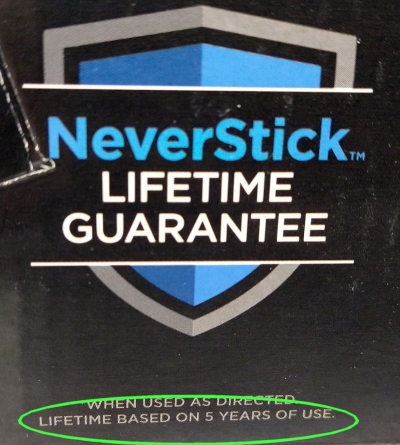
Ninja Lifetime guarantee

The NAD also addressed the lifetime guarantee issue in its 2021 decision.

NAD also recommended that SharkNinja discontinue claims that NeverStick has a “lifetime guarantee.” NAD determined that a reasonable takeaway from such claims is that the product’s useful life is far longer than the five years for which it is guaranteed…

SharkNinja has been the subject of multiple NAD cases by competitors alleging that the company makes misleading claims for their products. As a company headquartered here in Massachusetts, it is about time that our attorney general got out of the frying pan and into the fire to review this company’s advertising practices.

Share this story:


ADV
Updated every Monday!   Subscribe to free weekly newsletter.

Blue Bunny No Longer Real Ice Cream

Blue Bunny ice cream has been a rebel. When other brands downsized to 56 ounces, they stayed at half a gallon. Subsequently when the industry moved to a 48-ounce container, Blue Bunny didn’t follow. But ultimately, they did conform to the now standard 48-ounce size.

The company also saw other brands in the ice cream business like Breyer’s convert some of their real ice cream flavors to “frozen dairy desserts” — a product no longer allowed by federal law to be called “ice cream” because it has less than the required 10% milkfat. Back in 2016, Blue Bunny told Mouse Print*:

[other brands are] electing to stray from the true definition of ice cream and deliver frozen dairy dessert… the quality of our ice cream has not been ignored, in fact our ice cream is better than ever!

Fast forward a few years and so much for that noble stance. Our friend, the Ingredient Inspector, discovered a very inconspicuous change that Blue Bunny appears to have made three years ago. The words “ice cream” quietly disappeared from most of their 48-ounce containers, and “frozen dairy dessert” appeared next to the net weight.

*MOUSE PRINT:

Blue Bunny frozen dairy dessert

Even the best of us would not likely spot that change. But how does that wording change translate in the composition of the product?

*MOUSE PRINT:

Blue Bunny ingredients

Instead of milk and cream as the primary ingredients in the real ice cream product, now skim milk and whey powder predominate in the revised version, and they’ve added coconut oil.

I bet that most Blue Bunny customers never realized the product changed, making this an early example of skimpflation.

For more examples of the ingredients changes in Blue Bunny “frozen dairy dessert” please see the detailed story at the Ingredient Inspector.

Share this story:


ADV
Updated every Monday!   Subscribe to free weekly newsletter.

Does Your Fabric Softener Give You the Loads Promised?

Breaking News

If you didn’t see it, President Biden released a video on Super Bowl Sunday warning viewers to check their snack foods because many of them have gotten smaller, costing you more money. He called on manufacturers to voluntarily stop the practice of shrinkflation.


Snuggle 120 loadsA common ploy used by detergent and fabric softener manufacturers is to exaggerate the number of wash loads you get out of each bottle.
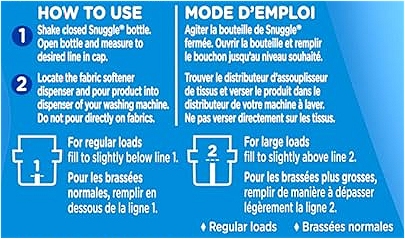
Now a Missouri consumer is suing the maker of Snuggle fabric softener for misleading practices (see complaint).

*MOUSE PRINT:

In the 120-load, 96-ounce bottle, there is a hard-to-see diamond-shaped asterisk-like symbol that leads shoppers to a disclosure on the back of the bottle.

Snuggle asterisk
Snuggle back of bottle

It says “120 loads” refers to “regular” loads. However, you have to use double the amount of softener for “large” loads which according to the consumer’s lawyer is the laundry load size that most users do.

19. Because consumers … expect full loads of laundry when seeing the term “load” (instead of half-loads) – consumers are being cheated out of at least 50% of what they expect, based on Defendant’s own measurements.

20. For the vast majority of consumers doing full loads of laundry, the most loads the Product provides softener for is approximately 60 or less, not 120.

The complaint points out that some fabric softener manufacturers play it straight(er) now by saying that the load size shown on the front refers only to a small wash load.

Suavatel

That is certainly better but it is still misleading since the average user does not do small loads according to the complaint.

Why can’t manufacturers just play it straight and tell purchasers the actual number of loads they will get from a bottle based on the way most consumers actually use the product?

Share this story:


ADV