Updated every Monday!   Subscribe to free weekly newsletter.

Shoppers Sue Retailers Over Sneaky Practices – Part 1

They’re mad as hell and not going take it anymore. That seems to be the case these days when shoppers have had enough of retailers’ broken promises. Over the next three weeks, we will examine three recently filed class action lawsuits again some big name chains. First up — Safeway.

Safeway

Everyone loves buy one, get one free (BOGO) offers when they are legitimate. But one Washington state consumer says Safeway is not playing fair because she alleges the supermarket chain raises the price on items that are offered as BOGO specials.

*MOUSE PRINT:

In her complaint, the consumer claims:

Contrary to the language of Defendants’ free product offers, the BOGO products are not actually free. Instead, Defendants increase the price of the first unit of the product to cover the cost of the second purportedly “free” unit of the product.

Throughout the class period Defendants routinely increased the regular retail price of items when offering them in BOGO sales. For example, during the class period, Safeway sold boneless, skinless chicken breasts to Club Card members for $2.99 per pound. Within the same month, Safeway sold seasoned boneless, skinless chicken breasts for $5.99 per pound in a Buy 1, Get 1 Free promotion. Thus, Club Card consumers overpaid by $3.00 per pound for any BOGO chicken purchase.

Safeway chicken breasts

Other examples in the lawsuit don’t give clear-cut examples demonstrating that the one purchased item had doubled in price to make up the cost of the free item.

And worse for the consumer and her lawyer, they may not understand the variability of retail pricing. Stores sell goods at a variety of different prices. In the case of the chicken breasts above, for example, it is unlikely that $2.99 was the regular price of that item. It perhaps was on sale for $2.99 a pound one particular week. So to suggest that whenever Safeway runs a BOGO sale on chicken breasts it should have been $2.99 for the first package and the second free is just plain wrong.

Regular prices have to be bona fide. Generally speaking, products must be offered at full regular price for a substantial period of time and then they can be periodically discounted. In the case of buy one, get one free offers, under Federal Trade Commission rules, retailers cannot jack-up the price of the purchased item beyond its regular price.

So, if the court finds that Safeway only charges $5.99 a pound for chicken breasts when offered on a BOGO basis, then the consumer has a great case. But if it really charges $5.99 a pound “regularly” when not on sale, but occasionally has a sale for $2.99 a pound, the case may fail.

Of note, however, is a case that Safeway and Albertsons have recently agreed to settle for $107-million after similar allegations were made about buy one, get one free meat sales in Oregon. A similar suit complaining about Safeway’s BOGO practices was also filed in California in June.

Next week, we’ll examine a complaint filed against Best Buy for not honoring its price guarantee.
Share this story:


ADV
Updated every Monday!   Subscribe to free weekly newsletter.

Supermarket Sweepstakes’ Free Entry Method Challenged

In early June, a number of the Albertsons Companies supermarket chains (Acme, Albertsons, Carrs, Jewel-Osco, Pavilions, Randalls, Safeway, Shaw’s, Star Market, Tom Thumb, and Vons) began running a “Flavor Adventure” sweepstakes game with over $6-million in prizes. The more you spend in the store, the more entries you get.

Sweepstakes email

But, no commercial enterprise can require you to spend money in order for a chance at a prize — that is the classic definition of an illegal lottery. They have to offer a simple, free method whereby anyone can enter without making a purchase. That is called an “alternate method of entry” (AMOE). So at the bottom of the company’s email shown above in (too) tiny type is information about that free means of entry with the magic words “no purchase necessary.”

*MOUSE PRINT:

No purchase necessary disclosure footnote

That footnote says to find out the free AMOE you have to visit this link (called “rules”) or for all the details, this link called “Official Rules.” They both take you to the same place. [Note: URLs depersonalized]

Buried in those rules is the free method of entry:

*MOUSE PRINT:

Free means of entry

Rather than tell you in simple terms where to send in an entry, like your name and address on a 3 x 5 card, or provide a specific URL, it just says to go to the promotion website, click on the menu, and then the rules button, etc. Didn’t I already click on the rules and now it telling me to do it again. And which menu on the website am I supposed to click?

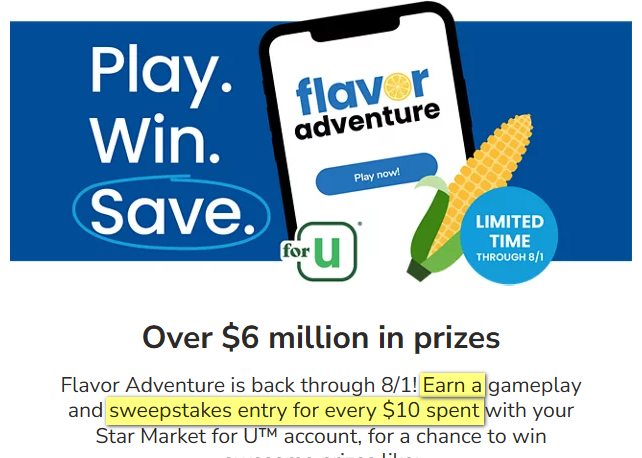
But let’s play along. Going to the promotion’s website, [page varies for non-loyalty club members] brings us here. There is no menu, but there is a “play now” button and farther down the page yet another link to the official rules.

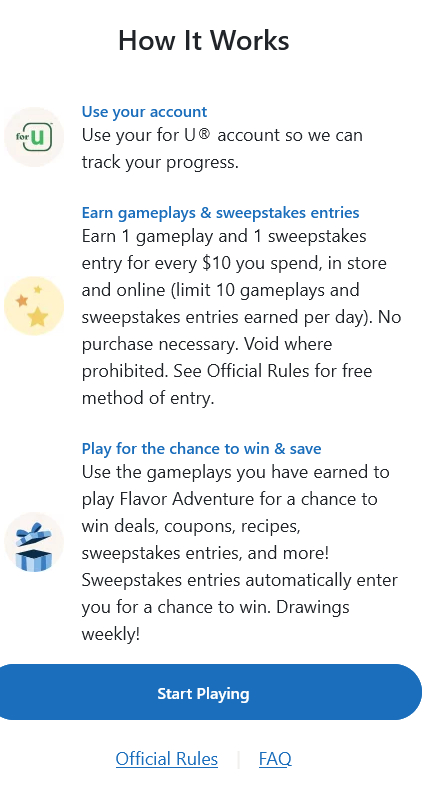
If you click “play now” the next page gives you a pop-up that among other things says you have to be a loyalty club member to participate (itself a questionable requirement), and yet another instruction to “See Official Rules for free method of entry.” OMG. Do you feel like you are being sent in circles?

Start playing

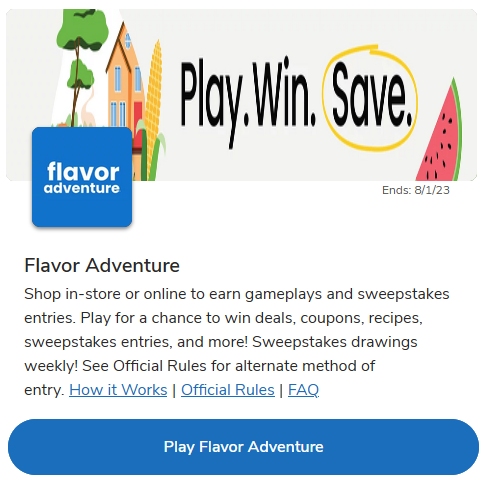
And when you click “start playing,” then you get yet another screen with instructions to see the rules about playing for free:

Start playing 2

And if you click that button, you get yet another button to start the game.

Play now

Clicking that button brings up what appears to be the actual start of the game… but nowhere to be seen is how you enter the sweepstakes without having to demonstrate that you bought groceries at the store.

Game 1

I invite intrepid readers to spend time reading the rules, and trying various options on the website to find where exactly the free method of entering the sweepstakes has been hidden and to report in the comments what steps you had to go through to get there. There is an answer and believe it or not, you have not seen the most obnoxious part yet!

In our view, the free means of entry that Albertsons Companies has created is illusory because of the complicated series of hoops they created for nonpurchasers to follow that most people will likely abandon. In essence, the alternative means of entry has failed of its essential purpose. And if that is the case, a consumer-sympathetic judge might deem the Albertsons promotion to be an illegal lottery.

Why would any company make it so difficult for their customers (and noncustomers) to participate in this game? Then it dawned on me. What if it was in their financial interest to make it harder? A scan of the official rules provided a possible answer.

*MOUSE PRINT:

unclaimed prizes

Of the over $6.6-million in prizes being offered, only $1.25-million-worth are prizes over $25 for shoppers. That means as much as $5-million of the smaller prizes if they go unclaimed never have to be given away. Obviously, we don’t know the company’s motivation in designing the sweepstakes as they did.

We posed some very pointed questions in multiple inquiries to the Albertsons Companies’ PR folks, including whether they consumer-tested the no-purchase-necessary-method of entry to see if average humans could follow their instructions. They did not respond.

This promotion cries out for action by the FTC and the consumer bar.

Share this story:


ADV
Updated every Monday!   Subscribe to free weekly newsletter.

Subway’s “No Tuna” in Their Tuna Sandwiches Saga Nears an End

It has been going on for nearly two-and-half years already. Two California consumers claimed there was no tuna in Subway’s tuna sandwiches.

The case generated headlines worldwide.

Subway Tuna Headlines

We’ve written six stories about the case. First the consumer claimed there was no tuna in their subs, then her lawyers said it wasn’t 100-percent tuna, and on and on. The lawyers filed and withdrew complaint after complaint, changing their theory of the case.

The company got a huge black eye because of these cases, and probably suffered significant reputational damage and lost sales.

Now, on April 20, 2023, the consumer sought to voluntarily dismiss the case.

But guess what? Subway said not so fast. In essence, because the consumer and her lawyers put the company through the wringer even after having been provided with documentation pinpointing the place where the tuna is captured to how it’s packaged, Subway’s lawyers are seeking sanctions against the consumer’s lawyers.

They say the suit should have been dropped long ago, and way before the company had to spend over $600,000 in legal fees to defend itself. The six consumer lawyers filed various pleadings, they say, to extend the lawsuit “motivated by the prospect that Subway might simply pay a windfall settlement.”

For their part, the consumer’s lawyers countered that the consumer is withdrawing her complaint because of health issues. They went on to say:

Plaintiff filed her complaints with a good faith, non-frivolous basis based on testing and evidence that there was something amiss with respect to the meat product defendants were selling as ‘tuna.’

MrConsumer has always thought the case was a little fishy because of the questionable test results the consumer’s lawyers claimed to have. Now, finally, the case should come to a conclusion after an August hearing.

Share this story:


ADV