Updated every Monday!   Subscribe to free weekly newsletter.

Walden Farms Salad Dressing: Zero Calories?

walden dressingImagine being able to enjoy a salad with all the thick, creamy dressing you want and feel guilt free because it has no calories.

That seems to be the promise of Walden Farms dressings. In fact, it may be the perfect food because they say it is “sugar free, fat free, gluten free, and calorie free.”  Why sprinkle your salad with mere water (which is also sugar free, calorie free and fat free) when you can use this dressing?

Is it possible to make a salad dressing with zero anything?

*MOUSE PRINT:

Walden calories

According to the label, while there is some dijon mustard in this honey dijon dressing, there is no honey. It is composed mainly of thickened water and vinegar with spices and flavoring. But aren’t there at least some calories in that?

The company says:

If a product, under US Government regulations, has less than 5 calories per serving, it is considered zero. That is the category we fall into. Our products actually contain 3 to 4 calories per serving. The products also have less than .5gm of carbs, fat and sugar per serving. The calorie free line has taken extensive research and development to offer this extradinary product to the consumer. A blend of concentrated natural flavors, flavored vinegars and dehydrated vegetables together with a special non caloric emulsifying base, make you think that you are consuming a regular dressing,instead of a calorie free product.

In fact, the company is right! The Code of Federal Regulations says that “amounts less than 5 calories may be expressed as zero.”

Walden Farms makes a host of other no-calorie foods including chocolate syrup, pancake syrup, fruit spreads, carmel topping, and pasta sauce. Of course, they haven’t yet figured out how to make calorie free ice cream, pancakes, bread, and spaghetti that you put their cellulose gel-thickened products on.
Updated every Monday!   Subscribe to free weekly newsletter.

Supermarket Surprise: The Price You See is Not the Price You Pay

We are used to seeing airline ads that promise a roundtrip fare of say, $199, but have come to understand (unfortunately) that we really don’t pay $199. Rather, we are charged some higher price like $249 after all fees and taxes are added on. Rental car firms are also guilty of advertising an artificially low price that is boosted significantly by junk fees and taxes. And let’s not forget your cable, Internet and telephone bills — you never pay the advertised $99 triple play package price.

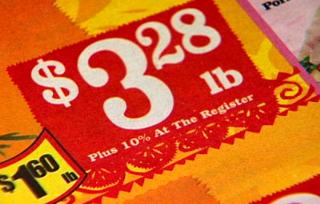
Can you image if other types of sellers, like retailers, did that too? Stop imagining. A couple of years ago, a midwest supermarket chain that caters to a primarily Hispanic audience did just that. They advertised one price on the shelf, but customers had to pay a higher price at cash register!

*MOUSE PRINT:

Huh? Pay 10% more than the advertised price? The company called this “shelf plus pricing”. Sometime after introducing this concept, the chain became the subject of a local TV news exposé. The store made all the usual arguments: our advertising and pricing is clear, customers are not being deceived, etc.

What a crock.

They did eventually drop the surcharge.

Avanza is owned by the Nash Finch Company. Like many companies, they subscribe to set a corporate values, the first one of which says:

Integrity:
We are honest and open with one another and with our customers.

UPDATE: Mouse Print* reader Bryan A. says a supermarket in his area uses the same technique of adding a 10% surcharge. Here is a sample ad from Food Depot (“a new way to save”).

Updated every Monday!   Subscribe to free weekly newsletter.

Fry’s (Not So) Free Shipping

One of the biggest attractions online sellers can offer is free shipping. And that’s what Fry’s does for some items.

MrConsumer recently purchased Norton Internet Security (plus Norton Utilities and Norton Ghost) for about $75 from Frys.com because a full price rebate was offered, as well as free shipping (instead of the usual $6.98). In the same order, he added on another software program that was also $75, but it was not labeled as coming with free shipping.

Sure enough, their computerized ordering system charged $6.98 for shipping the order, despite the fact that Norton was supposed to be shipped free. How can the company get away with this?

*MOUSE PRINT: If one clicks the “free shipping” logo, there is this disclaimer:

1. If your order contains “eligible” and “non-eligible” items, shipping will be charged for “non-eligible” item(s).

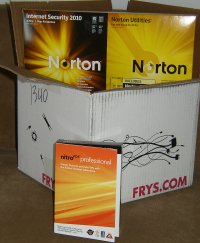
The policy is understandable if the non-free shipping item is sent separately or adds weight to the box that contains the free shipping item causing the company to pay more for postage. But that was not the case here. As you can see from the picture above, Norton is a rather large product and it came shipped in a carton roughly 12″ by 12″ by 12″. In the same carton, was the other software — a box that weighed a mere three ounces.

The carton with just Norton weighed 21 ounces and with the added software box, it weighed 24 ounces. That additional three ounces did not push the shipping cost into a higher bracket, according to FEDEX’s shipping chart. So, Fry’s charged $6.98 for shipping a carton that otherwise would have shipped free, and which cost them no more to send because of the added three ounce software box.

Customer service was unsympathetic, and only after speaking to a supervisor did the company agree to refund half the shipping cost.