Updated every Monday!   Subscribe to free weekly newsletter.

Is Starbucks Pocketing Millions in Small Gift Card Balances Illegally?

Starbucks gift cardA new class action lawsuit claims that Starbucks is pocketing millions of dollars from small balances on used gift cards rather than making refunds of those amounts readily available to customers.

Under the law of some states, consumers can request cash back when a gift card’s balance falls below a certain amount. In this case, since the consumer lives in Massachusetts, that law governs requiring a refund at the customer’s option when the gift card balance falls to five dollars or less.

*MOUSE PRINT:

The complaint in this case alleges:

5. Defendant’s Gift Cards state that they “Cannot be redeemed for cash unless required by law.”

6. However, Defendant does not reveal that despite this affirmation, Defendant’s policy is that the Gift Cards are completely non-refundable and in fact have no mechanism in Massachusetts to refund the value of the Gift Cards even in situations where state law requires it.

The filing says the consumer’s lawyer was not able to get a refund of the $4.94 remaining on his client’s gift card by using the online form on the Starbucks website because that is limited to just residents of California and Oregon. A Boston Starbucks location was also called inquiring about a refund but it was denied there too. What the lawyer apparently didn’t do, however, is call the customer service number listed on the website for those in other states seeking refund assistance.

For its part, the company gave Axios the following statement:

“Starbucks is well aware of state gift card redemption requirements and has proper policies and procedures in place to honor valid gift card cash redemption requests.”

This case is similar to one we reported on in May when Dunkin’ was allegedly found not refunding small balances on its gift cards.

We’ll let you know what happens as these cases move forward.

Updated every Monday!   Subscribe to free weekly newsletter.

CPSC Slow to Issue Product Safety Warnings

We expect state and federal agencies charged with protecting public safety to warn and protect us from dangerous products and defects in a timely way.

That is particularly the role of the U.S. Consumer Product Safety Commission (CPSC). In the story below, grieving parents of a baby who died by suffocation in a Fisher-Price Rock ‘n Play sleeper in 2017 say the agency knew about previous deaths and injuries but the product was still on the market.

The baby sleeper in this case was eventually recalled by Fisher-Price but only after information about its safety issues and reported deaths was obtained by Consumer Reports and made public. Here is some history.

*MOUSE PRINT:

The federal law being called into question here, section 6(b) of the Consumer Product Safety Act, has been controversial for years. It basically requires the CPSC to give manufacturers at least 15 days advance warning before it goes public with news of a safety defect from which the public could learn the name of the manufacturer and product involved. The manufacturer can then respond to the CPSC with its position, and object to the release of the information.

Since the CPSC is surprisingly not empowered to order a product recall without going into court to sue for one, the agency and manufacturer are often at loggerheads for years over the issue. This is why when you hear about a recall, it is typically the manufacturer “voluntarily” doing it and not the CPSC. Additionally, some say if manufacturers know that the product defect and injury reports they file with the CPSC are not going to be easily made public that incentivizes them to continue to make such important disclosures.

While the TV report above asserts that section 6(b) is a gag order being placed on the CPSC, a former assistant general counsel at the agency says it is not. He asserts the real problem at the agency is that it fails to understand and use its existing authority.

No matter, in the current Congress, the Sunshine in Product Safety Act was filed to abolish section 6(b), but it has gone to committee and not likely to pass.

Whether section 6(b) is preventing the CPSC from naming names and alerting the public early to safety hazards, or they are not effectively using their own rules and tools, the result is the same. We deserve better protection.

Updated every Monday!   Subscribe to free weekly newsletter.

Carnation Breakfast: Where’s the Promised Protein?

Earlier this month, a class action lawsuit was filed against Carnation about the allegedly misleading label on some of its Breakfast products.

The product, which comes in packets, boasts on the front of the package that it has 13 grams of protein, 21 vitamins and minerals, 3 times the vitamin D of milk, and three times the calcium of Greek yogurt.

Carnation breakfast

On the far right of the package, in tiny type, is a key disclosure:

*MOUSE PRINT:

Carnation - add milk

Most shoppers are not likely to see that, and it certainly isn’t remotely close to the protein claim. On the back, the ingredients statement has powdered nonfat milk as the primary ingredient. That might lead one to believe all you have to do is add water.

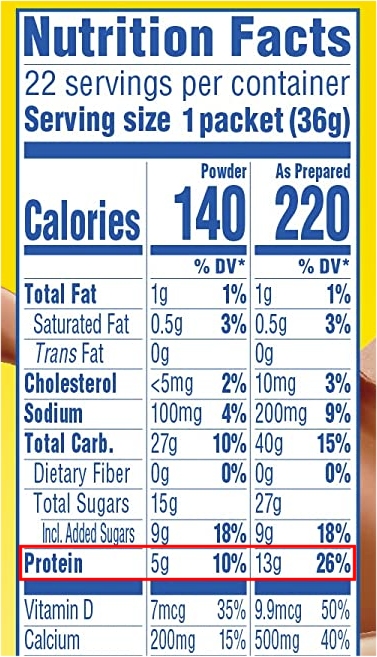
However, when checking the nutrition facts label, it becomes clear that the protein content of each packet is only 5 grams, and only magically becomes 13 grams as represented on the front of the package when consumed “as prepared” when adding milk.

*MOUSE PRINT:

Carnation nutrition label

So, what do you think? If you picked up this product and saw the 13 grams of protein claim on the front of the package, would you understand that that amount is only the result of adding milk to the product? There are no instructions on how much to add.