Updated every Monday!   Subscribe to free weekly newsletter.

You May Not Own Your New Cellphone

  If you are about to get a new cellphone from Sprint or T-Mobile, you better read the fine print, because you may not actually be buying that phone. You may only be leasing it.

MOUSE PRINT*:

Sprint ad

That’s right. Sprint is turning back the clock to the 1950s when you paid a monthly rental fee to Bell for your black landline Western Electric telephone. The difference: you are responsible for repairs if you don’t have a costly protection plan or warranty, and that old phone really sounded good.

For the iPhone 6, $20 of your monthly payment for 24 months is a lease payment, because under this plan, Sprint owns the phone. What happens after the lease ends?

  • You can turn in the telephone, get a new one if you want, and pay its monthly lease payments.

  • You can continue leasing it at an undisclosed monthly cost.

  • You can buy it outright for an undisclosed “purchase option price.”

  • The first option assumes your phone is in “good working condition.” If it isn’t, or if you lose the phone during the lease term, you owe the balance of any yet-to-be-paid monthly installments plus the “purchase option price.”

    If you opt to buy your Sprint iPhone 6 at the end of the lease, they will charge you $200 according to a local Sprint representative. That makes the phone slightly more expensive than buying it outright to start.

    Not to be outdone, effective this week, T-Mobile joins the leasing world also, by offering Jump on Demand. It is an 18-month lease program that allows you to upgrade your phone up to three times a year. T-Mobile, however, adds all kinds of penalties if the phone you turn in is not in working order.

    *MOUSE PRINT:

    You could be charged up to $750 in fines for the following:

    Cracked Screen Damage fee – $250
    Liquid Damage fee – $250
    Device does not power on fee – $250

    There are a whole bunch of other terms and conditions in both the Sprint and T-Mobile lease programs. It is getting to the point that you need a Ph.D. in cellphonery to understand all the choices, options, and terminology.

    Updated every Monday!   Subscribe to free weekly newsletter.

    PayPal Gets Its Wrist Slapped by FCC for Violations

      In May, PayPal sent its customers an email notifying them of forthcoming changes to the PayPal User Agreement because eBay and PayPal are becoming separate companies.

    One section of that revised agreement announces changes to how the company can contact you.

    In short, it provides that you automatically give permission to PayPal to call or text you, via autodialed or prerecorded call, on any telephone number (cell or landline) you have given them or that they can find for you, for almost any purpose including to sell you stuff and to collect debts.

    *MOUSE PRINT:

    1.10 Calls to You; Mobile Telephone Numbers. You consent to receive autodialed or prerecorded calls and text messages from PayPal at any telephone number that you have provided us or that we have otherwise obtained. We may place such calls or texts to (i) notify you regarding your account; (ii) troubleshoot problems with your account (iii) resolve a dispute; (iv) collect a debt; (v) poll your opinions through surveys or questionnaires, (vii) contact you with offers and promotions; or (viii) as otherwise necessary to service your account or enforce this User Agreement, our policies, applicable law, or any other agreement we may have with you. The ways in which you provide us a telephone number include, but are not limited to, providing a telephone number at Account opening, adding a telephone number to your Account at a later time, providing it to one of our employees, or by contacting us from that phone number. If a telephone number provided to us is a mobile telephone number, you consent to receive SMS or text messages at that number. We won’t share your phone number with third parties for their purposes without your consent, but may share your phone numbers with our Affiliates or with our service providers, such as billing or collections companies, who we have contracted with to assist us in pursuing our rights or performing our obligations under this User Agreement, our policies, applicable law, or any other agreement we may have with you. You agree these service providers may also contact you using autodialed or prerecorded calls and text messages, as authorized by us to carry out the purposes we have identified above, and not for their own purposes. Standard telephone minute and text charges may apply if we contact you.

    It also provides that if you don’t like it, you can cancel your account:

    *MOUSE PRINT:

    IF YOU DO NOT AGREE TO THE AMENDED USER AGREEMENT, PRIVACY POLICY OR ACCEPTABLE USE POLICY, YOU MAY CLOSE YOUR ACCOUNT BEFORE JULY 1, 2015 AND YOU WILL NOT BE BOUND BY THE AMENDED TERMS.

    There is just one small problem with all of this. It is illegal. PayPal cannot just impose all these terms. With respect to robocalling, for example, they have to get your express written permission to allow it. They also have to tell you that you are not required to agree to these terms and they cannot deny you services or terminate your account if you opt-out. Oops.

    Here, for your reading pleasure, is the much too polite letter that the FCC sent to PayPal last week:

    Click top right corner to enlarge.

    Because of the uproar created about the calling changes even before the FCC letter was sent to PayPal, the company posted a link in their blog to opt-out of being called. In relevant part, the post says this:

    You can choose not to receive autodialed or prerecorded message calls by clicking here and contacting customer support.

    MrConsumer clicked that link and only found the means to contact PayPal by phone or email message. There was no specific opt-out choice. So he filled out their form, using the closest relevant topic (changing/updating account information) and said that he wanted “to opt-out of all calls and texts from PayPal.”

    What did he get back from them? An automated, non-responsive answer, that in essence says to write again. Great work, Paypal.

    PayPal answer

    Updated every Monday!   Subscribe to free weekly newsletter.

    The Price They Advertise is Not the Price You Pay

      Enough is enough. Isn’t it time that cell and cable companies stopped advertising seemingly low monthly prices for their service, while tacking on a multitude of junk fees, undisclosed charges, and taxes that significantly boost your bill?

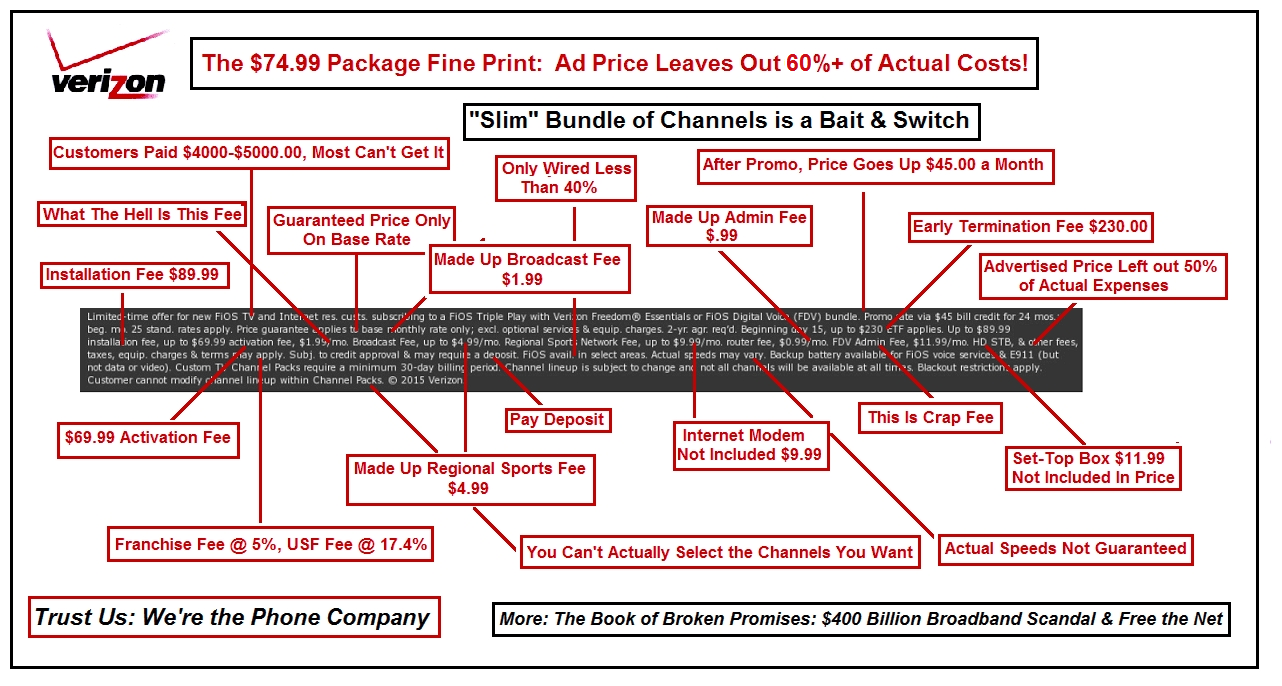
    Recently the Huffington Post did an exposé, using Verizon FiOS’ new pick your own channel bundle for $74.99 as an example. When you added all the other charges, you actually had to pay over 60% more than the advertised price.

    *MOUSE PRINT:

    Huffington Post
    Click to Enlarge

    There were equipment/HD fees, FDV administrative fee, broadcast TV fee, regional sports fee, franchise fee, USF fee, federal/state/local taxes, etc. There could also be installation fees, activation fees, and early termination fees depending on the offer.

    Verizon is certainly not alone in tacking on all these fees. Comcast and Time Warner are equal opportunity offenders, as are the wireless cell companies.

    Is it any wonder that these types of companies rate low in customer satisfaction surveys and on trust indices?

    Maybe there needs to be a requirement, like airfares, that a single all-inclusive price must be the amount advertised, and not these bait and switch prices.