Updated every Monday!   Subscribe to free weekly newsletter.

Here We Downsize Again – May 2019

Prices on paper goods are going up again, but you’d never know it because the packages look about the same and you pay the same at the checkout. But you are getting less in each package.


Kleenex Tissues

The boxes are the same size but Kleenex is giving you 10% fewer tissues. Thanks to Leif S. for spotting this downsizing in progress right now.

*MOUSE PRINT:

Kleenex downsized


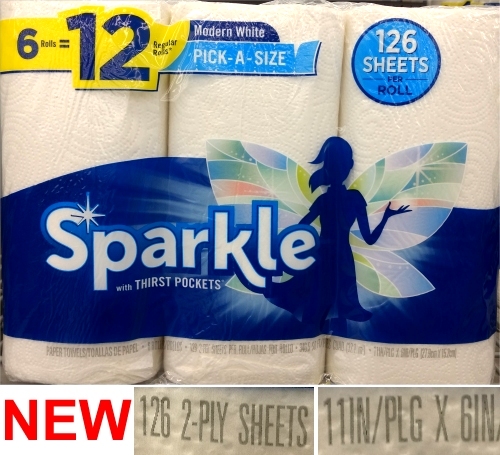
Brawny Paper Towels

Brawny has a long history of downsizing its paper towels. This time, packages are going from 87 sheets down to 80 sheets — almost a 10% reduction.

*MOUSE PRINT:

Brawny paper towels downsized


Downy Unstoppables

*MOUSE PRINT:

Downy Unstoppables NOT downsized

P&G recently came out with new bottles of Downy Unstoppables laundry fragrance enhancers. The bottle is slightly larger but the contents actually weigh 25% less. That’s a big downsizing… seemingly. Even more surprising, when tossing these pellets in water, they float, whereas the old ones sunk to the bottom. Checking with customer service revealed what had really changed. The product engineers at P&G removed some of the dead weight from each pellet making them lighter. That cut the net weight of each bottle by a quarter, but the number of laundry loads you get remained the same. So it only looked like Unstoppables had been downsized.

If you spot a new example of a product being downsized, please try to take a sharp picture of both the old and the new packages and send it to: edgar (at symbol) mouseprint.org . Thanks.

Share this story:


ADV
Updated every Monday!   Subscribe to free weekly newsletter.

Act Fluoride: Alcohol-Free?

Bob F., a regular Mouse Print* reader, recently bought a bottle of Act fluoride mouthwash/rinse for kids. The front label of the bottle clearly stated that the product was “alcohol-free.”

Act front

When he looked at the ingredients statement, however, he was taken aback.

*MOUSE PRINT:

Act ingredients

The first inactive ingredient listed was “benzyl alcohol.” What?

Clearly, any parent would be concerned about a child swallowing this candy-flavored liquid if it contained alcohol.

But that is not the case here. When most consumers think of alcohol, they think of the alcohol in liquor. That is actually ethyl alcohol or ethanol. Benzyl alcohol in ACT is chemically different. It is a flavor enhancer and preservative.

So, Act is properly labeled as “alcohol-free” because it does not contain the common type of alcohol that you find in other mouthwashes like Listerine.

Share this story:


ADV
Updated every Monday!   Subscribe to free weekly newsletter.

Wayfair Called Out on Exaggerated Savings Claims

Wayfair, the large online seller of home goods, had its big “Way Day” sale on April 10th and 11th, promising the “lowest prices of the year” and “up to 80% off.” In the process of checking it out, we discovered often exaggerated savings claims and misleading price comparisons, and not just on Way Day.

Wayfair Way Day


Perusing those six categories, some of the discounts seemed too good to be true. For example:

Wayfair memory foam mattress on Way Day

Here they’re claiming this store brand memory foam mattress is on sale for $349.99, marked down from what looks like their $2,100 regular price. That’s 83-percent off, seemingly saving shoppers $1,750!

Many other items were advertised at 40 – 80% off, with some discounts so large as to raise questions about the legitimacy of the savings claimed. To check this out, Consumer World conducted a spot-check of a dozen deeply discounted items from the six categories featured above on April 10, 2019 – the first day of Wayfair’s Way Day 36-hour sale.

Here is the cart with those 12 items:

Wayfair Way Day cart

Scroll down the list.

You’ll see the amazing discounts above that Wayfair was offering.

But the question was, when the Way Day sale was over, would all these items revert to the higher price shown? Or, would you save almost as much if you delayed your purchase or missed the sale and returned later? To find out, we went back the day after the sale ended, April 12, to check the prices of the same dozen items.

Wayfair day after cart

Scroll down the list.

One item we checked was that memory foam mattress pictured at the top of this story. It was on sale during Way Day for $349.99 and was still on sale right afterwards and only slightly higher — $376.99. So customers who purchased that item on Way Day when it was said to be 83% off, really only saved a mere $27.

Wayfair mattress after Way Day


All the items went up in price right after Way Day, some by only a little and some by much more. This certainly suggests that the company did lower its everyday prices for the sale and it was a good day to shop there.

But none of the items in our spot-check reverted to the stated crossed out price (the “strike-through price” like the $2,100 reference price for the mattress). In fact, while Wayfair’s claimed savings on Way Day for the items in the sample averaged 71% off, the actual savings on Way Day compared to Wayfair’s everyday prices right after the sale only averaged out to be a 16% discount.

*MOUSE PRINT:

What Wayfair does in their product listings for many sale items, and not just on Way Day, is make it appear that their own regular price is being cut by crossing it out and claiming it is now being offered at an often large percentage-off discount. The trouble is, this is not how Wayfair’s discounts actually work.

Take the mattress pictured above, for example. Is the $2,100 strike-through price really their regular price? Wayfair buries the answer in a 42,000-word page of fine print accessible through an inconspicuous “terms of use” link. Its strike-through price is really the list price or the highest price they ever offered the item, according to that disclosure.

*MOUSE PRINT:

Wayfair terms

The Federal Trade Commission’s Guides Against Deceptive Pricing says that comparison to a high list price or regular price that is rarely charged can mislead buyers as to the discount they actually receive.

Various states have similar false advertising laws. For example, in Massachusetts where Wayfair is headquartered, the company appears to run afoul of state consumer law by not “clearly and conspicuously” stating the basis for its price comparisons and discount claims. Simply put, under the attorney general’s regulations [940 CMR 6.05], when sellers advertise an item as “X% off”, it automatically means the discount is off the seller’s own regular prices – just the way a shopper would understand the claim. If sellers intend the savings claim to be a comparison to any other type of price, they have to finish the comparison — X% off what — such as by stating “83% off list price.” Similarly, putting a line through a higher price suggests it is the seller’s own regular price that is being reduced unless it is labeled otherwise. Wayfair’s product listings fail to make these critical distinctions and disclosures.

And Wayfair has an additional burden. List price comparisons are not even allowed under Massachusetts law unless the seller can demonstrate that a reasonable number of sellers in its trade area actually offer the goods at the stated list price.

We asked Wayfair to comment on our findings and their pricing policies. The company did not respond to two inquiries.

In our view, shoppers are misled when retailers make illusory savings claims based on inflated regular prices rarely if ever charged or by making comparisons to list prices that virtually no one ever pays. Why can’t sellers just play it straight?

Consumer World is turning over its findings to the Massachusetts Office of the Attorney General and other relevant agencies.

The spot-check of prices done by Consumer World is limited in scope, and cannot be used to project the average actual savings on all items during Way Day nor the number of items that did or did not revert to the claimed reference price.

Share this story:


ADV