Many of us shop at dollar stores because of bargains you can often find there. Sometimes, however, the bargain is no deal.
For example, Dollar General sells quarts of its own brand of motor oil, DG, for $2.50 to $2.75. That is cheaper than the big name brands.

What could be bad?
*MOUSE PRINT:

The back of the label provides an unexpected shock. This oil is not for use in cars built after 1988?! Who would ever expect a common oil like 10W-30 sold by a major general merchandise chain to be inappropriate for the expected use for most customers?
While the label says it meets a particular automotive specification, that spec is outdated, and has been updated six times since then according to the Petroleum Quality Institute of America.
Another product the company sells, an oil called SAE 30, has an even more astonishing disclaimer on the back of the bottle:
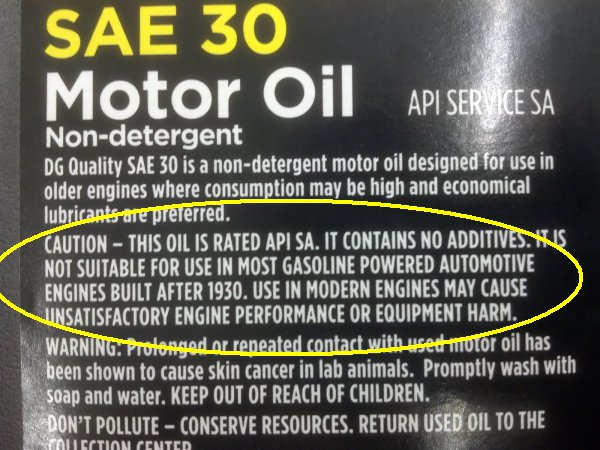
This one is not for cars built after 1930! So for everyone with a Model T, go grab some.
But for everyone else, thanks for nothing, Dollar General.
Now, consumers in 14 states have filed lawsuits against Dollar General for selling obsolete motor oil: CA (see lawsuit), CO, FL, MD (see lawsuit), KS, MI, MN, MO, NE, NJ, NY (see lawsuit), VT, OK, and TX.
And our friends at ABC’s Good Morning America, with a little help from Mouse Print*, just completed an undercover investigation of these motor oils:

Click to view
We asked the company to explain why they even sell these products that are inappropriate for most of their customers, whether they would put up more prominent warnings for shoppers, and what their reaction was to the lawsuit. They responded as follows in relevant part:
We are confident that our DG-branded motor oil products meet not only our standards for quality and value, but also all applicable federal and state labeling requirements where they are sold. In addition, the labeling on these products contains obvious and unambiguous language regarding the products’ intended and appropriate use.
Dollar General intends to vigorously defend against the claims raised in the recently-filed lawsuits regarding these products, including the filing of motions seeking their dismissal. — Dollar General Corporate Communications
Few shoppers know that there is more to buying motor oil than looking for the proper viscosity, such as 10W-30 or 10W-40. You need to make sure that you are choosing the one specified in your owner’s manual, including the appropriate service category. This is an industry specification, noted on the label, relating to the additives put in the oil to help prevent corrosion, sludge build up, and engine damage.
The most current service category is API “SN”. The oils shown above have obsolete service category designations such as “SA” or “SF,” meaning they are missing more modern additives.
Here is a chart from the Petroleum Quality Institute of America (an organization that tests motor oils for compliance with the labeled standard) showing which car model years are covered by each service category designation. Each category is backwards compatible.

=======
We welcome your submissions of other great “thanks for nothing†examples. Just email them to edgar(at symbol)mouseprint.org .


 We contacted the PR folks at Comcast, who were extremely responsive. Within a few days, they offered an explanation. Our consumer was being billed for a TV Guide subscription that they say she ordered. “The Cable Guide” was a separate magazine that Comcast offered years ago. TV Guide purchased it, and subsequently sent subscribers TV Guide instead.