Updated every Monday!   Subscribe to free weekly newsletter.

Dentyne Pure: Endorsed by Whom?

Dentyne has just begun an advertising campaign for its new gum called Dentyne Pure. It claims to be the only gum that is “able to neutralize — not mask — the odors that cause bad breath.”

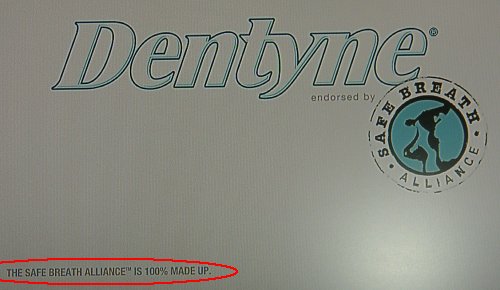
They also advertise on TV and on their website that they have even received an important endorsement:

The endorsement comes from “The Safe Breath Alliance”. The “what”, you may ask? Is there really an association dedicated to fighting bad breath?

*MOUSE PRINT — From their television commercial:

Sounds like the new Dentyne gum will not only sweeten your breath, but also comes with an April Fool’s joke in its advertising. (We just don’t know if the FTC is laughing or not, however.)

Updated every Monday!   Subscribe to free weekly newsletter.

When a Lightbulb’s Promised Life is Unrealistic

Philips manufacturers compact fluorescent lightbulbs some of which come with a very generous warranty and a promise of a long life. Mouse Print* reader Chet M. sent us the packaging on one such bulb with a seven year life expectancy that he thought was misleading.
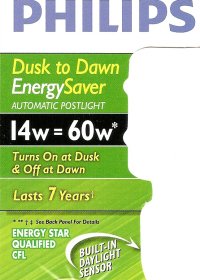
That little dagger symbol leads to a tiny disclosure on the back of the package.

*MOUSE PRINT:

The problem with basing this bulb’s life on only three hours of use daily is that this is a special purpose bulb, with a built-in light sensor.  It is meant to go on automatically when it gets dark, and then turn off at daybreak. In most parts in the world, the night is always longer than three hours.   Typically, it might be nine hours or longer, meaning the actual life of the bulb might be just over two years — not the seven promised.

Mouse Print* brought this issue to the attention of Philips.  A senior manager of the lighting division replied:

“The company was by no means trying to be misleading, just following accepted industry practices, and as soon as we were made aware the issue, we quickly updated the packaging.  Philips stands by its products and services and we take all consumer inquiries/feedback seriously, using it as an opportunity to improve our offerings.”

True to their word, the company sent us a picture of their new package which removed the seven year claim on the front, and incorporated into their warranty that under normal usage, the bulb was guaranteed to last for two years.
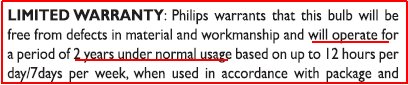
In this instance, Philips is a shining example of a company fixing a legitimate consumer issue in record time.  We salute them.

Updated every Monday!   Subscribe to free weekly newsletter.

Wal-mart’s Coupon Acceptance Policy – The Fine Print

At the beginning of March, Wal-mart modified its coupon acceptance policy to be more liberal in certain respects and more restrictive in others.

On the good side, Wal-mart will actually give you back money if the coupon you present is for more than the cost of the item (e.g. you present a $1 coupon for an item that is only 75 cents.)

*MOUSE PRINT:

Coupons may exceed the price of the item. Change may be given or applied toward the cost of the basket purchase.

They will also accept “Catalina” coupons, the coupons that are spit out at supermarkets based on what you buy.

On the downside, Wal-mart will not accept home-printed coupons for free items, and has restricted acceptance of competitors’ coupon to those for specific items at a specific price:

*MOUSE PRINT:

Walmart does not accept the following coupons:

•Print-at-home Internet coupons that require no purchase
•Competitors’ coupons for dollars/cents or percentage off, buy one get one free, and double- or triple-value coupons

Conspicuously missing from the list of acceptable coupons are pharmacy coupons — typically competitors’ coupons — for dollars off a new or transferred prescription. If you have one, it doesn’t hurt to ask if they will accept it.