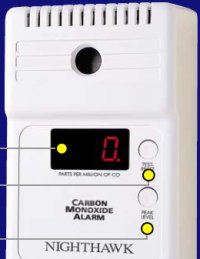
 To help prevent illness and death, some states require carbon monoxide alarms to be installed in various parts of your home.
Kidde is one of the large, recognized brands of smoke alarms and other fire prevention products. Certain of their carbon monoxide detectors, however, come with conflicting promises and warnings.
In the manual’s introduction for one of their basic carbon monoxide detectors, it reassures customers they have made a good choice:
“Thank you for making Kidde a part of your complete home safety program. With proper installation and use, your new Kidde CO alarm will provide you with years of dependable service.”
Buried on page 8, however, is some starting news:
*MOUSE PRINT:

A similar disclosure appears in fine print on the box itself. On one hand, the company seems to take safety seriously and doesn’t want to give customers a false sense of reassurance that their detectors are working when they have really lost the ability to sense carbon monoxide. On the other hand, one would not normally expect to have to throw out a $25 to $70 product after only seven years.
What’s going on here? The answer is that carbon monoxide detectors do indeed have a limited life. Inside many detectors is an electro-chemical cell that reacts in the presence of carbon monoxide. It tends to be very accurate. But, over time, the chemical can degrade and its performance is diminished. Accordingly, a national safety standard for carbon monoxide detectors published by Underwriters Laboratories (UL) requires that manufacturers build in a warning system to alert consumers that the unit is no longer functioning properly.
*MOUSE PRINT:
8.1 The unit (including the sensor) shall have a specified lifetime of at least 3 years from the date of manufacture, or from the date the unit is placed into service.
38.1.6 The unit shall indicate end-of-life, based on the manufacturer’s specified lifetime, with an end-of-life signal (see 3.11). This signal shall be triggered either by an internal timer or by a self-diagnostic test(s).
3.11 END-OF-LIFE SIGNAL – An audible signal, differing from the alarm signal, intended to indicate that the device has reached the end of its useful life and should be replaced. … The end-of-life signal shall repeat once every 30 – 60 seconds ±10 percent. — UL 2034, Standard for Single and Multiple Station Carbon Monoxide Alarms.
So, no matter what brand of carbon monoxide detector you buy, the unit will automatically commit suicide at the end of its useful life.
Note: MrConsumer is a member of UL’s Consumer Advisory Council.
Â