Last week, Consumer World linked to the report from the Environmental Working Group (EWG) where they announced the 2026 annual “Dirty Dozen” and “Clean 15” lists of produce items that are highest and lowest in pesticide residue according to recent government tests.
EWG says:
This year’s guide incorporates data from a total of more than 54,000 samples of 47 fruits and vegetables. EWG uses USDA data for non-organic samples of fruits and vegetables from the most recent sampling periods [emphasis added]…
A reader of ours was concerned because his favorite vegetable, spinach, topped the bad list. When he poked more deeply into the report, he discovered EWG’s 2026 ranking for spinach was based on tests done 10 years ago according to the methodology section of the report!
EWG says that their 2026 lists are based on the “most recent sampling periods.” Most people reading that, like our reader, might expect to see that the 2026 good and bad lists were based on 2025 test results. Apparently, however, the most recent test results available from the U.S. government are from 2024.
*MOUSE PRINT:
And for spinach, it is even older, according to EWG:
… to analyze residues on spinach, we used 1,295 samples the USDA collected between 2015 and 2016, the most recent data range for spinach.
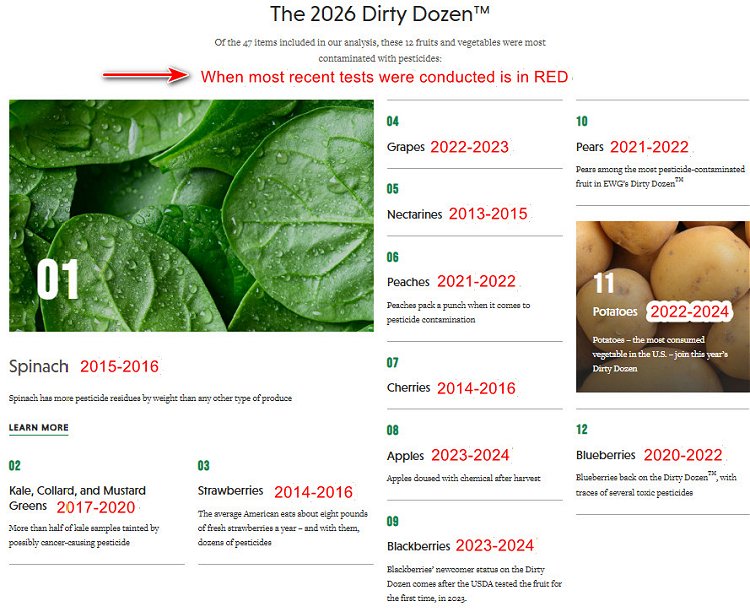
In fact, only three of the “2026 Dirty Dozen” were tested “recently.” And their 2026 lists are based on tests as old as 2011 — 15 years ago! We annotated their “Dirty Dozen” list below with the actual dates the produce items were last tested for pesticide residue.
*MOUSE PRINT:
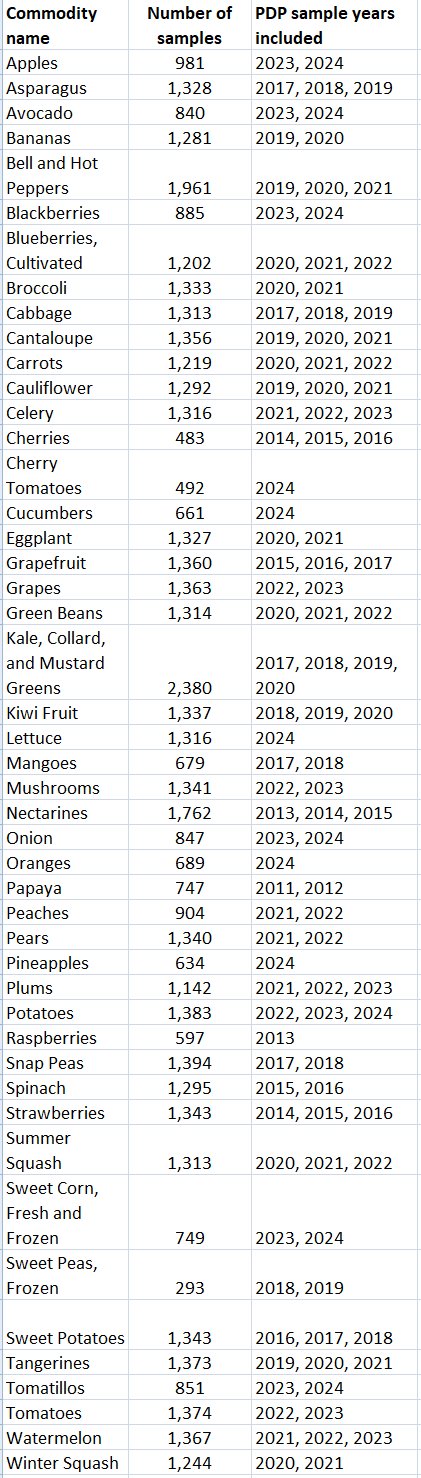
We contacted EWG and asked for all the dates of the most recent tests that were used to compile their 2026 “good” and “bad” lists.
*MOUSE PRINT:
Most Recent Tests Used in 2026 Report
Scroll down the list.
We believe the average reader would never expect an annual report of test results could be based on old data. In fact, only three varieties of produce in the 2026 Dirty Dozen list were tested in 2024 – the most recent year. Others made the “bad” list because of test results from as long ago as from 2013. Couldn’t industry practices change where produce that was previously contaminated is now less so, and categories that did well previously could now exhibit more contamination than previously?
We asked EWG some very pointed questions about the fairness of coming out with annual good and bad lists when the vast majority of items have not been tested recently. We also asked why they don’t disclose right in those lists the test dates upon which their rankings are based?
EWG responded immediately with comments by Varun Subramaniam, their science analyst, saying that the government does not test each category every year. He also said in relevant part:
We often find that, even with updated testing data, residues remain consistent over time in the absence of new regulations. For example, new data were available for pineapples this year for the first time since 2002; however, this update after a long pause didn’t change pineapple’s position on the Guide…
[On] our methodology page, we publish a list of the sample sizes and most recent sampling years for every produce item on the Shopper’s Guide.
… we find that overall trends in pesticide use on specific produce items generally remain consistent over time… so, while some of the data is a few years old, they likely still represent the current overall contamination profile of the corresponding produce item.
What do you think? Should this organization keep coming out with annual lists when there is no recent data to support most of their rankings? Feel free to add your thoughts in the comments.

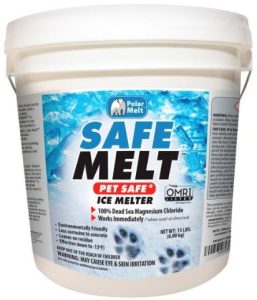 In March, two New York consumers sued the manufacturer of Safe Melt — a snow and ice melter specifically marketed to pet owners as “pet safe” and “pet friendly.” [See complaint.]