
MrConsumer has been a consumer advocate for over 35 years, and he is always astounded by the number of sneaky (and potentially illegal) practices that not only companies will use, but that shoppers will put up with, or even defend.
The comments on this blog are often a reflection of that attitude, and I find that troubling. It suggests that consumer advocates have not educated the public enough about what are acceptable practices and which ones cross the line.
Some consumers and too many businesses think that as long as they make a disclosure or disclaimer SOMEWHERE that that is all that is necessary.
The Staples story we brought you last week is a perfect example. It is not okay to run an advertisement for goods at a stated sale price but fail to mention IN THE AD that you have to buy other goods totaling $50 in order to get the goods at the advertised price. Too many commenters and the company itself thought it was enough just to let shoppers know before they checked out that there was a catch in the offer.

That is not what the law says in Massachusetts (and probably in some other states). One of the primary principles in consumer law is the requirement of disclosing key facts upfront. What needs to be “clearly and conspicuously” disclosed? Anything that might mislead the prospective purchaser or induce him or her not to enter into the transaction.
“It is an unfair or deceptive act for a seller to fail to clearly and conspicuously disclose in any advertisement any material representation, the omission of which would have the tendency or capacity to mislead reasonable buyers or prospective buyers.”
“A disclosure is not clear and conspicuous if any material terms of the offer that affect the price of an item, impose conditions on acceptance of the offer, … are not disclosed in the advertisement itself…”
“Even though the true facts are subsequently made known to the buyer, the law is violated if the first contact … is secured by deception.”
Here are some examples of specific requirements of the law (at least in MA), and how they might apply to various advertising practices.
Example 1:
Under the law, important disclosures must be “clear and conspicuous.”
“Clear and conspicuous … means that the material representation being disclosed is of such size, color, contrast or audibility and is so presented as to be readily noticed and understood by a reasonable person to whom it is being disclosed.”
*MOUSE PRINT:

Is it clearly disclosed that by ordering ProActiv for $19.95 that you will also be signing up for regular monthly deliveries of the product? Is the average TV viewer likely to have even noticed that small disclosure for the few seconds it was on the screen?
Example 2:
“Clear and Conspicuous, is not clear and conspicuous unless such material representation … appears in type which is a minimum of eight point type;”
*MOUSE PRINT:

Burying key information in a fine print footnote is frowned upon. The above footnoted disclosures (note: the type size above may appear larger on your computer screen than it actually is) are actually part of a single paragraph where each line is 20 inches long, spanning two pages in a multi-page circular. The type size is five point type, not the minimum of eight point type required assuming there is something important in this footnote that is required to be clearly and conspicuously disclosed. Few if any human beings can read straight across a densely packed 20-inch line of type, with about 90 words per line, line after line, to understand what is trying to be conveyed. This is a perfect example of the belief that as long as a disclosure is made, no matter how or where placed, that that is sufficient.
Example 3:
A disclaimer can’t be used to change the meaning of the original claim.
“It shall be an unfair or deceptive act or practice for a seller to use a disclosure set apart from the primary claim to which it refers, such as by use of an asterisked footnote, if such disclosure imparts a meaning that contradicts or materially alters the meaning of the term, statement or claim to which it refers.”
*MOUSE PRINT:
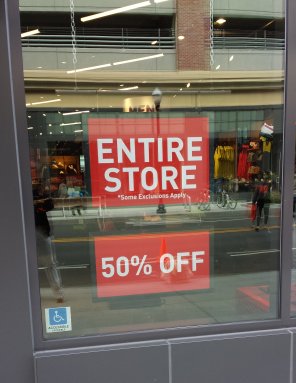
You’re across the street from this store and you see that everything in the store is half price. But as you walk closer, you see the disclaimer that certain items are excluded. Did you lose anything other than a few seconds, no. But stores can’t try to lure you in with a false claim, even if the truth is made known in an asterisked disclosure. The sale claim should have been worded to be true on its face.
The bottom line is this: you are entitled to full and clear disclosure upfront in advertising. Don’t settle for less. And don’t give advertisers a free pass when they fail to do this.
What is sad is we consumers have the power to change all this deception if we choose to stop shopping at a store that does these types of things.
It takes more than “educating” the consumer, it takes a call for affirmative action. File a Small Claims Court action against the store for false, misleading and deceptive advertising; breach of the implied condition of good faith and fair dealing in all contracts; loss of your time in trying to get the merchant to comply, etc.
A complaint means little or nothing to companies, I know. They send out a form letter to the complaining customer and maybe a $2.00 certificate.
I suing sixteen (16) distributors, including 99 Cents Only Stores, for false, misleading and deceptive advertising AND for an injunction. The Summons and Complaint are out for service and I have a website telling it all.
Tell the consumers not just about the problems, but what to do; hit the wrongdoer where it will be felt, in the pocketbook.
The truth is that when products are discounted this deeply (assuming 50% off is not an inflated claim) the store doesn’t want you to buy them. They want you to see something else you like and buy that at full price. Or, at the very least, if you do buy a discounted item, they want you to buy a non-discounted one as well (there are exceptions of course, like going out of business sales or a massive old inventory liquidation). So I would be very suspicious of any store offering you an “entire store 50% off” discount regardless of whether there’s any visible fine print. On the other hand, “some exclusions apply” implies that chances are whatever you want to buy will not be excluded (are there any regulations about what “some” can mean in this context?), so it is not really preventing people from entering the store, which is what the advertiser wants you to do.
Edgar replies: “Some” is not defined in the law. And what are the odds of what you want to buy being excluded when “everything” is on sale? Last week, a friend from out of town was visiting and I took her to an outlet mall. She saw that they had a Pendleton Mills store and wanted to buy some blankets. The sign outside indicated that everything was on sale… except, you guessed it… blankets!
I can understand the frustration with consumers settling for less. I was one of the commenters who did not mind the Staples advertisement from last week because the web page with the merchandise on it clearly said that the $8 price was after purchasing $50 worth of goods. At the MINIMUM I expect to be told what the actual price of an item is before I put it in my shopping cart and Staples did that. I am not familiar with how merchandising and advertising laws vary by state so I cannot speak to that.
I don’t think consumer advocates have done a bad job of informing the public at all. The problem is that the public is either apathetic or satisfied with most market conditions. The incentive for vendors to change is not there. A lot of consumers like the idea of shopping being a “game”. I remember when JC Penny changed their pricing to reduce the fake sales and marketing gimmicks. Consumers came up with every kind of excuse to say that JC Penny was a terrible store after that, but in reality JC Penny didn’t change much of its actual merchandise. Consumers just weren’t happy that they didn’t see a lot of stuff with “25% off” tags on them. They didn’t care that the 25% off came after a 25% markup in price. And don’t get me started on unit pricing at grocery stores. There has already been a lot of coverage on that in this blog.
At the end of the day it is impractical for all advertisements to contain all the information necessary. Sometimes consumers will have to look up more information. The Staples ad should have come with a warning about conditional pricing, I agree, but at the most the Staples ad probably would have changed to “$8 after special savings offer”. Still not very clear.
Another form of tricky ad is in radio, where the ad ends in a rapidly spoken line of details and disclaimers, instead of being incorporated into the main ad audio. Sometimes it sounds like someone is just reading the text normally, but other times it sounds like the audio was sped up to cram all the detail in and make it harder to understand.
I received a coupon from CVS for 25 percent off non sale merchandise. Got there and I would say at least 75 percent of the store was on sale. What a wasted trip.
I’m with David and have followed the same path. Let them go to the expense and explain themselves in court. I have done this with retailers and with AOL. So far I am 5-0. They are so stupid in their attempt to be deceptive they hang themselves by their own petard.
i had this last weekend for a big box store ad quote “participating stores – prices may vary”