

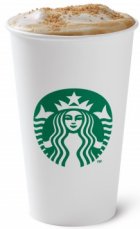
 A few weeks ago, two consumers sued Starbucks alleging that the company routinely and deliberately underfills their cups of latte.
The lawyers contend that in 2009 the company adopted a money-saving move that would force Starbucks’ baristas to make lattes in a uniform way. They were required to use a pitcher that contained “fill to” lines like those on detergent bottle caps so they would know how much milk to add. They then had to add a certain number of one-ounce shots of espresso, a certain number of pumps of flavored syrup, and 1/4-inch of foam on top, leaving 1/4-inch of space.

The lawyers say that based on this recipe plus the actual physical capacity of Starbucks’ cups, their lattes can’t possibly be the full size they claim.
What are Starbucks’ size claims?
*MOUSE PRINT:

Starbucks represents that their hot lattes are 12, 16, and 20 fluid ounces in tiny letters right on their menu boards. When the lawyers tested the capacity of their cups, they found that only when filling them all the way to the brim did they hold the claimed capacity. But since they interpret the official instructions as requiring that 1/4-inch of space be left at the top, right off the bat all their lattes are short-weighted, they contend. Note: a test by Mouse Print* of a 16-ounce Starbucks cup reveals that it actually holds about 17 ounces when filled to the brim.
Even if the cups are only one-ounce short when served, multiply that by millions of cups sold a week, and that means huge savings for the company and a huge loss in the aggregate for customers. But the lawyers offer more proof based on actual store inspections. They say they “purchased and measured Starbucks Lattes at different stores, in different states, in different sizes, and in different flavors. However, each Latte was underfilled by approximately 25%.”
On the face of it, that is a rather shocking allegation.
Yet, in the very next paragraph of the complaint, the lawyers present conflicting evidence when they recount what happened when they followed the company recipe using one of the Starbucks pitchers that they had obtained.
*MOUSE PRINT:
For a [16-oz] Grande beverage, the “fill to†line comprises less than 12 fluid ounces of milk. After adding 2 shots of espresso (2 fluid ounces), the resulting beverage measures less than 14 fluid ounces at most. This falls far short of Starbucks’ “16 fl. oz.†representation.
Haven’t they just contradicted their claim that drinks were all underfilled by about 25% in their tests? In this example, for a 16-oz drink to be 25% short, it would have to be 12 ounces, not the almost 14 ounces they found. And did they really follow the recipe? Where’s the four pumps of flavored syrup? Where’s the foam? If these ingredients were added, what would be the total number of ounces in the cup?
And if cups were all 25% short, wouldn’t consumers across the country have been yelling bloody murder about the practice for years? Well, maybe not, since Starbucks puts an opaque cover on hot lattes and you drink it through a hole on the cover.
Mouse Print* emailed two of the lawyers raising some of these very issues, but we have not yet received a response.
Starbucks has been relatively circumspect in their response to the lawsuit.
“We are aware of the plaintiffs’ claims, which we fully believe to be without merit. We are proud to serve our customers high-quality, handcrafted and customized beverages, and we inform customers of the likelihood of variations.”
We have a sneaking suspicion this case may turn on two points. The first is what is the proper way to measure foam (and maybe the aerated milk) — do you just measure its height/volume and count that as part of the total fluid ounces, or do you have to wait until it settles to see how much liquid is actually contained in the foam? According to Handbook 133 of the National Institute of Standards and Technology, you have to dissipate the foam, and then you measure the quantity of liquid in the cup.
Secondly, there is an issue related to the syrup, which we won’t detail here. But, according to weights and measures rules, since both flavored and unflavored lattes are represented on the menu board to be a certain number of ounces, they must in fact meet that standard –and not by adding a whole bunch of extra foam to fill the cup.
Look for MrConsumer on the Today Show commenting on Starbucks’ practices:

Click picture to view video

