Updated every Monday!   Subscribe to free weekly newsletter.

That Computer Tablet From China May Not Be Up to Spec

This is the story of a guy who bought a couple of computer tablets on eBay from China and got less than he bargained for.

Phil S. wasn’t a stranger to buying on eBay, and had purchased many computer items from sellers in the USA, China, and other countries around the globe. Phil was also a “power user” and adept at resolving just about any problem that he came across since he used to run a computer store.

Last month, he saw a tablet being offered by a highly-rated seller with excellent specifications like Android 9, a ten-core very fast processor, and tons of ram and storage. So, he bought two of them.

Phil ad pic

The tablets arrived from China a few weeks after ordering them. A quick double-check of the specs according to the “about” section of settings revealed he got exactly what he paid for, an even got an Android upgrade to version 10.

Phil tablet fake specs

However, when he started using the tablet, he noticed problems immediately. There was something off. The specs claimed that the unit was running Android 10, but the screen had the exact appearance of Android 4.4. The units seemed slow. After running a few tests, he found that they were old units hacked to appear like new, high capacity fast tablets. In other words, the seller or his henchmen went into the “about” page on the tablet (shown above in the black picture) and actually changed the wording that it displayed.

Using some sophisticated sniffing tools, Phil found some of the real specs of his tablets.

*Mouse Print:

phil actual specs

The fraud pervaded every specification that the seller had listed, speed, resolution, capacity, processor, and software version. For example, the resolution was not the 2560 x 1600 promised, but only 1280 x 720; and the processor only had four cores and not 10.

When Phil complained to eBay, they refunded his money. But he wanted to warn others about this scam. If you see ads online for no name computers with great specs but at ridiculously low prices (Phil’s tablets were only $69), you might want to think twice before hitting the buy button.

Updated every Monday!   Subscribe to free weekly newsletter.

Even Our Readers Get Tripped Up by the Fine Print

Mouse Print* readers are a savvy bunch, but even the best of them may get caught by surprise by the fine print they find after making a purchase.

Tom B., who is a professional landscape contractor, recently was looking for a good quality garden hose nozzle for a commercial customer. He thought he found the perfect product — a Gilmour professional nozzle, with a lifetime warranty and tested to a pressure of 250 pounds per square inch:

Gilmour nozzle

Our landscaper became disenchanted after trying it, and discovering the fine print on the back of the package.

*MOUSE PRINT:

Gilmour nozzle warning

Although the nozzle is tested to withstand pressures of up to 250 PSI, the company warns users not to subject it to pressures over 60 PSI.


About six months ago, Tony P. bought a MacBook Air from Micro Center and was convinced to buy an extended warranty for $79, being told it would “cover everything” for a year.

Sure enough, a couple of keys came loose from the keyboard last month and he couldn’t re-attach them. So, Tony went back to the store, expecting a quick fix. Instead he was told that Apple requires them to replace the entire keyboard. What really upset him was that the cost of the repair — $280 — would be deducted from the total dollar amount of repairs he is entitled to under his contract. Huh? This is the first time Tony is told there is limit on repairs, and he was never given a copy of the actual extended warranty when he bought the laptop.

Sure enough, in the terms and conditions statement of his service contract, there is language to limit the issuer’s liability to the price of the computer purchased:

*MOUSE PRINT:

Administrator may elect, at Administrator option, to buyout the Service Contract during the coverage term for the lesser of (I) current market value of a Covered Product with equivalent specifications or (II) purchase price of Your Covered Product minus sales tax and claims paid.

Who would ever suspect there was a clause allowing the provider to get out of all future liability when they have paid for repairs equal to the purchase price? (If this were challenged in court, it is unclear if a judge would even enforce this clause.)

Our consumer was advised to buy the missing two keys online for about $15 and save the benefits of his plan for a more serious repair.


If you come across a nasty bit of fine print in an advertisement, product label, or contract, please let us know.

Updated every Monday!   Subscribe to free weekly newsletter.

Did Toys”R”Us Really Make a Mistake in its Posted Return Policy?

Every December, Consumer World releases its annual survey of retailers’ return policies and this time around it found that three stores had tightened their policies since the year before. One of them was Toys”R”Us.

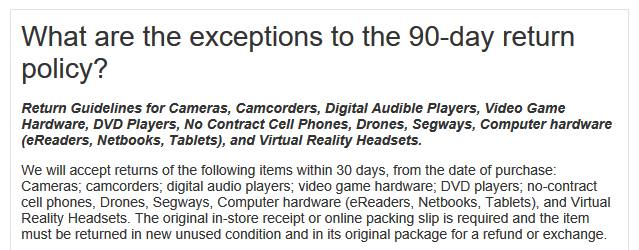
In 2016, the toy chain had a two-tier return policy: 90 days for most items, but only 30 days for various electronic goods like cameras, video game hard, computer hardware, etc.

*MOUSE PRINT:

2016 TRU 30 day items

In November 2017 when Consumer World visited websites to find the current return policies, the Toys”R”Us policy had changed. “Computer hardware” which had been in the 30-day category the year before now was in a new separate section of its own indicating only a 15-day return period.

*MOUSE PRINT:

Toys R Us exceptions 2017

So Consumer World reported that Toys”R”Us had shortened the return period from 30 days to 15 days for computer hardware in its December 18, 2017 report. (Keep this date in mind.) On that same day or the day after, in planning for a TV segment on return policies to air just after Christmas, staff from the Today Show contacted retailers to confirm the changes that Consumer World found. Toys”R”Us reportedly told Today that it had not in fact changed its policy to 15 days for computer hardware, and that it was still 30 days.

Taken aback by the possible error, MrConsumer doubled-checked his verbatim copy of the Toys”R”Us policy captured in late November and sure enough it said “15 days” for computer hardware. Surprisingly, however, a visit to the ToysRUs.com website on December 19 — a day after the report was issued and just after the Today Show contacted Toys”R”Us — revealed that the policy now said “30 days” for computer hardware.

*MOUSE PRINT:

TRU policy dec 19thDecember 19, 2017

What MrConsumer said upon seeing that Toys”R”Us apparently had changed its website after hearing from the Today Show can’t be printed on a family website. He did some sleuthing however, and discovered through the miracle of Google cache, what the website said the very day before the company heard from the Today Show, December 18.

*MOUSE PRINT:

TRU Dec. 18December 18, 2017

Consumer World asked the company why the policy had been changed back to 30 days and whether it was the result of the Today Show contacting them. MrConsumer was told in a phone call that the 15-day policy was listed in error and that the company changed it as soon as it learned of the mistake.

A review of archived copies of their returns page reveals that that whole separate section singling out computer hardware for a special shorter return period was added and has existed online at least since August 2017. The return policy signs in a T-R-U store checked by Consumer World on December 20, however, said “30 days” for computer hardware.

So what do you think? Did Toys”R”Us make an innocent mistake in their posted return policy online or did they backtrack when they found out that the change was going to be part of a news story on national TV?