Updated every Monday!   Subscribe to free weekly newsletter.

Skimpflation: Cough Syrup Strength Cut in Half

NOTE: The next new Mouse Print* story will be published on January 2nd.

Shrinkflation’s evil twin is “skimpflation.” That is when a manufacturer reformulates a product using less of the expensive components and sometimes substitutes less expensive ingredients. In other words, some products actually get watered down.

Store Brand Cough Syrup

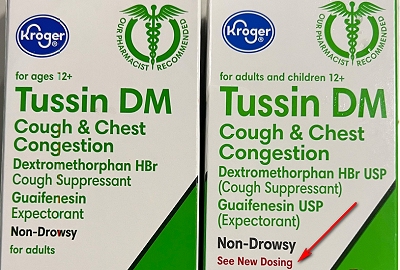
Discovering that a product’s recipe has changed is very difficult to detect. But regular reader Mark D. spotted a great example. Shopping at his local Kroger store he discovered that their store brand cough syrup had been diluted, now requiring you to take twice as much per dose.

Kroger cough syrup

We found that Kroger was not alone in doing this because various other chains are also changing the formula of their own brand of cough syrup.

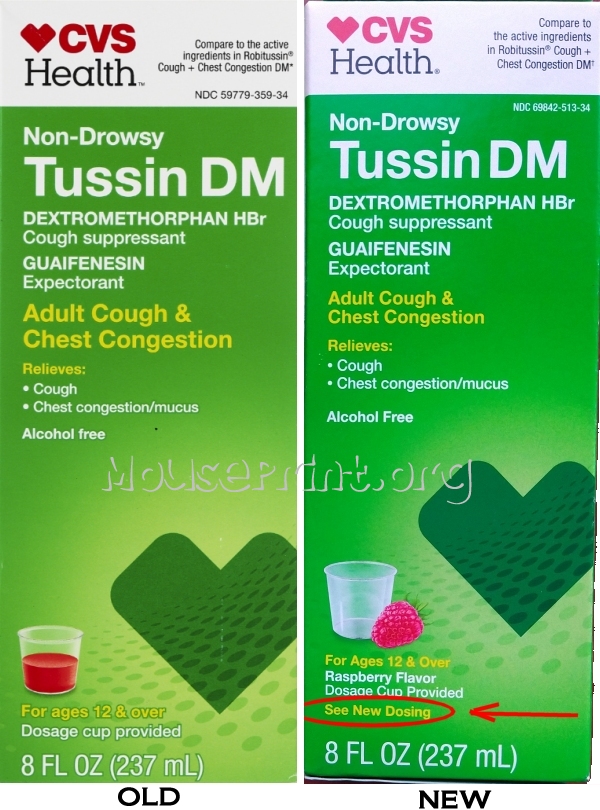
Here are before and after CVS’ versions of Tussin DM (a knockoff of Robitussin):

CVS tussin dm

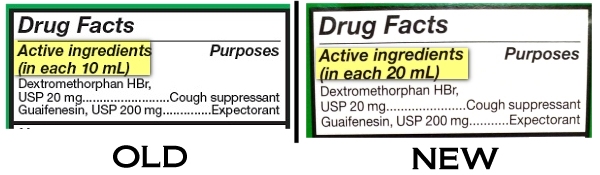
Only that tiny notation on the front panel that says “see new dosing” gives a clue to a change in the product. When checking the drug facts, comparing the ingredients in the old and the new product, the clever ploy is revealed.

*MOUSE PRINT:

Tussin DM active ingredients

Now there is only half the amount of active ingredients in each bottle. Put another way, to get the same amount of the two active ingredients per dose, you now have to consume twice as much cough syrup – 20 ml per dose instead of the old 10 ml.

CVS tussin dm dosing

We asked CVS why it made the change, and a spokesperson responded in relevant part:

In 2021, when the national brand equivalent made changes to their formulation, including changes to flavor, a change in dosing, and removal of high fructose corn syrup, CVS also updated its formulation of CVS Health Brand Tussin-DM.

Best we can tell changes like this are occurring with other store brands including Walgreens. If there is any good news, it seems to have taken the store brands four or five years to realize that Robitussin changed its dosing around 2017. The spokesperson for Haleon, the maker of Robitussin, when asked why the formulation changed said:

Over the years the brand has launched new, innovative products and evolved to meet changing consumer needs. This includes in 2015 and thereafter, when the brand reformulated its Robitussin DM products to improve factors such as taste to allow for a better consumer experience.

None of the store brands is promoting the fact that with less medicine in every dose, the product is better tasting. But, they are benefiting financially because the product now gets used up twice as fast.

If you spot an instance where a product has been watered-down or cheaper ingredients have replaced more expensive ones, please let us know. Just send an email to Edgar (at symbol) ConsumerWorld.org . Try to include “before” and “after” pictures.

Updated every Monday!   Subscribe to free weekly newsletter.

Act Mouthwash: Now With Less Fluoride?

A sharp reader found what he thought was a new example of skimpflation — when a product is reformulated with cheaper ingredients, or perhaps simply watered down.

He wrote about Act Total Care mouthwash which is an anticavity product with fluoride that you swish around in your mouth once a day to provide added protection for your teeth.

A closer look at the front label reveals an inconspicuous difference between the smaller bottle he had at home and the larger one he had just bought.

*MOUSE PRINT:

Act small and big

Could the print be any smaller? The strength of the fluoride is less than half in the large bottle going from 0.05% to just 0.02%! So users have to wonder whether it is going to be less effective since in essence they are giving you diluted fluoride.

But there was a second difference on the back label. Instead of gargling once a day, you have to use the product on the right, the larger bottle, twice a day.

*MOUSE PRINT:

Act smallAct large

The effect of both these differences seems like a double-whammy for users. You’re getting half the strength so you have to use twice as much a day, and the larger bottle costs more.

We asked Sanofi, the maker of Act, to explain these changes, as well as calling their consumer line. We were provided with a most unexpected answer. Although the products look the same but for the size of the bottle, and have the same name, they are actually two separate products. The smaller bottle is meant to be a once-a-day product and the larger one is meant to be a twice-a-day product, and this is nothing new. The customer service rep said the larger bottle has to have a less concentrated amount of fluoride since you are taking twice as much of it.

There is no indication on the front label that you need two doses a day from the larger bottle of Act Total Care unlike some other of their mouthwashes that at least have a tiny designation on the front.

*MOUSE PRINT:

Act 1x Act 2x

We can only wonder how many people are taking the wrong dose of Act Total Care if they change bottle sizes? Some may wind up taking double the dose, while others could wind up with only getting half the protection they expect. When we asked Sanofi why they don’t try to prevent misdosing by clearly labeling the products “1x Daily” or “2x Daily,” their spokesperson (non)responded:

“All of our products are labeled in accordance with FDA regulation.”

Updated every Monday!   Subscribe to free weekly newsletter.

More Groceries Hit by “Skimpflation” – Part 2

We continue reporting on products this week that have been reformulated in some way, usually with less of the expensive components and often by substituting cheaper ingredients (“skimpflation”).

Scott 1000-Sheet Toilet Paper

Virtually every brand of toilet paper has been downsized over the years, but Scott still has 1000 sheets. Of course, they reduced the size of each sheet multiple times as we have reported, but the current size has remained the same since 2010. So besides raising the price, Kimberly-Clark has also tinkered with the paper itself. According to purchasers, it is getting thinner and rougher. (See recent shoppers’ reviews.)

The sheets are so thin they’re transparent. I don’t even think they are a full ply.

Won’t be buying again … Would rather use a leaf then this crap again. Couldn’t be more disappointed!!!

It’s thin like the cheap paper in public restrooms and you have to use twice as much. I will never buy again.

If you enjoy picking out little globs of paper from your body parts because it is so thin it disintegrates from getting wet with the slightest friction – this is the toilet paper for you!

To try to quantify the change, we compared the weight of a four-pack of Scott from around 2006 to today’s version, while accounting for the sheets size change. Though not perfect, this method demonstrates how much less paper fiber or pulp goes into today’s sheets. And the difference is dramatic.

*MOUSE PRINT:

Scott Weight Comparison

The current version has about 20-percent less paper by weight than the 2006 version. So if purchasers are perceiving it has gotten thinner, it is not their imagination. This a perfect example of a company reformulating the product to cut costs — the essence of skimpflation.

We don’t know if Kimberly-Clark made small changes over time or all at once. The company did not reply to multiple requests for comment.


Hungry Man Double Chicken Bowls

An eagle-eyed shopper named Random Keith found that this TV dinner had changed. Hungry Man Double Chicken Bowls fried chicken used to pack 39 grams of protein. Now it has 33 grams — 15% less protein — but it still comes in a 15-ounce box. This could suggest a reduction in the chicken or cheese content — the two most dominant proteins.

*MOUSE PRINT:

Hungry Man Double Chicken Bowl

But, a check of the ingredients statement and nutrition label offers a clue to their recipe sleight-of-hand. The new version is missing “textured soy protein concentrate” which was part of the breading. Does that solely account for the reduction in protein? We asked Conagra, the maker of Hungry Man, what had actually changed, but didn’t get an answer.


If you spot a product that has been reformulated with cheaper ingredients, please send a sharp before and after picture of the primary labels and the ingredients statements to Edgar (at symbol) ConsumerWorld.org . Thanks.