Updated every Monday!   Subscribe to free weekly newsletter.

Credit Cards Cutting Back on Benefits

  Consumers who ignored the flurry of “update” notices sent by a number of credit card issuers this summer may be in for a rude surprise this fall when some longstanding benefits disappear from popular credit cards.

For example, collision damage waiver, and half a dozen other travel and purchase benefits including 2-5% back in points at Sears and Kmart will be removed from the Sears platinum MasterCard issued by Citi as of October 1. Bank of America is eliminating five benefits on its Better Balance Rewards MasterCards as of November 1. And Discover, as of last month, removed from its cards benefits for lost or delayed luggage, travel insurance, and emergency roadside service. (See chart below.)

“Credit card issuers have used a host of benefits to attract customers to their cards, but now they are quietly removing many of them,” explained Consumer World founder Edgar Dworsky. “Some customers may be in for quite a surprise when they go to use one of these benefits but only then discover that it no longer exists.”

Most of the MasterCard changes were made by the card company itself last year for their standard, gold, and platinum cards, but the cuts are only being implemented now by some individual banks. MasterCard says it evaluated which benefits cardholders preferred and actually put to use for everyday transactions in deciding what set of core benefits to offer and which to drop. For these basic cards, the new core benefits funded by MasterCard only include Extended Warranty, Price Protection, Identify Theft Resolution, and lost card services. Individual banks can supplement the core benefits with other perks, or even buy back deleted ones.

A Visa spokesperson said it had no plans to reduce benefits on its cards. AMEX did not respond to inquiries.

At the same time that they are reducing benefits, some of the card issuers say they are adding or improving some perks. For example, FIA Card Services, a unit of Bank of America that issues credit cards for Fidelity Investments, is expanding its “extended warranty” benefit on certain cards. Starting in November, it will double a manufacturer’s warranty up to two additional years (up from one year) for warranties of 24 months or less.

Sears MasterCard claims that as of October 1 it is improving “Extended Warranty” and “Price Protection” on its platinum cards, but PR representatives at neither MasterCard nor Citi could provide any details of the enhancements.

*MOUSE PRINT:
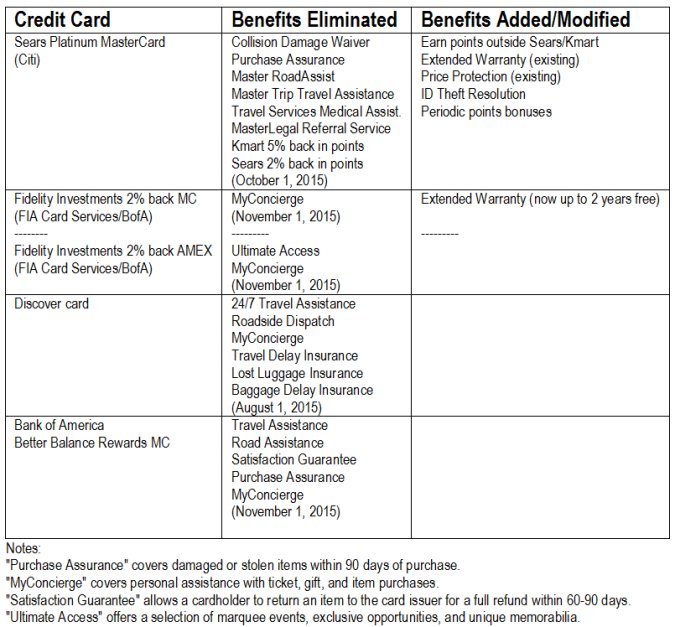
Credit Card Benefits Changes Summer/Fall 2015
credit card benefits

Before making a critical purchase, cardholders are urged to check with their card issuer to ensure that a particular benefit traditionally associated with their card is still in effect. For example, don’t assume you still have automatic collision damage waiver protection when renting a car, counseled Consumer World.

Upper tier cards like World MasterCard, World Elite MasterCard, and Visa Signature tend to offer more benefits than basic cards. Many of the eliminated benefits are still available on them and on many basic cards that have opted not to adopt the changes (yet).

Updated every Monday!   Subscribe to free weekly newsletter.

Ambiguous 2-Fer Offers

  Everybody loves a bargain, and when a company offers a second product free or at reduced price, that can be an attention-grabber.

The problem is that too often companies advertise 2-fer offers that are ambiguous at best, causing the shopper to jump to a conclusion about pricing that might be erroneous.

Example 1:

4.95 checks

Okay, what are these people offering? Is it two boxes of checks for a total of $4.95 and you get a third box free? Is it merely buy one box for $4.95, get a second box free? Or is it $4.95 for each box, and if you buy two, you get the third box free?

MOUSE PRINT*:

The answer in this case: This is a straight buy one box for $4.95, get another one free. (That’s an amazingly low price until you factor in mandatory handling charges of $3.45 per box.)


Example 2:

49 cents checks

Now, what’s this deal? Is each book of checks 49 cents? Is one box 49 cents when you buy two other boxes for $13.44 each? Are two boxes $13.44 period?

MOUSE PRINT*:

The answer when you clickthrough to their website is that this is a buy one for regular price offer, get the second box for 49 cents. So, apparently the first box is $12.95.

Incidentally, two many of these cheap check printers do not disclose how many checks are in a box. If memory serves correctly, it was standard practice to get eight books of checks in a box, or 200 total. Now some sellers only provide 150 checks, and others only 100.


Example 3:

Staples paper

So cases of paper are $4.99 after rebate at Staples “when you buy two.” So do you have to buy two cases at regular price and then get the third for only $4.99? Or are two cases $4.99 total? Or are cases $4.99 each, but you have to buy two of them to get that price?

MOUSE PRINT*:

In this example, unlike the check ads, the stated price is meant to apply per item. So, paper is $4.99 each case, but you must buy two to get that price each.

With these three examples, you have to wonder if sellers ever look at their offers to make sure that they are clear and unambiguous.

Updated every Monday!   Subscribe to free weekly newsletter.

Despite Crushing Publicity, TurboTax Sales Surge

  In January, we were the first to call national attention to TurboTax’s nasty and inconspicuous ploy of stripping its flagship desktop income tax preparation software of key tax forms, thus forcing long-time users to upgrade to significantly more expensive versions. (See series of Mouse Print* stories.) Customers were livid and nearly 3000 of them posted one-star reviews on Amazon.

Major media picked up on the story, and after three weeks of a public pummeling, Intuit, the maker of TurboTax, finally relented (after some half-hearted attempts to satisfy customers) and offered free upgrades to everyone.

Then came the revelation that crooks were claiming income tax refunds via TurboTax’s online software before their rightful owners could. Some states temporarily stopped accepting TurboTax returns. The FBI, Congress, and the FTC all launched investigations. And Intuit finally strengthened verification of identities on its website. This dual onslaught of negative press spanned most of January and February.

TurboTax headlines

One would think with the crushing and sustained negative publicity the company received over this period in the height of tax season that their sales would surely plummet. After all, consumers were mad as hell about the costly upgrades being forced on them, and worried as hell that TurboTax online was facilitating theft of their tax refunds.

According to Streetinsider.com, however, TurboTax desktop sales dropped only 6% or about 300,000 units, but online sales surged by two and a half million additional tax returns.

MOUSE PRINT*:

Unit Sales of 2015 TurboTax
TurboTax Sales

It is unfathomable to MrConsumer that millions felt more comfortable with TurboTax online this year than last, and that only relatively few abandoned the company’s desktop product. Wasn’t anyone paying attention except the two people who sued Intuit last week? Are all the alternatives just not up to the task? Or were those extra 2.5 million returns all filed by crooks?