Updated every Monday!   Subscribe to free weekly newsletter.

Where’s the Honey in Honey Bunches of Oats?

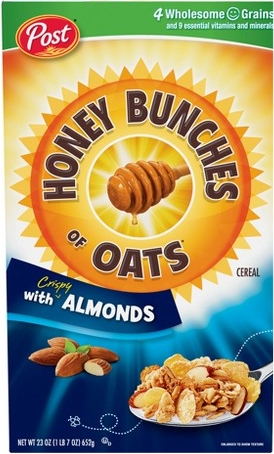
Honey Bunches of OatsFor years, we’ve all seen the commercials for Post’s Honey Bunches of Oats cereal where the female assembly line worker waxes poetic about her crispy crunchy bunches.

Last year, a health-conscious California consumer bought a box of this cereal thinking that honey would be a more healthy sweetener to have rather than sugar or corn syrup. Soon thereafter he learned (probably from a class action lawyer rather than a nutritionist) that the product in fact had almost no honey.

A check of the ingredients statement on the side of the package revealed the not-so-sweet truth.

*MOUSE PRINT:

Honey Bunches of Oats Ingredients

There are three other sweeteners in the product — sugar, corn syrup and molasses — all of which are in greater amounts than any honey. In fact, there was more salt in the cereal than honey. (Barley malt extract is also a sweetener, incidentally.)

So our consumer sued Post claiming false advertising and misrepresentation. He believed the packaging conveyed the impression that honey was either the only sweetener or certainly a significant one in the product.

Post argued among other things that no reasonable consumer would understand that the cereal’s packaging was making a claim about the amount of honey in the product. MrConsumer always loves when a company tries to assert that only stupid consumers would believe the baloney the manufacturer shows and tells them right on the package.

The company asked the judge to dismiss the case, but she sided with the consumer in her procedural decision.

In applying the reasonable consumer standard, however, the packaging must be considered in context. That is, the image of a radiating sun, the words “HONEY BUNCHES OF OATS,” and the honey dipper dripping honey occupy about two-thirds of the front of the packaging. Although the package does not make any objective representations about the amount of honey in the cereal, a reasonable consumer could see the prominent honey-related words and imagery and be deceived into thinking the cereal contained relatively less refined sugar and more honey. If so misled, the reasonable consumer is not expected to pick up the product and examine the fine print of the ingredient list. –Judge Yvonne Gonzalez Rogers, U.S. District Court

And so the case moves forward. We’ll keep you “Posted,” so to speak.

Updated every Monday!   Subscribe to free weekly newsletter.

Is a Hamburger Legally a Steak?

Back in 2017, several consumers sued Dunkin’ Donuts in a class action lawsuit alleging that the company’s Angus Steak and Egg sandwich really contained a ground beef patty rather than a solid piece of steak.

Dunkin' Steak & Egg

In commercials for the product, Dunkin’ repeatedly referred to the sandwich as containing “steak.”

*MOUSE PRINT:

None — they did not make any type of disclosure that it really was a ground beef patty.

The consumers in the case argued that this was a misrepresentation, they didn’t get what they paid for, and they would have paid less had they known they were going to be served a chopped meat sandwich rather than a solid piece of Angus steak.

The lower court dismissed the suit, and the appeals court agreed in a March 2020 decision. That court quoted the definition of steak from the dictionary, in part saying:

Moreover, while the word “steak” can refer to “a slice of meat,” it is also defined as “ground beef prepared for cooking or for serving in the manner of a steak.” Classic examples of ground beef served as “steak” include chopped steak, hamburger steak, and Salisbury steak.

The court concluded that no reasonable consumer would expect to be served a piece of solid steak for the $2-$4 price that Dunkin’ was charging:

As the television advertisements themselves demonstrate, the Products are marketed as grab-and-go products that can be consumed in hand, without the need for a fork and knife. A reasonable consumer purchasing one of the Products from Dunkin Donuts in that context would not be misled into thinking she was purchasing an “unadulterated piece of meat.”

MrConsumer has to disagree. If he walked into a sub shop and ordered a steak and peppers sub, he would expect to get solid pieces of meat, or at a minimum shaved slices of beef, but not hamburger meat. Dunkin’ had to know that by calling their product a steak sandwich, some number of customers — maybe even the majority — might reasonably believe they would be getting a solid meat sandwich.

Updated every Monday!   Subscribe to free weekly newsletter.

Is This the Way to Give Workers a Bonus?

No doubt, many people are facing personal financial hardships because they have lost their job or are working reduced hours. But many companies are stepping up continuing to pay workers or even offering extra pay.

One such company is the closeout retail chain Ocean State Job Lot (OSJL) with 139 stores throughout the Northeast. In an email to customers last week, their CEO told of hundreds of thousands of dollars of in-kind contributions of food and protective medical equipment their company has made.

He also noted a $2 an hour pay increase for workers, an additional bonus, and a more generous employee discount program.

There was one unusual disclosure in the letter, however.

*MOUSE PRINT:

OSJL- letter

The company is financing the bonus to employees by automatically tacking on a two-percent surcharge to every shopper’s bill at the checkout. While you can opt-out, how many people even realize that they are being surcharged in the first place? Many won’t see the signs nor have carefully read the email. And how awkward and embarrassing to have to say to the very person this money is intended to help that you don’t want to contribute.

While we applaud OSJL for its very generous contributions to hospitals and veterans organizations, in our view, the customer contribution for an employee bonus should be voluntary — opt-in — just like this chain does for the other causes it asks customers to support during the year.

Contrast their surcharge approach with the voluntary method being taken by the Daily Table in Boston. Their nonprofit mini-supermarkets, created by the former CEO of Trader Joe’s, buy soon-to-expire food from manufacturers and stores. They cook some of it and prepare single-portion meals for the lower-income shoppers that frequent their stores. Last week, the Daily Table sent out an urgent email plea to customers asking them to help pay their employees an emergency aid bonus of $2 an hour which was not in their budget. MrConsumer was happy to contribute.

So what do you think? Should stores be able to automatically tack on a surcharge to their customers’ bills to help finance an employee bonus, or should they simply just ask shoppers to support their employees through voluntary contributions?