Updated every Monday!   Subscribe to free weekly newsletter.

Movie Candy — More Box Than Candy

Have you seen the price of movie candy lately? In Boston, AMC Theatres charges $3.99 to $4.49 for a box with just 3.5 to 5.5 ounces of candy inside. Yikes.

These boxes have come under scrutiny lately because of several class action lawsuits against major manufacturers. Shoppers allege they were misled by the packaging which makes it look like there is a lot of candy in the box, but in reality, most are only about half full.

Here is a story about it by Jeff Rossen, NBC’s investigative reporter on the Today Show (with MrConsumer at the end).
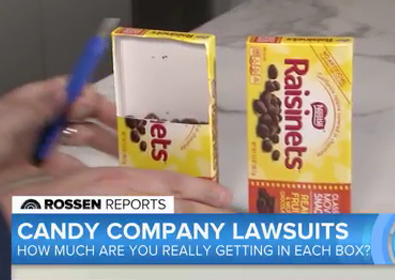
Rossen Reports Movie Candy
Click to watch video

When manufacturers over-package a product creating empty space inside that has no function other than to make consumers think they are getting more for their money than they really are, that is called slack fill, and it’s illegal under federal law (and the law of some states). It is not illegal if the empty space is needed because of settling of the product, or because the machinery to fill the package requires it, or the space is needed to protect the product (such as the cushioning pillow created by large potato chips bags).

Here’s another example not part of a lawsuit. This is a huge box of Bazooka bubble gum — maybe six or seven inches long and over an inch thick. Sure looks like it has a lot of gum inside.

Bazooka

But when you stack up the contents, you get much less than meets the eye given the size of the box.

*MOUSE PRINT:

Bazooka contents

Although the net weight is on the package, and fine print on the back says there are “about 19” pieces inside (there were 18 in this box), the FDA and courts have ruled that having the net weight on the package is an independent requirement separate from the requirement not to use deceptive packaging.

Updated every Monday!   Subscribe to free weekly newsletter.

When the Chips are Down in Fat, Are the Calories Too?

Diet-conscious consumers are probably attracted to low-fat products. And in the case of potato chips, they probably feel a bit less guilty indulging in that treat if it contains less fat.

Enter Cape Cod 40% Reduced Fat potato chips:

Cape Cod potato chips

Now don’t assume that the reduced fat chips on the right have 40% less fat than the Cape Cod regular chips on the left.

*MOUSE PRINT:

fat reduction claim

The reduced fat chips contain 40% less fat than the market leader, Lay’s potato chips. Lay’s has 10 grams of fat per ounce, Cape Cod 40% Reduced has six grams – 40% less as advertised, and regular Cape Cod has eight grams. This means that Cape Cod Reduced Fat chips contain 25% less fat than their own regular chips — still a substantial savings.

Dieters, however, are not only concerned about fat but calories as well. Would you care to venture a guess as to how many fewer calories Cape Cod 40% Reduced Fat chips has compared to their regular chips?

*MOUSE PRINT:

Cape Cod chips nutrition label

What? The lower fat chips have exactly the same number of calories — 140 — as their regular full-fat chips? Yep, that’s what the nutrition (alternative?) facts label says.

How can that be? The portion size is exactly the same – 28 grams — as is the number of chips per portion, but there is 25% less fat in one product.

So we posed that very question to the PR folks at Snyder’s-Lance, the makers of Cape Cod chips. And we also wanted to know whether they felt they had an obligation to dispel the likely consumer misimpression that their 40% fat reduced chips were lower in calories than their own regular variety. In reply, after three attempts to obtain answers, all the company (through their PR firm) would say relevant to our questions was this:

With regards to the calories in each item, we adhere to the strict FDA regulations that dictate how companies must calculate and report nutritional information.

Clearly something just doesn’t add up here. The company should be able to explain to customers how it is possible that their substantially reduced in fat product offers no caloric savings if in fact the label is correct.

Updated every Monday!   Subscribe to free weekly newsletter.

The New Math at Mio

Mouse Print* reader Jack K. recently wrote to us complaining about Mio water enhancer. This is a little bottle of concentrated flavor that you squirt into a glass of water to give it some flavor and maybe a few vitamins, all while adding zero calories.

Mio label   Mio side label

Jack says that despite the label promising that the product makes 24 eight-ounce glasses, he was getting much less and felt shortchanged. Since the amount a customer squirts into a glass could vary each time, our intrepid consumer used a measuring spoon, following the instructions on the side of the bottle which called for using about 1/2 teaspoon per glass. Lo and behold when he emptied the bottle he had only been able to make the equivalent of 16 eight ounce glasses of flavored water — one-third less than the package promised.

We did a little math using an online conversion program to find out how many half teaspoons are actually in a bottle whose net contents are 1.62 fluid ounces (48 ml).

*MOUSE PRINT:

Mio conversion

There are about nine and three quarter teaspoons worth of syrup in those Mio containers, which is slightly less than 19-1/2 half teaspoons. So just by pure mathematics, each bottle only holds enough product to make about 19 glasses of beverage rather than the 24 claimed.

We contacted the PR folks at Kraft to ask about this discrepancy. They responded in part as follows, without directly addressing our specific math question and example:

MiO Vitamins and our other MiO products are labeled properly.

Other Mio Vitamins products yield 24 servings and have prep instructions that indicate 1 squeeze of approximately 1/2 teaspoon (~1/2 tsp) per 8 floz. We clearly label that this is 2ml/about 1/2tsp for a 1.62oz 48ml) bottle.

So, if you want 24 glasses of Mio from each bottle, you’ll just have to use your handy 2-ml measuring spoon, which, of course, no one owns.