Updated every Monday!   Subscribe to free weekly newsletter.

Fry’s (Not So) Free Shipping

One of the biggest attractions online sellers can offer is free shipping. And that’s what Fry’s does for some items.

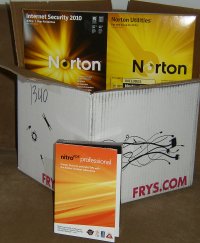
MrConsumer recently purchased Norton Internet Security (plus Norton Utilities and Norton Ghost) for about $75 from Frys.com because a full price rebate was offered, as well as free shipping (instead of the usual $6.98). In the same order, he added on another software program that was also $75, but it was not labeled as coming with free shipping.

Sure enough, their computerized ordering system charged $6.98 for shipping the order, despite the fact that Norton was supposed to be shipped free. How can the company get away with this?

*MOUSE PRINT: If one clicks the “free shipping” logo, there is this disclaimer:

1. If your order contains “eligible” and “non-eligible” items, shipping will be charged for “non-eligible” item(s).

The policy is understandable if the non-free shipping item is sent separately or adds weight to the box that contains the free shipping item causing the company to pay more for postage. But that was not the case here. As you can see from the picture above, Norton is a rather large product and it came shipped in a carton roughly 12″ by 12″ by 12″. In the same carton, was the other software — a box that weighed a mere three ounces.

The carton with just Norton weighed 21 ounces and with the added software box, it weighed 24 ounces. That additional three ounces did not push the shipping cost into a higher bracket, according to FEDEX’s shipping chart. So, Fry’s charged $6.98 for shipping a carton that otherwise would have shipped free, and which cost them no more to send because of the added three ounce software box.

Customer service was unsympathetic, and only after speaking to a supervisor did the company agree to refund half the shipping cost.

Updated every Monday!   Subscribe to free weekly newsletter.

Don’t Let the Juxtaposition of Deals Fool You – Part 1

Some advertisers make you think you are getting a better deal than you really are by clever (or unfortunate) juxtaposition of the price with a statement of benefits.

Example 1: Clear Internet Service

A flyer in the paper recently promoted “4x faster internet” for as little as $35 a month:

This deal certainly is designed to attract attention by seemingly combining a fast speed with a low price. Immediately, MrConsumer wondered “4x faster than what” because the tiny dagger after the claim was not explained on the front of the flyer.

The back explained the comparison:

So the Internet they are selling for $35 is 4G Internet, which they say is four times faster than 3G. Let’s put aside for the moment what speed they are actually selling, which is not disclosed anywhere in the flyer.

When visiting the Clear website using the link provided in the advertisement, and you click on the $35 logo found there, you are taken to a page only showing a $45 offer! Clicking an inconspicuous tab labeled “Base Home” reveals the real $35 offer.

*MOUSE PRINT::

The download speed is stated as “up to 1.5 Mbps” — which is more in the range of what 3G speeds are, not four times 3G, and certainly not full 4G speed. A 13-city study of carriers’ 3G speeds by PC World published earlier this year showed that AT&T averaged 1.4Mbps, while Sprint, Verizon, and T-Mobile averaged 800-900Kpbs (1000Kbps = 1Mbps).

So how can Clear advertise “4x faster Internet” for $35? The juxtaposition of the $35 price on the flyer above likely has nothing to do with the “4x faster” claim. Their $35 service, which the company says is 4G, really appears to be 4G ramped down to 3G-like speeds. My guess is that the four times faster claim actually refers to their more expensive $45 service, which does in fact appear to be full 4G speed.

But what reasonable consumer would understand there is no connection between the “4x faster” claim and the adjacent $35 price?

To add insult to injury, when visiting the Clear the website to find out exactly what speed they are selling on their 4G network, claimed to be four times faster, you find this for their $45 service:

*MOUSE PRINT:

What? Unlimited download speed? The sky is the limit? Of course not.

*MOUSE PRINT:

Buried in the FAQ: “CLEAR supports average download speeds up to 3-6 Mbps and upload speeds up to 1Mbps.”

Mouse Print* asked the company why they don’t advertise (in the print ad) the actual speed they are selling to avoid confusion, why they juxtapose the four times faster claim right next to the $35 price, and whether now that the potentially misleading nature of the ad was pointed out to them, would they consider modifying it.

A spokesperson for the company from their PR agency said, in part:

ON SPEED: “The speeds are detailed on our website, and the information is readily available. Many consumers may not understand technical terms pertaining to Mbps, so many of our ads in print, radio, and TV tend to put the language in simpler terms.”

ON JUXTAPOSITION: “The ad simply indicates that home plans start at $35, which is accurate. We use the term 4X faster as a general comparison to 3G wireless plans offered by conventional cellular carriers.”

ON CLARIFLYING THE AD: “I’ll look into this, but I do not believe that we have plans to change the ads at this time. “

Additional follow-up questions posed to the company related to the fact that their 4G $35 plan really was offering speeds only in the 3G range went unresponded to.

For a company with the name “Clear”, they certainly have chosen to make their advertising anything but.

——–
Stay tuned for another example of “Don’t Let the Juxtaposition of Deals Fool You”.

Updated every Monday!   Subscribe to free weekly newsletter.

United Airlines: Hurry, Only 4 Seats Left?

If you were planning a trip and were warned by the airline that the flights you were thinking of taking only had four seats left at the price you found, you might be prompted to book immediately, right?

Well, it seems that United Airlines has taken to giving passengers such a warning on their website. For example, on the flights between Boston and Washington, DC leaving on October 27 and returning on October 29, a notice appeared warning that only four seats remain at the outrageous price of $497 plus taxes/fees for a particular flight. [See separate previous story about this high fare.] I better grab my seats, I thought to myself, before the price gets even higher.

Thinking that there might be more seats available on alternate flights the same day, I starting clicking all the various flight options shown.

*MOUSE PRINT:


As you can see, no matter what flight combination was chosen, whether it be six in the morning or nine at night, “only” four seats were left on EVERY flight in either direction. Coincidence? I think not. It looks like United is using a bit of a scare tactic, not unlike that used by timeshare hucksters — “this deal is available today only, if you delay, you will miss out”. 

Since MrConsumer was going to fly to DC anyway, he decided to test United’s system to see if they were displaying an actual count of seats left.  At the time of the test, it was not obvious that these were “code-share” flights actually operated by US Airways.

Below is the flight selection screen MrConsumer saw just prior to booking his flights. Note that supposedly only four seats are left at the price shown.

And here is a new fare selection page moments after one of the four remaining seats was purchased:

*MOUSE PRINT:

Hmmm… still only four seats available at the posted price after I bought one of them. Hmmmm. Incidentally, a check of their website three days later revealed the same “only 4 seats left” warning for all flights.

Mouse Print* asked United Airlines for an explanation of how it could be that “only 4 seats” were left on all these flights, and that the number did not decrease when a ticket was purchased.

“First, we are able to book certain codeshare partners (e.g., US Airways) on united.com, however we can only view 4 seats of their inventory at a time, when in fact there may be more available.  This is a technical constraint.”  — United media relations

It seems to me that United should not be displaying their “only 4 tickets left” warning when they know that it is not an accurate statement of the actual number of seats remaining on the flight.

It is not known how accurate these seat availability warnings are on regular United flights.