Updated every Monday!   Subscribe to free weekly newsletter.

Credit Cards Cutting Back on Benefits

  Consumers who ignored the flurry of “update” notices sent by a number of credit card issuers this summer may be in for a rude surprise this fall when some longstanding benefits disappear from popular credit cards.

For example, collision damage waiver, and half a dozen other travel and purchase benefits including 2-5% back in points at Sears and Kmart will be removed from the Sears platinum MasterCard issued by Citi as of October 1. Bank of America is eliminating five benefits on its Better Balance Rewards MasterCards as of November 1. And Discover, as of last month, removed from its cards benefits for lost or delayed luggage, travel insurance, and emergency roadside service. (See chart below.)

“Credit card issuers have used a host of benefits to attract customers to their cards, but now they are quietly removing many of them,” explained Consumer World founder Edgar Dworsky. “Some customers may be in for quite a surprise when they go to use one of these benefits but only then discover that it no longer exists.”

Most of the MasterCard changes were made by the card company itself last year for their standard, gold, and platinum cards, but the cuts are only being implemented now by some individual banks. MasterCard says it evaluated which benefits cardholders preferred and actually put to use for everyday transactions in deciding what set of core benefits to offer and which to drop. For these basic cards, the new core benefits funded by MasterCard only include Extended Warranty, Price Protection, Identify Theft Resolution, and lost card services. Individual banks can supplement the core benefits with other perks, or even buy back deleted ones.

A Visa spokesperson said it had no plans to reduce benefits on its cards. AMEX did not respond to inquiries.

At the same time that they are reducing benefits, some of the card issuers say they are adding or improving some perks. For example, FIA Card Services, a unit of Bank of America that issues credit cards for Fidelity Investments, is expanding its “extended warranty” benefit on certain cards. Starting in November, it will double a manufacturer’s warranty up to two additional years (up from one year) for warranties of 24 months or less.

Sears MasterCard claims that as of October 1 it is improving “Extended Warranty” and “Price Protection” on its platinum cards, but PR representatives at neither MasterCard nor Citi could provide any details of the enhancements.

*MOUSE PRINT:
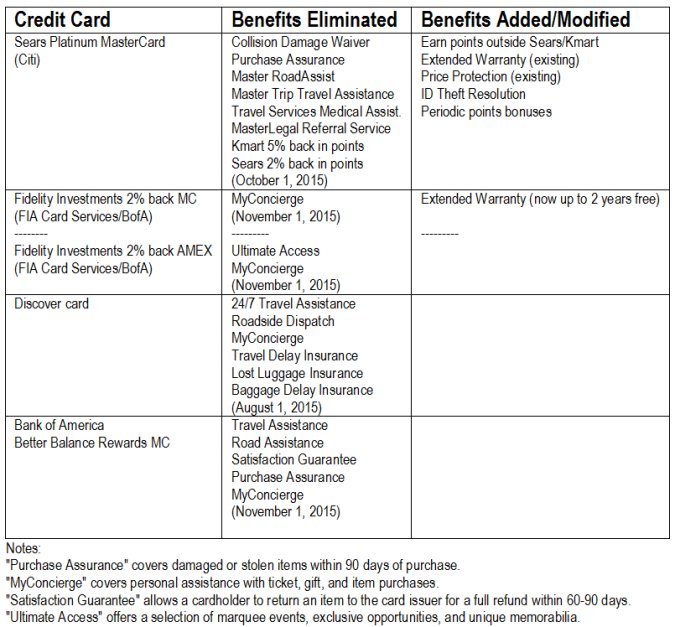
Credit Card Benefits Changes Summer/Fall 2015
credit card benefits

Before making a critical purchase, cardholders are urged to check with their card issuer to ensure that a particular benefit traditionally associated with their card is still in effect. For example, don’t assume you still have automatic collision damage waiver protection when renting a car, counseled Consumer World.

Upper tier cards like World MasterCard, World Elite MasterCard, and Visa Signature tend to offer more benefits than basic cards. Many of the eliminated benefits are still available on them and on many basic cards that have opted not to adopt the changes (yet).

Updated every Monday!   Subscribe to free weekly newsletter.

Walmart’s Got the Lowest Priced Unlimited Cell Plan?

  Joe S. wrote to Mouse Print* last week about a Walmart television commercial for cell service that he thought was misleading. Here’s the commercial (and listen very carefully to their lowest price claim):


https://www.youtube.com/watch?v=K1FLfA01eAA

It says “and at $29.88, it is the lowest price unlimited plan that includes 4G LTE.” That is an unambiguous, unqualified lowest price claim.

But wait, there’s some hard-to-read fine print.

*MOUSE PRINT:

Walmart lowest claim

The fine print qualifies the blanket lowest price claim saying that it is the lowest priced among the offerings that one can buy at Walmart. That is a far different, and narrower claim, and certainly not what any reasonable consumer would understand listening to the commercial.

So we wrote to Walmart’s PR folks and asked two questions:

1. Do you recognize how a viewer could misconstrue the oral claim in your current commercial to mean that your $29.88 plan is the lowest priced 4G LTE plan IN THE MARKETPLACE because you do not qualify the claim?

2. Will you change the commercial, such as by saying “OUR lowest priced plan” instead of “THE lowest price plan”?

Walmart did not respond.

And just in case some of you are saying that maybe their claim is true that they are the lowest price in the market. Nah. Boost Mobile just announced a switching promotion to offer a $20 plan with unlimited talk, text, and data, with 2.5 gigs of high speed LTE data.

Boost $20 plan

Now it is not as if we were asking Walmart to do something difficult — change one word in the commercial so it wouldn’t be deceptive. And it is not as if they had never done it properly before. Here’s a similar commercial from last year where they clearly say orally that this plan is “our lowest priced family unlimited plan.”


You have decide what it says about a company that won’t fix a misleading advertisement when it is brought to their attention.

Updated every Monday!   Subscribe to free weekly newsletter.

T.J. Maxx Sued for Phony “Compare at” Prices

  Two California consumers are suing T.J. Maxx for using deceptive price comparisons on their price tags. [See lawsuit.]

T.J. Maxx price tags looks like this:

TJ Maxx pricetag

It shows a higher “compare at” price and the lower T.J. Maxx selling price. Average consumers, like the plaintiffs, might believe they were saving that amount of money on the items they were buying because the same item or a similar item was selling elsewhere for the stated higher price.

As it turns out, T.J. Maxx defines “compare at” on their website (and they say on signs in their stores) in a bit of an unexpected way:

*MOUSE PRINT:

What do we mean by “compare at”?

The “compare at” price is our buying staff’s estimate of the regular, retail price at which a comparable item in finer catalogs, specialty or department stores may have been sold. We buy products from thousands of vendors worldwide, so the item may not be offered by other retailers at the “compare at” price at any particular time or location. We encourage you to do your own comparison shopping as another way to see what great value we offer.

T.J. Maxx seems to be saying that its “compare at” prices are merely estimates and not actual prices that it has found for comparable merchandise in the marketplace.

This does not square with state or federal guidelines that seem to require substantiation that a reasonable number of sellers are actually offering a comparable in quality item at the stated “compare at” price.

In T.J. Maxx’s defense, the actual selling price for their merchandise tends to be as low or lower than some of the best prices being offered elsewhere for the same item. And, in many of the cases that we checked, the compare at price that T.J. Maxx uses is conservative and sometimes less than the manufacturer’s suggested retail price.

For example:

Nautica luggage

In this case, Nautica claims the list price of the 20-inch (not 21-inch as T.J. Maxx asserts) suitcase is $320. T.J. Maxx says the “compare to” price is $140, and they are is selling it for $69.99. Who knows what other brand is comparable to this particular item, but this very item sells for no more $99.99 at other stores.

So real life savings are $30 rather than $70 (at least for an identical item).

None of this excuses the company, however, for using estimates instead of basing its “compare to” prices on actual products and their real prices in the marketplace.