Updated every Monday!   Subscribe to free weekly newsletter.

With New LED Light Bulbs, Be Careful Watt You Buy

  Light emitting diode (LED) light bulbs are poised to become the bulb of choice for many shoppers. With a recent price drop announced by GE, it is predicted that LED light bulbs might in coming years make compact fluorescent bulbs (CFLs) obsolete.

But not all LED bulbs are created equal.

Here is a conventional incandescent 60-watt bulb and its CFL equivalent:

60-watt incandescent     cfl

The conventional 60-watt bulb has a life of about 1000 hours, and is rated at 870 lumens (the brightness or amount of light it gives off). But the CFL uses only one-quarter of the electricity (15 watts), lasts eight times longer, and produces slightly more light — 900 lumens — at least initially. That CFL cost a dollar or less.

The new GE bulb, called the GE LED Bright Stik, comes in packs of three at Home Depot for $9.97.

GE Bright Stik

*MOUSE PRINT:

While it uses one-sixth of the electricity of an incandescent, and a third less than the CFL, it only provides 760 lumens of light versus 870-900 lumens for the other two. It also provides a paltry 15,000 hours of life — short for an LED.

It appears that GE has sacrificed longevity and light output for a lower price. Compare the specs of some of its competitors:

*MOUSE PRINT:


60-Watt Equivalent LED Bulb Comparison
chart
“Conventional” refers to bulb shape

As you can see, prices and specs vary widely. The point of this comparison is to show that you shouldn’t assume that all LED bulbs of a certain wattage equivalent provide the same amount of brightness or have the longest possible life.
Updated every Monday!   Subscribe to free weekly newsletter.

The Price They Advertise is Not the Price You Pay

  Enough is enough. Isn’t it time that cell and cable companies stopped advertising seemingly low monthly prices for their service, while tacking on a multitude of junk fees, undisclosed charges, and taxes that significantly boost your bill?

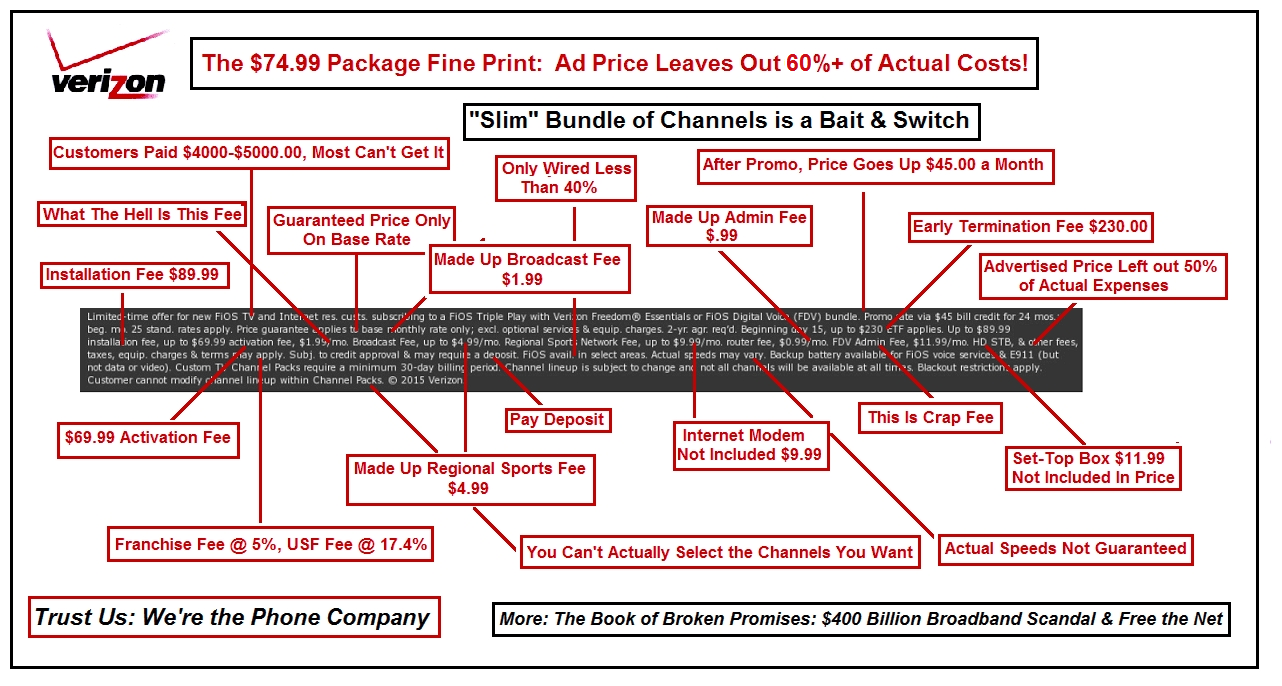
Recently the Huffington Post did an exposé, using Verizon FiOS’ new pick your own channel bundle for $74.99 as an example. When you added all the other charges, you actually had to pay over 60% more than the advertised price.

*MOUSE PRINT:

Huffington Post
Click to Enlarge

There were equipment/HD fees, FDV administrative fee, broadcast TV fee, regional sports fee, franchise fee, USF fee, federal/state/local taxes, etc. There could also be installation fees, activation fees, and early termination fees depending on the offer.

Verizon is certainly not alone in tacking on all these fees. Comcast and Time Warner are equal opportunity offenders, as are the wireless cell companies.

Is it any wonder that these types of companies rate low in customer satisfaction surveys and on trust indices?

Maybe there needs to be a requirement, like airfares, that a single all-inclusive price must be the amount advertised, and not these bait and switch prices.

Updated every Monday!   Subscribe to free weekly newsletter.

Get Rewards with Plenti (of Strings Attached)

  A new unified rewards program named Plenti was recently introduced by a number of retailers. The concept is simple, and actually kind of smart on the face of it: instead of separate loyalty programs, these stores use the same card to allow shoppers to earn points that get deposited into a single account. Then, the points can be redeemed at participating members’ stores for discounts.


But wait, there was some almost illegible fine print on the screen for a mere three seconds.

*MOUSE PRINT:

“You cannot use points with all participating partners or at all locations.”

Huh? Isn’t that the point of the program to earn points at member stores and then be able to redeem there?

For example, here is AT&T’s Plenti ad.

*MOUSE PRINT:

AT&T Plenti

In case you can’t read that, it says that you can’t currently use points at AT&T.

*MOUSE PRINT:

In fact, according to the Plenti site, you can only redeem Plenti points at Macy’s, Rite Aid and participating Exxon and Mobil stations.

So, if you like to collect points just for the sake of collecting them because you don’t shop at the above retailers, knock yourself out at AT&T, Nationwide Insurance, Direct Energy, Enterprise, National, Alamo, and Hulu.

And as with any discounts, there are “plenti” of other earning and redeeming exclusions.