Updated every Monday!   Subscribe to free weekly newsletter.

Product Dilution: Breyers Lightens More Ice Cream

Last year, we reported that Breyers “cheapened” many varieties of their ice cream by reducing the amount of butterfat content to the point where the product could no longer legally be called “ice cream,” but rather had to be renamed “frozen dairy dessert.”

Some stalwart flavors, like MrConsumer’s beloved lactose-free vanilla, remained untouched until now. To MrConsumer’s horror and surprise, Breyers quietly converted that ice cream variety to “light ice cream.”

*MOUSE PRINT:

Breyers old - new front
Click to enlarge

In the new packaging, the “All Natural Ice Cream” claim is replaced with the phrase “Quality Since 1866.” Of course, it doesn’t say the same quality. And the words “ice cream” are replaced with “light ice cream.”

What exactly is “light ice cream?” According to FDA rules:

“Light” ice cream contains at least 50% less total fat or 33% fewer calories than the referenced product (the average of leading regional or national brands).

Looking at the nutrition panels of the old Breyers lactose free ice cream and the new one reveals only a minor reduction in calories.

*MOUSE PRINT:
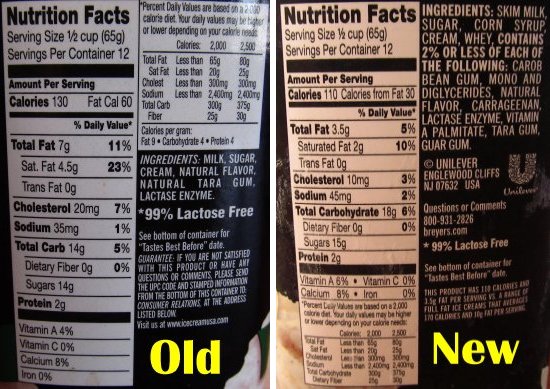
Breyers old-new

The old “ice cream” product had 130 calories and the new “light” one has 110 calories, only 20 fewer calories. It does however have half the fat. And, the federal law says that light ice cream must have EITHER half the fat OR 33% fewer calories.

There is just one problem, though. The front of the package claims very clearly that the new light ice cream has BOTH half the fat and 1/3 fewer calories.

Breyers fat-cals

Clearly, this new lactose free light ice cream does not comply with that representation when compared to their old regular lactose free ice cream. So how do they get away with this claim?

*MOUSE PRINT:

breyer one-third fewer

Tucked away on a side panel is that tiny disclosure. They are not comparing this new light ice cream with THEIR old regular ice cream, but rather with some super premium brands like Ben & Jerry’s and Haagen Dazs as well. Those have been thrown in to up the average amount of fat and calories in “full fat” brands, and thus make Breyers’ reduction seem more impressive than it really is. (Haagen Dazs has 250 calories and 17 grams of fat per serving, while Ben & Jerry’s has 230 calories and 14 grams of fat.)

Mouse Print* asked the PR firm representing Breyers three times to explain why they cheapened some of their products, and they provided no response.

If you spot a new example of “product dilution,” please send complete before and after details to edgar [at symbol] mouseprint.org .

Updated every Monday!   Subscribe to free weekly newsletter.

Product Dilution: Cheerios Decreases Vitamin Content

In a move rarely ever done, General Mills actually reduced the quantity and number of vitamins (and therefore the nutritional value) of one of its cereals — MultiGrain Cheerios.

*MOUSE PRINT:

MultiGrain Cheerios

The nutrition label on the left shows that one serving provides 100% of the daily requirement of nine vitamins and minerals. The one on the right shows that these were reduced to only 25% of the daily requirement in most cases, and two were actually eliminated completely from the product.

We asked the company why they reduced the vitamin content.

“The change in vitamin levels brought MultiGrain Cheerios in line with the Cheerios family of cereals. MultiGrain Cheerios now delivers an excellent source of 8 vitamins and minerals for our all-family consumer base.” — General Mills spokesman.

As consumers, we are used to having to check the price of a product to see if it has changed. Readers of Mouse Print* have learned that you also have to check the net weight of a product to see if it has been downsized. And, who would have believed it, but now we have to check the nutrition label to see if we are getting fewer vitamins.

We are nicknaming this phenomenon of a product being reforumulated and watered down as “product dilution.” Another example of product dilution was when many flavors of Breyers ice cream had the amount of milkfat reduced to below 10% requiring it to be renamed “frozen dairy dessert.”

If you spot a product that has been diluted, please email details to edgar (at symbol) mouseprint.org .

Thanks to Nancy W. for discovering the Cheerios product dilution, which the company says actually occurred in 2011.

Updated every Monday!   Subscribe to free weekly newsletter.

The Little Secret Inside that Big Pill Bottle

A couple of years ago, MrConsumer’s doctor recommended that he take 1000 iu of vitamin D a day. Recently he switched from tablets to softgels, and got quite a surprise when he opened the bottle.

Here is the CVS pill bottle with contains 300 softgels:

CVS D3

Upon opening the bottle, MrConsumer discovered that most of the bottle was just filled with air, with the softgels way at the bottom.

*MOUSE PRINT:

CVS fill line

In this roughly five-inch high bottle, the pills only occupy the bottom one-and-one-quarter inches.

Had MrConsumer had his trusty x-ray device with him at the store, he would have seen this:

*MOUSE PRINT x-ray:

CVS D3 x-ray

Presumably there really were 300 softgels in the bottle, so that is not the issue. This is, however, an example of over-packaging or “slack-fill” as it is known. Slack-fill is the difference between the actual capacity of a container and the volume of product contained therein. If the extra space is really non-functional and not required for filling machines to operate properly, the product can be deemed misbranded under federal law.

It certainly would be cheaper for CVS to use a smaller bottle, and better for the environment. One has to wonder, then, why they continue to sell pills in oversized bottles. So we asked them.

“The front label on our over the counter products clearly states the number of pills/capsules/tablets contained in the bottle, as evidenced by the sample photo you provided, to ensure that customers are aware of the quantity being purchased. We also need to ensure that the container is sufficient in size to accommodate the required drug fact information. Generally speaking, manufacturers choose the container size.” — Public Relations, CVS/pharmacy

Coincidentally, Consumer Reports in its August issue shows more examples of air-filled pill bottles and gets other explanations of why this is a common practice.