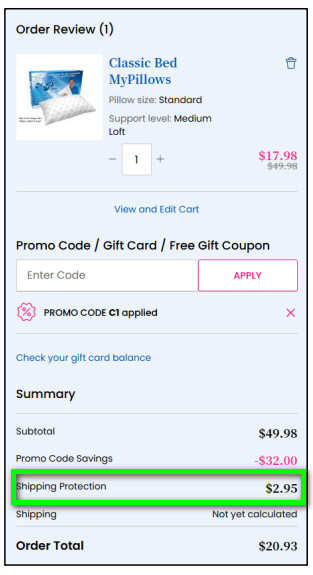
Recently a California consumer sued Domino’s for advertising one price on their menu but tacking on a junk fee to his bill that upped the price. [See complaint.]
*MOUSE PRINT:
On his bill was the expected sales/meals tax, but then a second line was labeled “Tax 2.” According to the lawsuit:
Moreover, once the “Tax 2” amount appeared on the receipt, the representation of the Junk Fee as a “tax” lead Mr. Murphy to believe that “Tax 2” was a mandatory charge imposed by the government that was required to be paid on the transaction by him. The representation of the
Junk Fee as a “Tax” was also material to Mr. Murphy.
When Mr. Murphy paid for the two pizzas and the breadsticks in cash at checkout, he was charged two “tax” amounts. In addition to sales tax, Mr. Murphy was charged a “Tax 2” amount that, although deceptively and misleadingly labeled as “Tax,” was in reality a Junk Fee charged by Defendants to offset their own business expenses.
Under California’s “Honest Pricing Act” additional junk fees are illegal because businesses are prohibited from “[a]dvertising, displaying, or offering a price for a good or service that does not include all mandatory fees or charges.” Cal. Civ. Code § 1770(a)(29)(A).
Domino’s is being sued for unfair business practices, violation of the new complete pricing law, and the state false advertising law. The consumer’s lawyers are seeking refunds and damages, and an order stopping Domino’s from continuing to charge any illegal extra fees.
Last week, Aldi ran a sweepstakes called Aldi Blind Box promising to give away mystery boxes of groceries each day for four days at exactly the stroke of noon. It sounded like such a good deal that we promoted it as a “Bargain of the Week” in Consumer World.
At the appointed hour last Monday, MrConsumer along with perhaps thousands of others watched the Aldi clock tick down to zero so we could try to get a box of goodies. After clicking the “claim a box” button, your online cart showed that a box was added to it. Then you had to click a “check out” button and prove you were a human by solving THREE CAPTCHAS, and then later another set of CAPTCHAS. At that point you are told you are in line to check out and for me it said the estimated wait time was 45 minutes.
After patiently waiting three-quarters of an hour, a message popped up saying they were all sold out!
Say what?
Soon after Monday’s giveaway we received a complaint from a regular reader who experienced the exact same thing. She commented, “I wasted 42 minutes believing that Aldi was going to honor my place in line.” Some other people said they got as far as entering their shipping information but then received a “sold out” message.
Immediately, we wrote to Aldi’s PR people complaining about the misleading nature of the promotion because it gave entrants the impression that a free box was in their cart and that they were just waiting in line to check out. We asked many pointed questions including how they were going to make good for the thousands of customers they disappointed. They only answered that question as noted below.
In addition, it appears that Aldi may have violated state and federal sweepstakes laws that require disclosing “official rules” of giveaways like this. A review of the Internet Archive reveals that they did not make this disclosure prior to the Monday drawing, but did so in time for the ones after that.
A glutton for punishment, MrConsumer returned on day two of the promotion where the process remained the same except the wait time was reduced to just four minutes seemingly. However, when the four minutes elapsed, the wait time reset to 30 minutes, followed by the inevitable “sold out” message! The video below shows the process in actual time.
By day three of the promotion, the company finally decided to explain to participants how the promotion worked in detail. Duh.
Part of the problem was that despite having 2,684 stores in the United States, Aldi only made available 84 – 92 boxes a day (without disclosing that to participants initially), and chose an entry system that inconvenienced and misled their customers. They should pay a price for that, both monetarily and legally.
After the fourth and final day of the planned giveaway, Aldi announced a make good of sorts — an unscheduled fifth day of mystery box giveaways, wherein the company would offer 5,000 free boxes but still using the same cockamamie system.
In making the announcement, Aldi said they were doing it “because when the fans get loud, ALDI responds with an encore.” Get loud? They really meant “complain.”
How did the 5,000 box giveaway turn out? No different. Despite entering the site before noon, clicking the “claim a box” button as soon as it appeared adding the mystery box to my cart, the countdown clock to check out said 4 minutes. After hitting zero, it reset to 22 minutes. And after hitting zero again it reset to 17 minutes. And after hitting zero again it reset to 12 minutes. And when it hit zero for a fourth time (a total of 55 minutes waiting in queue), here’s what MrConsumer (and others) saw:
As one poster said on Instagram after Friday’s make-good farce:
Today’s was the biggest joke of them all… Never again… I have wasted 2-1/2 hours on this.
MrConsumer was taken aback when he saw a nationally televised commercial by The Wellness Company selling an emergency kit containing eight prescription drugs that you keep at home just in case you need them at 2 a.m. when pharmacies and doctors’ offices are closed.
You get bottles of these eight prescription drugs to self-treat conditions such as parasites, strep, pneumonia, lyme disease, bacterial infections, GI and urinary tract infections, and more.
To get the kit, you have to fill out a health form, and have a brief consultation with a health professional at the company who can write the prescription.
Once you get the kit, how exactly do you diagnose yourself with these conditions? They give you a handy booklet about what to use each drug for, or you can speak to a health-care professional at their company during regular business hours for an extra fee, presumably.
And how much does this kit cost? $299.
*MOUSE PRINT:
In their FAQ section they reveal a key fact:
To the best of our knowledge, no state pharmacy boards or consumer authorities have taken legal action against the company because what they are doing may not be outside current medical, legal, and ethical guidelines. One state pharmacy board reportedly denied a drugstore’s request to carry a similar kit in their store.
Some things are very unsettling about this whole proposition:
Shouldn’t new conditions be diagnosed first by a doctor, rather than having patients read a booklet to self-diagnose and self-medicate, perhaps incorrectly, in the middle of the night?
Should doctors and pharmacies be allowed to prescribe and dispense packages of drugs on the speculation that someday they might come in handy, particularly knowing that some patients may self-medicate without proper diagnosis or medical follow-up?
Can’t purchasers of these kits wait until 8 a.m. the next day to call their doctor to get a real diagnosis or prescription?
How many of these drugs will expire before use and wind up being a big waste of money?
Why haven’t state or federal medical authorities stepped in to regulate sales of kits like these?