Fast food companies have a knack for making their burgers and chicken sandwiches look much larger than they really are.
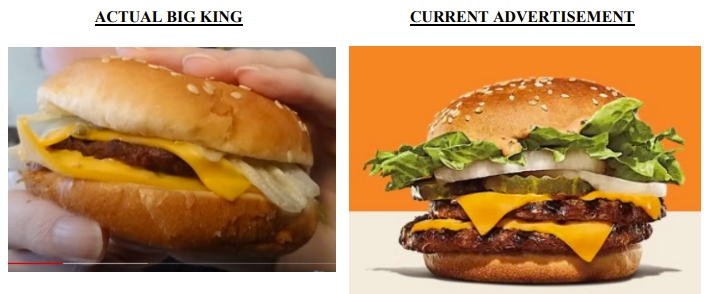
Now a new class action lawsuit has been filed against Burger King alleging that certain of their burgers are depicted in advertising as much larger than they actually are.
*MOUSE PRINT:
The complaint goes on to allege:
A side-by-side comparison of Burger King’s former Whopper advertisement to the current Whopper advertisement shows that the burger increased in size by approximately 35% and the amount of beef increased by more than 100%.
The court is being asked to require Burger King to pay damages to all affected consumers, and to stop misrepresenting the size of their sandwiches in advertising and on menu boards.
It is about time that restaurants are called on the carpet for exaggerating their portion sizes.
Earlier this month, district attorneys from seven California counties reached a court settlement with Target for over $5-million after they sued the chain for allegedly charging shoppers more than the advertised price on some items.
In addition to the run-of-the-mill pricing violations like leaving old sale signs up and then charging customers the full price at the checkout, the DAs alleged something very unusual in their complaint:
*MOUSE PRINT:
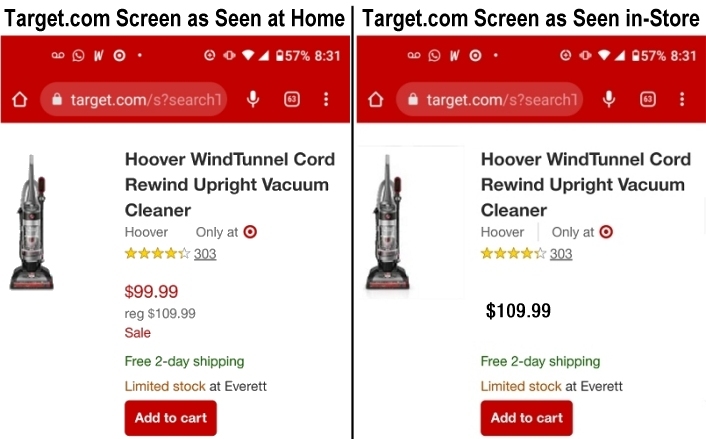
“..advertising, posting, marking or quoting a price for a commodity on Target.com or via the Target mobile application (“Target app”) when deployed by a consumer outside the perimeter of the store [such as at home] and then advertising, posting, marking or quoting a different price for that commodity on Target.com or via the Target App when deployed in-store by the same consumer…
..advertising, posting, marking or quoting a price for a commodity on Target.com or via the Target App that is simultaneously available for purchase in a store at a different price without clearly and conspicuously disclosing the sales channel — online or in-store — at which the commodity may be obtained at the stated price.”
With respect to this latter point, Target was apparently not making clear on the Internet whether the price it was showing for specific items was the online price, the in-store price, or was valid for both.
The other issue is a bit trickier to explain. The DAs alleged that Target used technology called “geofencing” to send a different set of prices on some items to consumers’ cellphones when they were close to or in the store compared to the prices displayed when at home. In some cases, a consumer who saw, say, a vacuum cleaner on sale for $99.99 in the Target app or on their website at home, may have discovered when visiting the store to actually look at the item that the price had changed in the app/website to reflect a higher in-store price of $109.99.
Hypothetical Example
In the settlement with the California DAs, Target is required to maintain an elaborate price verification and audit program checking hundreds of prices weekly. It has to correct the inconsistencies it finds in those price checks and also when customers bring a discrepancy to the attention of store personnel.
Target is also being required to clearly disclose on its website and app specifically where the advertised price shown is valid (in-store, online, or both). And with respect to displaying a different set of prices to customers who enter the store, the settlement says:
“Target will not use Geofencing in conjunction with the Target App or Target.com such that the price of any product advertised as available when purchased online on the Target App or Target.com either (1) increases or (2) switches to a price advertised as available when purchased at a store based solely on the geographic location of the user.”
Both the Sonoma County DA’s office and the one in San Diego County declined to provide further clarification of this and other issues.
But, three cheers for the DAs of California and the weights and measures departments in those counties who continue to watch out for shoppers on these types of pocketbook consumer issues when many state attorneys general ignore them.
Incidentally, back in 2019, the NBC affiliate in Minneapolis (Target’s hometown), conducted an investigation demonstrating how Target sometimes charges a higher price in-store than it does online. Don’t get confused by the story’s reference to a lower “parking lot price.” It is the same price you would see at Target.com using your computer or cellphone at home.
After that segment aired, Target said it would make clear whether a price shown on your phone was an in-store price or an online price.
We continue this week to spotlight big brands that are shrinking their products but charging the same or more for them. Shrinkflation continues unabated.
Cottonelle
Just like Charmin, Cottonelle has reduced the number of sheets it provides on each roll of toilet paper depending on the variety (soft or strong). Here, the strong version of Cottonelle mega rolls has gone from 340 1-ply sheets to just 312. And the soft version went from 284 2-ply sheets to just 268. See past examples of how Cottonelle has shrunk over the years. Thanks to Richard G. for this submission.
*MOUSE PRINT:
Sun-Maid Raisins
Those canisters of Sun-Maid Raisins are getting smaller too. They just lost over two-and-a-half ounces each.
*MOUSE PRINT:
Chobani Yogurt
Remember when yogurt used to come in eight-ounce cups? Those days are long gone. Some of them aren’t even six ounces anymore. And the specialty versions with mix-ins, just got even smaller. Thanks to Richard G. who spotted this change.
*MOUSE PRINT:
Dove Body Wash
Like so many shampoos, body wash bottles are getting smaller too. Here, Dove Body Wash went from 24 oz. to 22.
*MOUSE PRINT:
Safeguard Soap
Remember when “bath size” soap was five ounces? Those days are long gone because soap has been shrinking for years. Most recently, Safeguard has gone from four ounces down to only 3.2 — just about the size of what was once considered a regular bar.
*MOUSE PRINT:
If you find an example of a product that has recently been downsized, please take a clear before and after picture, including the net weight or net count statement and send it to: Edgar (at symbol) MousePrint.org . Thanks.



 Hypothetical Example


