Consumer World Celebrates 30 Years: 1995 - 2025  
Subscribe to free weekly newsletter.

TSA Pre-Check: A Pleasant Surprise in the Fine Print

On the way back from Washington, DC a couple of weeks ago, MrConsumer was stopped by a TSA official before entering the waiting line for security. He scrutinized my boarding pass and diverted me to the TSA Pre-Check line. Thinking he made some mistake because perish the thought would MrConsumer pay extra for a pre-screening program to expedite his trip through security, the TSA official said it was a random choice that I was being directed there.

Okay, I thought, maybe this is a heightened security check for random passengers. But how much more could they ask me to remove?

Turns out that pre-check is an expedited process to go through security. No removing of shoes or belts. No taking out your plastic bag of toiletries. No laptop in a separate bin. And no going through the full body scanner. All I had to do was remove metal from my pockets and go through the old-fashioned metal detector.

A check of the TSA website reveals that the TSA Pre-Check program is indeed a system being rolled out across the country. It is currently available at seven airlines, including American, Delta, United, and US Airways in selected cities. They have a secret formula to figure out who is harmless enough to let through security with only minimal screening (and clearly the system isn’t working too well if they let MrConsumer through ).

How do you know if you have been selected to cut the long line, and go express through security?

*MOUSE PRINT:
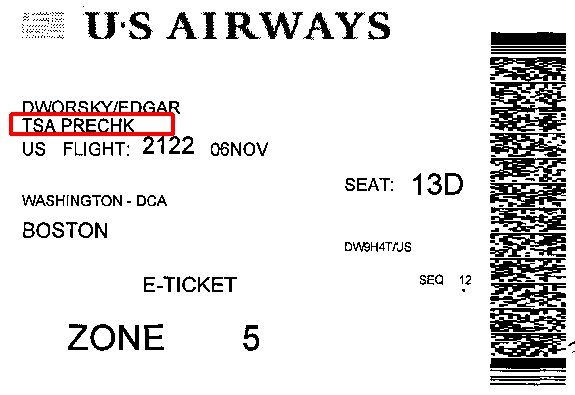
TSA Pre-Check

Look right on your boarding pass in most cases for that designation.

Based on the details found at the TSA Pre-Check program website you do have to pay $85 for a five year expedited “pass” through security. So maybe the TSA is taking a page from product manufacturers and offering a free sample to random passengers in the hope that they will buy into the program.

Consumer World Celebrates 30 Years: 1995 - 2025  
Subscribe to free weekly newsletter.

One Way Fare to Heaven Gets Costly for Delta Frequent Fliers

A couple of weeks ago, Consumer World brought you a story suggesting that savvy travelers shouldn’t let their frequent flier miles die with them. The miles can be inherited and transferred to an heir in many cases.

Delta Airlines must be a regular Consumer World reader, because last week they changed the rules of the game for holders of Delta SkyMiles.

*MOUSE PRINT:

Here are the 2012 rules for the Delta SkyMiles program:

Transfer upon Death of Member

Upon the death of a Member, the Administrator or Executor of the Member’s Estate may designate one or more other Members to receive a transfer of the mileage credit in the deceased Member’s account. Only whole number amounts of miles may be transferred. The required form and other instructions for requesting a transfer of mileage under these circumstances is available on delta.com/skymilesaffidavit.

On March 20, 2013, however, Delta changed their SkyMiles rules for 2013.

*MOUSE PRINT:

Restrictions on Transfer

Miles are not the property of any Member. Except as specifically authorized in the Membership Guide and Program Rules or otherwise in writing by an officer of Delta, miles may not be sold, attached, seized, levied upon, pledged, or transferred under any circumstances, including, without limitation, by operation of law, upon death, [emphasis added] or in connection with any domestic relations dispute and/or legal proceeding.

Delta dropped the whole paragraph about the procedure for transferring miles on death, and substituted the above new “no transfer” rules. Now Delta says that your miles are not yours, you can’t take them with you when you die, and you can’t give them to anyone else in your will.

Thanks to John Materese, the consumer reporter at WCPO in Cincinnati for the story idea. Here is his video of this story.

Consumer World Celebrates 30 Years: 1995 - 2025  
Subscribe to free weekly newsletter.

Choice Hotels: That Room Safe Could Cost You

A regular Mouse Print* reader, Bob, recently returned from a cross-country car trip and wrote to complain about what he calls the “hotel safe scam.” Here’s his story:

You check into a hotel, and you are asked to initial a registration form in several places and then sign it. You initial to accept the hotel’s rate. You initial to acknowledge the non-smoking policy. And again for the no-pets policy. Some hotels also ask you to initial the “optional” safe fee. Then you sign at the bottom.

People are tired, distracted, in a hurry, or perhaps their English isn’t so good. If you stay in enough hotels, it all becomes routine. Many consumers just do as they are asked without reading.

The safe fee is usually $1.50 per day, but sometimes a different amount. Supposedly, it’s for the use of the safe. In some cases, I found the safe locked and unusable, but that made no difference to the charge.

An “optional” fee is rather extraordinary. The hotel form often says that you can ask for the fee to be removed. Some say they will remove the fee up to 60 days later. If you ask up front that the fee be removed, some tell you to ask again at checkout. In every case, when I insisted that the fee be removed, it was, although I had to ask twice sometimes.

The safe fee is a hidden-in-plain-sight scam. The hotels expressly tell you about the fee and rely on inertia to get your money. The hotels know that most people won’t notice or won’t object. Checkout at most hotels doesn’t require any action by a consumer. The hotel often slips a bill under your door, and you can leave without stopping at the front desk.

Sure enough, some Choice hotels tack on a “safe with limited warranted” charge of $1.50 a day onto your bill:

*MOUSE PRINT:

Choice safe charge

Mouse Print* contacted the PR folks at Choice Hotels to ask for an explanation of this charge and why they chose a sneaky way to raise the cost of a hotel room. The company did not respond.

The lesson here is clear: don’t blindly initial all the Xs on that card when you first register at a hotel, and scrutinize your bill for “optional” charges that the hotel might tack onto it.