Updated every Monday!   Subscribe to free weekly newsletter.

Here We Downsize Again – Winter 2020

We start the new decade with an old trick — inconspicuously reducing the package size of products as a sneaky way to raise prices. You pay the same price but get less for your money. Here are our latest discoveries. (If you find a product that has been downsized, please take a clear picture of both the old and new size packages and submit it here. )


Charmin

The folks at P&G are doing it again on supermarket shelves right now. Newly designed packages of Charmin toilet tissue are sitting next to the current version.

*MOUSE PRINT:

Charmin

The difference is that each “mega” roll now has 20 fewer sheets. And just a reminder… the Charmin of 50 years ago in the Mr. Whipple days had 600-650 single-ply sheets per roll. Thanks to our ace downsizing detective Richard Ginn for spotting this change.


Powerade

Another item right in the midst of being downsized now is Powerade. The Coca-Cola Company is reducing the size of its 32-ounce bottles of this sports drink to just 28 ounces. Thanks to consumer reporter John Matarese of WCPO-TV for this tip.

*MOUSE PRINT:

Powerade


Puffs

Paper products continue to be downsized regularly. The makers of Puffs tissues reduced the size of its cube-shaped boxes from 56 tissues to 48.

*MOUSE PRINT:

Puffs

Thanks to Liz B. for pointing out how this product changed.


Hershey’s Kisses

One of the nasty tricks that some product makers do sometimes when downsizing an item is to make the package size bigger than the old one, but now contain less. In this case, a number of Hershey’s chocolate products sold in large bags lost two ounces last fall. Here, even though it is still called “family size,” these bags of Hershey’s kisses went down from 18 ounces to 16. 1. And their 12-ounce “classic size” bags went from 12 ounces to just 10. But that size got renamed “share size.”

*MOUSE PRINT:

Hershey's Kisses


Angel Soft Toilet Tissue

Finally, the downsizing angels pulled a double-whammy on your fanny.

*MOUSE PRINT:

Angel Soft

Not only did they trim 30 sheets off of each roll of their toilet paper, Angel Soft made each sheet more narrow. The four-inch square tissues are now only 3.8-inches wide. Thanks to Richard Ginn for finding this change last fall.

Share this story:


ADV
Updated every Monday!   Subscribe to free weekly newsletter.

Do These Products Really Give You 40-50% More?

Grocery product manufacturers love to hide when they are giving you less for your money, but proclaim loudly when they are giving you more even if they really are providing nothing extra.

Example 1:

Clorox Clean-up spray bottles are adorned with a new claim that the product “cleans 40% more per spray*.”

Clorox 40% more

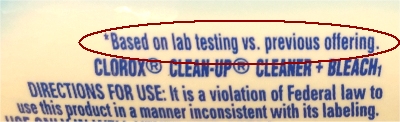
It took a while to find where that asterisked claim was explained, but there it was in tiny print on the back of the bottle.

*MOUSE PRINT:

Clorox fine print

Well that explains everything… NOT. What in the world does that claim mean? Has the product been reformulated so it is 40% stronger than before and thus cleans 40% better?

We asked the company’s PR folks multiple times for an explanation, but they did not respond. Our guess is that the spray nozzle and feeder tube have been redesigned and now 40% more cleaner comes out with every spritz. That’s sort of like making the hole bigger on the toothpaste tube so you’ll use more.

Examples 2 and 3:

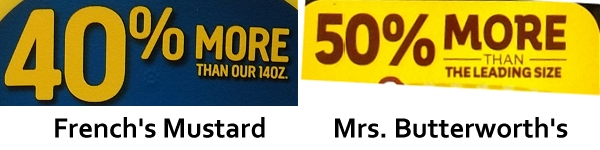
The most common type of “percent more” claim is designed to catch your eye and make you think you are getting a bonus — some extra amount free — because you picked up this particular promotional package.

French's Mustard - Mrs. Butterworth's

When you look more closely at these two bottles, they are not giving you anything extra free. They are merely providing a mathematics lesson.

*MOUSE PRINT:

mustard and syrup disclosures

Both products are just larger size bottles than smaller ones. A 20-ounce bottle is (approx.) 40% more than a 14-ounce bottle, and a 36-ounce is 50% more than 24-ounces. Nothing more. Nothing free.

Share this story:


ADV
Updated every Monday!   Subscribe to free weekly newsletter.

Are CVS Customers Better Than Most at Taking Their Pills?

Prescription adherence, as it is called, is a real problem. About half of prescriptions issued each year are either not filled or the medicine is not taken correctly. (See report.) So if someone has come up with a more effective method to ensure that patients take their drugs properly, that would be good news.

Along these lines, a curious new claim has recently adorned CVS circulars that asserts that “CVS customers are better than most at staying on their prescriptions*.”

CVS better than most

That asterisk goes to a small footnote on the front page of their advertisement.

*MOUSE PRINT:

“Based on 2019 study of national retain chain customer prescription adherence for diabetes, hypertension and hyperlipidemia medications.”

Checking the CVS website for further details, the following is displayed:

CVS better reasons

So, out of curiosity, we asked the CVS PR folks for a copy of the study, who did it and paid for it, how competitors fared, and whether the study explicitly cited the three elements above as reasons for CVS customers’ superior adherence record. The company only responded with this statement:

CVS Pharmacy worked with an independent third-party firm to study data for the top dispensed prescriptions in the U.S. across different pharmacy competitors. That data was used to create a campaign educating our customers on the benefits of filling prescriptions at CVS Pharmacy.

All this seems to say is that CVS paid for the study. We are left guessing as to which competitors did better than CVS, and which did worse. But without seeing the actual study, we simply don’t know if the conclusions that CVS drew are substantiated by it.

Share this story:


ADV