Updated every Monday!   Subscribe to free weekly newsletter.

Is Canada Dry Ginger Ale Made With “Real Ginger”?

Multiple lawsuits recently alleged that Canada Dry ginger ale was not the real thing because it did not contain “real ginger” as the label proclaimed.

Canada dry

*MOUSE PRINT:

ingredients

The ingredients statement says that it contains “natural flavor” but tests done by the plaintiffs indicate that the soda did not contain key components one would normally find in ginger root. Further analysis concluded that it only contained two parts per million of ginger extract.

In the settlements agreed to last month, Canada Dry is still allowed to say “made with real ginger” but only if that statement is modified with words like “flavor” or “extract.”

Examples of permissible label claims: “real ginger taste,” “made with real ginger extract,” “real ginger flavor,” “flavor from real ginger extract,” and “natural ginger flavor.” The Permanent Injunction shall also include court-approved use of “ginger extract,” “natural ginger flavor extract,” “natural ginger extract,” “natural ginger flavor,” or “ginger flavor” in the label ingredient line.

Would you catch those nuances?

Consumers who purchased Canada Dry ginger ale are entitled to modest compensation. Without proof of purchase, you can get 40 cents a can/bottle, up to $5.40. With sales receipts, you can get reimbursed at the same rate for up to 100 units.

After the settlement becomes final, you can file a claim here.

Share this story:


ADV
Updated every Monday!   Subscribe to free weekly newsletter.

Hey, Ghirardelli and Russell Stover, Where’s the Chocolate?

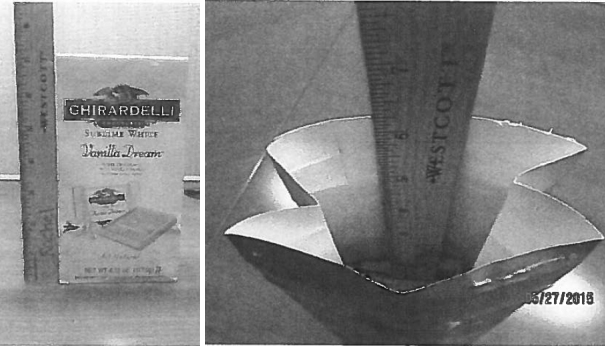
Six California district attorneys filed a complaint last month alleging that Ghirardelli and Russell Stover marketed some boxes and packages of chocolate that were “predominately empty” or that had large empty spaces or false sidewalls.

Readers of Mouse Print* know that this is called “slack fill” — nonfunctional empty space in an opaque product package. Manufacturers understand that consumers purchase products with their eyes. So if they can make the package look bigger, consumers will wrongly assume they are getting more product and thus more value for their money.

In the court case, the DAs alleged that some chocolate boxes had false bottoms, making the package look more filled than it really was.

*MOUSE PRINT:

Whitman's Sampler
Whitman’s Sampler Box with False Bottom

Another example is a bag of Ghirardelli chocolate squares that is full of air and not much chocolate:

*MOUSE PRINT:

Ghirardelli

The bag is seven inches high, but there is five inches of dead space inside.

The owner of both companies quickly entered into a settlement with the DAs and agreed to pay $750,000 in penalties and costs, and change some of their packaging practices.

Hats off to the California DAs who continue to publicly pursue weights and meassures violations for the benefit of everyone. More agencies around the country should step up and do the same.

And they can start with this one…

Lindt

Share this story:


ADV
Updated every Monday!   Subscribe to free weekly newsletter.

Is Supermarket Zone Pricing Ripping You Off?

As a reader of Consumer World and Mouse Print*, you are probably a savvier shopper than most. But did you know that some supermarket chains “zone price?” That means the shelf prices and advertised sale prices at its stores can vary from neighborhood to neighborhood, city to city, or region to region.

While many factors go into pricing decisions by supermarkets like rent and labor costs, the presence or absence of competition nearby is often the key to whether a particular store location has lower prices or not. The more competitive the area, the lower the prices, typically.

One exception, at least in my area just north of Boston, is Aldi. Aldi is a limited assortment supermarket, a fraction of the size of a conventional grocery store. They carry mostly store brands and are priced roughly at about 25% less than conventional supermarket store brands. If you’ve never shopped at Aldi or Lidl (a similar type store), give them a try.

But the Aldi near MrConsumer has significantly higher advertised prices for some items compared to other Aldi stores farther North. This is despite having a Stop & Shop (our largest conventional supermarket) in the same shopping plaza, as well as a Wegmans and two warehouse clubs (BJ’s and Costco) within half a mile, and two deep discount Market Baskets just a bit beyond that.

Here is a portion of this week’s circular for Massachusetts Aldi stores :

Aldi MA chips

But just 24 miles away, in Salem, New Hampshire, those very same items from their Aldi circular are much cheaper:

*MOUSE PRINT:

Aldi NH chips

These New Hampshire prices are half to almost two-thirds less than the Medford, Massachusetts store. While most of the other advertised items are identically priced, these stark price differences can make local shoppers here feel like they are getting ripped off royally.

When MrConsumer raised the zone pricing issue with a top Aldi executive, he offered little hope that anything was about to change here, saying:

“We are always reviewing our prices to ensure we offer our shoppers the lowest prices possible. While ALDI prices do sometimes vary from city to city, we pride ourselves on having the lowest prices in town.”

Well, Aldi, you are not offering us YOUR lowest prices. What do we have to do here in Massachusetts, get a team in the Super Bowl in order to get a good deal on chips?

Share this story:


ADV