Updated every Monday!   Subscribe to free weekly newsletter.

Clorox Splashless Is Also “Disinfectless”

A Missouri consumer is fed up with Clorox brand bleach. She has been waging a three-year long campaign against one of the company’s most popular products that she thinks is being packaged and marketed in a deceptive way. We think she has a point.

There are two primary types of Clorox bleach:

Clorox bleaches

The one on the left is regular Clorox and the one on the right is their “splashless” version. Note how similar the labels are.

According to the company, they came out with a thicker splashless variety because customers complained about the regular type which could inadvertently splatter where it was not intended.

As it turns, that is not the only difference between the two products. Only on the back of the label does the company disclose the following about the splashless product:

*MOUSE PRINT:

Clorox Splashless disclaimer

That’s right, surprise, the splashless version does not disinfect or sanitize. And while certainly many use bleach merely to whiten their laundry others do expect it to sanitize also.

A check of the ingredients statements also reveals a surprise.

*MOUSE PRINT:
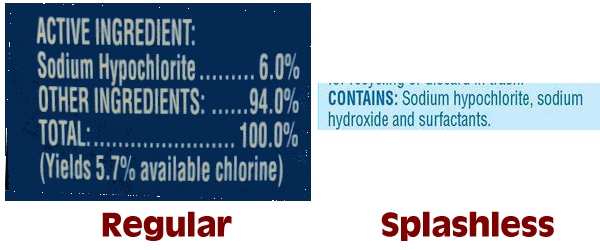
ingredients

While the exact amount of the disinfectant, sodium hypochlorite, is stated on the regular product, it is conspicuously missing on the splashless variety. One might reasonably conclude that there is not enough of the active ingredient in the splashless product to sanitize or disinfect properly.

We asked The Clorox Company why they don’t more conspicuously disclose that the splashless variety does not sanitize or disinfect and why the amount of the primary active ingredient is not disclosed. The company did not respond to our questions by publication time.

Share this story:


ADV
Updated every Monday!   Subscribe to free weekly newsletter.

Slick Olive Oil Label Designed to Deceive

Most shoppers don’t spend a lot of time scrutinizing product labels in the supermarket. And that might be what one manufacturer is counting on.

In what appears to be one of the most deceptive labels ever, this extra virgin olive oil brand seems to be deliberately trying to put one over on consumers.

Iberia full bottle

Only on closer inspection does the true nature of this product reveal itself:

*MOUSE PRINT:

Iberia oil closeup

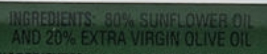
You will have to look closely at this picture taken from the Target website. It reveals in thin black type on a dark green background that the content of the bottle is really “sunflower oil and extra virgin olive oil.” How diluted with sunflower oil is this product?

*MOUSE PRINT:

Iberia ingredients

Look carefully. This product is really only 20% extra virgin olive oil and the rest is sunflower oil.

Now, the front of the product does say “premium blend” but that does not clearly convey the true nature of this product in MrConsumer’s view. One might believe this means, for example, that it is a blend of various extra virgin oils from several regions.

So how does this company get away with a label so seemingly deceptive? No one had gone after them — until last month. A New York law firm just filed a class action lawsuit against the company alleging that its label is violating the deceptive practice consumer protection laws of all 50 states. Among the claims being made is that the product is not delivering the expected health benefits that purchasers expect because it is not 100% olive oil.

Share this story:


ADV
Updated every Monday!   Subscribe to free weekly newsletter.

Official Looking Mailings Continue

This tried and true gimmick is as old as the U.S. mail probably. Send advertising in an envelope masquerading as official mail from a government agency and recipients are more likely to open it. We’ve seen debt collectors and even political candidates utilize this sleazy scheme.

Now comes this official-looking notice about your car:

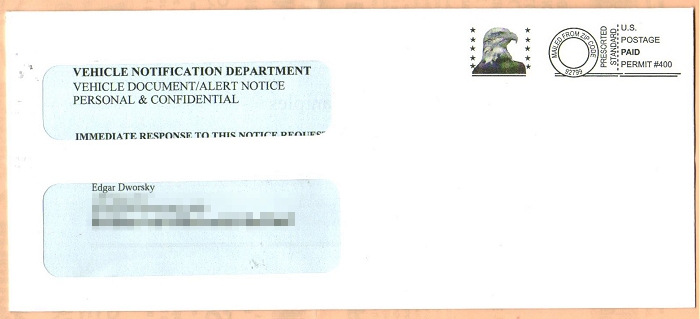
notification envelope

It comes from the “Vehicle Notification Department” in a window envelope that says it is “personal and confidential.” While many people may presume this to be junk mail, some may believe this from the state department of motor vehicles or perhaps is a recall notice from the manufacturer.

Inside, the truth is revealed.

*MOUSE PRINT:

notification letter

Scroll down the letter.

The letter inside looks pretty official and suggests that I have failed to renew my auto service contract or warranty and thus I could lose coverage. Considering that MrConsumer drives a 1996 Honda Accord, it has been decades since that all lapsed, this letter is nothing more than a bull feathers sales pitch.

Only in the smallest print on the page does it state “This is an advertisement to obtain coverage.”

Some people may have had a bit of a fright when seeing the envelope and immediately opened it … just to be fooled.

Share this story:


ADV