We received an email from John S. of Massachusetts last week inquiring about an urgent care center that he goes to and that he has heard advertised on the radio. It is called American Family Care.
The consumer says that while he has gotten good care from a physician’s assistant there, their radio ads tout their great doctors.
Indeed a review of their website reveals repeated claims that they are staffed by physicians (and other medical professionals).

——

There’s no need to make an appointment, you can just walk right in to see a doctor.
The company’s website also claimed that all its doctors are board-certified.
ORIGINAL WEBPAGE

MOUSE PRINT* CHECKS THE CLAIMS
We called 10 Boston area American Family Care locations last week and asked if they always had a doctor on duty. In nine out of 10 locations, they said “no” — not every day, maybe three days a week, it depends on the week, it’s the luck of the draw, today it’s a nurse practitioner, not on Wednesday, etc.
But a funny thing happened just a day after we started asking the company’s chief marketing officer questions about its claims about locations being staffed by board-certified doctors. The webpage where the company talked about its board-certified doctors was changed to read that it had board-certified doctors at “many” of its locations. And it also removed claims that all its doctors were board-certified and that they periodically check to make sure the board-certification is still in effect.
REVISED WEBPAGE
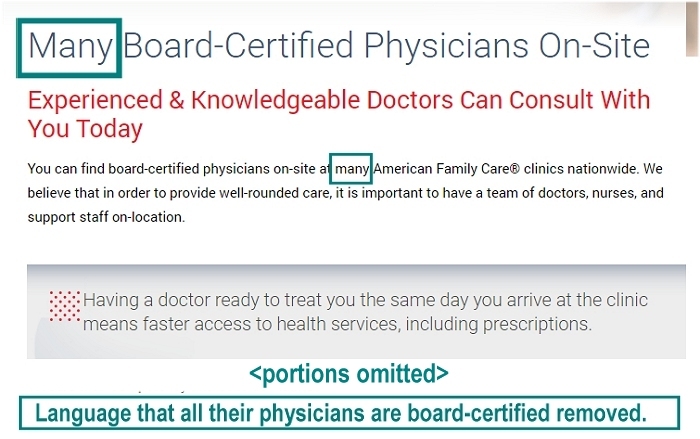
We asked the company to explain why it was representing that patients could see a doctor without an appointment when, at least in the Boston area for the locations checked, it was a hit or miss affair at the time. (Staffing levels may differ in other parts of the country.) We also wanted to listen to or get a transcript of the radio commercial the company was running to see what they were claiming about their doctors. The company never answered our questions nor provided the commercial despite three requests.
One last thing. Not every patient and not every medical issue requires the attention of a doctor. Other health professionals are well-equipped to handle many routine medical problems. The point, however, is that if a company tries to distinguish itself as being staffed with doctors, that is whom patients should reasonably be able to see if they so choose when they visit.
Do you know who’s treating you when you go to an urgent care center? Is it a doctor, a physician’s assistant, a nurse, or some other type of clinician? You have a right to know. Ask!