Updated every Monday!   Subscribe to free weekly newsletter.

FDA to Manufacturer: If You Make a Product with Love, Don’t Advertise It

Some federal agencies have been subjected to criticism lately that they are not policing the marketplace as much as they did in the past to protect consumers. For example, Bloomberg reported two weeks ago that the Food and Drug Administration was sending 30 percent fewer warning letters to companies about serious health and safety violations than they did every year since 2008.

Now comes news that in September, the FDA sent a warning letter to Nashoba Brook Bakery in Massachusetts alleging serious violations discovered when it spent three days inspecting their manufacturing facility.

FDA warning letter

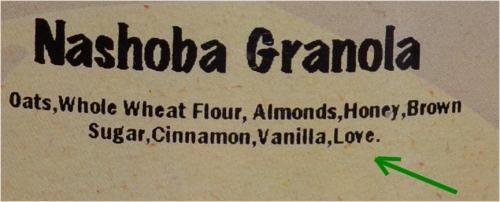
Besides citing instances of unsanitary conditions that inspectors discovered, it noted a serious labeling violation on packages of Nashoba Granola.

Nashoba granola

*MOUSE PRINT:

Love ingredient

Love ingredient

Yes, dear friends, Nashoba Brook Bakery was charged with selling misbranded products because they creatively made their granola with “love” and included that on the label.

John Gates, the CEO of the bakery, explained to Mouse Print* that while they will remedy the sanitary deficiencies cited by the FDA, “we will continue to put care, attention, passion and LOVE at the center of what we do. That’s who we are and who we want to be.”

We say the FDA should concentrate on real health and safety violations like the other findings in their letter. But, have a little heart (and common sense) when it comes to unofficial ingredients like love.

Share this story:


ADV
Updated every Monday!   Subscribe to free weekly newsletter.

T-Mobile Advertises: Ditch Verizon, Keep Your Phone ???

Over the past few months, T-Mobile has been advertising that you can bring your Verizon cellphone to T-Mobile if you switch to them. Here’s one commercial with the offer:

If you know anything about how cellphones transmit your calls and data, their offer might sound impossible because the two companies use two different and incompatible technologies to accomplish those tasks. Verizon uses CDMA and T-Mobile relies on GSM radio waves to work.

So how can T-Mobile make this claim?

*MOUSE PRINT:

Ditch Verizon, Keep Your Phone

Certain phones are dual-network capable. They have both technologies built-in so they can work on either network. But the number of Verizon-branded phones that can be brought from that CDMA provider to a GSM provider is very limited — Google Pixel and iPhone 6S or newer only — as noted in the fine print of the T-Mobile ad.

Apple iPhones account for only about one-third of the market and newer models can be used on both Verizon and T-Mobile. But market-leading Android phones generally cannot. AT&T phones, incidentally, are generally interchangeable with T-Mobile phones because they are both on the GSM system.

So, if you think you can take your old Verizon phone to T-Mobile, chances are you cannot.

Share this story:


ADV
Updated every Monday!   Subscribe to free weekly newsletter.

LifeLock Capitalizing on Equifax Breach, But Has a Secret!

LifeLock, which for years has touted its identity theft services, is doing big business in the wake of the Equifax data breach. And they are not shy about capitalizing on Equifax’s woes.

Lifelock

But as first reported by the L.A. Times, LifeLock has a little secret buried in its terms and conditions:

“You consent and authorize LifeLock and its Service Providers, including but not limited to Equifax, to access your personal credit information in order to (i) confirm your identity, (ii) display your credit data to you related to your use and enjoyment of the product and (iii) provide your Equifax credit data to LifeLock so that LifeLock may create and deliver to you, certain fraud alert products.” [color added for emphasis]

That’s right, LifeLock buys some of its services from Equifax, the very company that had a breach that LifeLock’s protection services are trying to alert you about.

The L.A. Times story also notes that LifeLock may share personal information with Equifax including information not normally found in Equifax’s files such as your driver’s license number, passport number, and your email address.

Share this story:


ADV