Updated every Monday!   Subscribe to free weekly newsletter.

Fake News Fakes Out Bing’s News Search

MrConsumer searches through thousands of news stories each week to find the two or three dozen best ones to feature in Consumer World. To do this, he uses targeted searches of Google news and Bing news everyday. Unlike the regular searches of Google and Bing, the news section only is supposed to list news stories from a core list of news and information sites.

Of late, however, Bing’s news search results have surprisingly been infected with listings for websites pitching fake news about, or the outright sale of illegal or counterfeit prescription drugs and other questionable potions or pills.

In a search for the keywords “consumer” or “scam” recently, Bing news presented about 20 results, half of which were not legitimate news stories (which we highlighted in green).

*MOUSE PRINT: (Use scrollbar below on the right to view.)

Bing news search


Note: Bing news results do NOT include paid advertisements or “sponsored results” as you might find elsewhere. The “stories” with green borders somehow tricked Bing’s algorithm into thinking these were legitimate news stories from legitimate news websites.

We alerted Microsoft’s technical support folks at Bing of the problem, including providing a screen capture. What ensued was an insane and inane series of nearly a dozen emails over a two week period. First they claimed they could not duplicate the problem. Then they asked for the search terms used (already provided) and a screen capture of the bad results (already provided). Then they wanted screen captures of each website that was listed improperly. (Do you own f*ing site screen captures I muttered to myself.) Then they wanted a list of all offending URLs. Oh, yes, I will find all the bad websites online that could come up in searches and send them to Microsoft. Nonetheless, we provided a list of about three dozen websites that kept offending. Their official response: they removed ONE URL.

I repeatedly suggested that something was wrong with their algorithm that was failing to filter out obvious scam sites that had nothing to do with legitimate news stories.

In desperation, we finally wrote to Microsoft’s PR firm, asking why Bing’s technical folks were seemingly doing little to weed out these fraudulent sites despite repeated complaints, and what the company was going to do to protect readers. Their response — silence. Nothing. Zilch.

In the past week, however, most of the bad listings have mysteriously been removed, but the problem may not be fully resolved yet.
Share this story:


ADV
Updated every Monday!   Subscribe to free weekly newsletter.

Movie Candy — More Box Than Candy

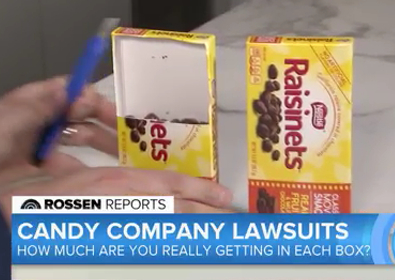
Have you seen the price of movie candy lately? In Boston, AMC Theatres charges $3.99 to $4.49 for a box with just 3.5 to 5.5 ounces of candy inside. Yikes.

These boxes have come under scrutiny lately because of several class action lawsuits against major manufacturers. Shoppers allege they were misled by the packaging which makes it look like there is a lot of candy in the box, but in reality, most are only about half full.

Here is a story about it by Jeff Rossen, NBC’s investigative reporter on the Today Show (with MrConsumer at the end).

Rossen Reports Movie Candy
Click to watch video

When manufacturers over-package a product creating empty space inside that has no function other than to make consumers think they are getting more for their money than they really are, that is called slack fill, and it’s illegal under federal law (and the law of some states). It is not illegal if the empty space is needed because of settling of the product, or because the machinery to fill the package requires it, or the space is needed to protect the product (such as the cushioning pillow created by large potato chips bags).

Here’s another example not part of a lawsuit. This is a huge box of Bazooka bubble gum — maybe six or seven inches long and over an inch thick. Sure looks like it has a lot of gum inside.

Bazooka

But when you stack up the contents, you get much less than meets the eye given the size of the box.

*MOUSE PRINT:

Bazooka contents

Although the net weight is on the package, and fine print on the back says there are “about 19” pieces inside (there were 18 in this box), the FDA and courts have ruled that having the net weight on the package is an independent requirement separate from the requirement not to use deceptive packaging.

Share this story:


ADV
Updated every Monday!   Subscribe to free weekly newsletter.

Staples Charges for Staples!

MrConsumer is not fortunate enough to have a copy machine, so whenever he needs copies, he goes to his local Staples store. They have self-service machines where copies are now 12 cents each. Whatever happened to three-cent copies?

As most users of copy machines know, you have to select the number of copies, whether you want the machine to collate multi-page documents, staple them, etc. Choosing all those options, MrConsumer was surprised to learn that a new charge was placed on his bill.

*MOUSE PRINT:

Staples receipt

For my six-page document that I made three copies of, I was charged six cents for three staples — two cents apiece. Traditionally there was never an extra charge if you wanted your copies stapled at these machines. And yes, there was a manual stapler nearby that I could have used instead. And yes, the two-cent charge was disclosed on the copy machine payment screen for the job.

But the cost of a staple is so minimal that it baffles MrConsumer why any company would charge extra for one — and comparatively, a lot extra. At retail, Staples sells boxes of 25,000 staples for $6.79 — or 0.0002716 each. Put another way, Staples is charging customers at least 74 times its cost per staple.

We asked the company why it was doing this, and whether they thought this was a bit excessive. A Staples media representative responded:

Staples has recently rolled out new and improved self-service copy machines that are focused on ease of use and convenience, and provide a range of services that were not easily available before – scanning, printing from email and the cloud, stapling and faxing. This allows the customer to pick and choose how they want to print something, best fitted to their needs, with add on services such as stapling for a nominal fee, similar to other retailers.

Alternatively, customers can collate and staple their documents themselves free of charge. There are always staplers available and free to use on the counters near the copy & print area.

Here’s my two-cents-worth: I’m sorry, sometimes companies go too far in their penny-pinching practices.

Share this story:


ADV