Updated every Monday!   Subscribe to free weekly newsletter.

Don’t Give Companies a Free Pass for Tricky Ads

 MrConsumer has been a consumer advocate for over 35 years, and he is always astounded by the number of sneaky (and potentially illegal) practices that not only companies will use, but that shoppers will put up with, or even defend.

The comments on this blog are often a reflection of that attitude, and I find that troubling. It suggests that consumer advocates have not educated the public enough about what are acceptable practices and which ones cross the line.

Some consumers and too many businesses think that as long as they make a disclosure or disclaimer SOMEWHERE that that is all that is necessary.

The Staples story we brought you last week is a perfect example. It is not okay to run an advertisement for goods at a stated sale price but fail to mention IN THE AD that you have to buy other goods totaling $50 in order to get the goods at the advertised price. Too many commenters and the company itself thought it was enough just to let shoppers know before they checked out that there was a catch in the offer.

thumb dirve

That is not what the law says in Massachusetts (and probably in some other states). One of the primary principles in consumer law is the requirement of disclosing key facts upfront. What needs to be “clearly and conspicuously” disclosed? Anything that might mislead the prospective purchaser or induce him or her not to enter into the transaction.

“It is an unfair or deceptive act for a seller to fail to clearly and conspicuously disclose in any advertisement any material representation, the omission of which would have the tendency or capacity to mislead reasonable buyers or prospective buyers.”

“A disclosure is not clear and conspicuous if any material terms of the offer that affect the price of an item, impose conditions on acceptance of the offer, … are not disclosed in the advertisement itself…”

“Even though the true facts are subsequently made known to the buyer, the law is violated if the first contact … is secured by deception.”

Here are some examples of specific requirements of the law (at least in MA), and how they might apply to various advertising practices.

Example 1:

Under the law, important disclosures must be “clear and conspicuous.”

“Clear and conspicuous … means that the material representation being disclosed is of such size, color, contrast or audibility and is so presented as to be readily noticed and understood by a reasonable person to whom it is being disclosed.”

*MOUSE PRINT:

Proactiv

Is it clearly disclosed that by ordering ProActiv for $19.95 that you will also be signing up for regular monthly deliveries of the product? Is the average TV viewer likely to have even noticed that small disclosure for the few seconds it was on the screen?

Example 2:

“Clear and Conspicuous, is not clear and conspicuous unless such material representation … appears in type which is a minimum of eight point type;”

*MOUSE PRINT:

fine print

Burying key information in a fine print footnote is frowned upon. The above footnoted disclosures (note: the type size above may appear larger on your computer screen than it actually is) are actually part of a single paragraph where each line is 20 inches long, spanning two pages in a multi-page circular. The type size is five point type, not the minimum of eight point type required assuming there is something important in this footnote that is required to be clearly and conspicuously disclosed. Few if any human beings can read straight across a densely packed 20-inch line of type, with about 90 words per line, line after line, to understand what is trying to be conveyed. This is a perfect example of the belief that as long as a disclosure is made, no matter how or where placed, that that is sufficient.

Example 3:

A disclaimer can’t be used to change the meaning of the original claim.

“It shall be an unfair or deceptive act or practice for a seller to use a disclosure set apart from the primary claim to which it refers, such as by use of an asterisked footnote, if such disclosure imparts a meaning that contradicts or materially alters the meaning of the term, statement or claim to which it refers.”

*MOUSE PRINT:
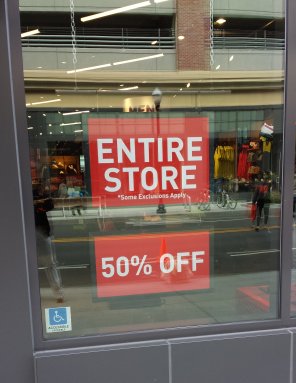
entire store 50%

You’re across the street from this store and you see that everything in the store is half price. But as you walk closer, you see the disclaimer that certain items are excluded. Did you lose anything other than a few seconds, no. But stores can’t try to lure you in with a false claim, even if the truth is made known in an asterisked disclosure. The sale claim should have been worded to be true on its face.

The bottom line is this: you are entitled to full and clear disclosure upfront in advertising. Don’t settle for less. And don’t give advertisers a free pass when they fail to do this.

Share this story:


ADV
Updated every Monday!   Subscribe to free weekly newsletter.

Oh, Did We Forget to Say You Need a $50 Minimum Purchase?

  In the last few weeks, Staples.com appears to have begun misleading customers about the price of some of its back to school sale items. Here is one of their recent advertisements:

Staples ad

When one clicks on that thumbdrive, for example, it takes you to a page like this:

lexar thumbdrive

Wow, you think it must be your lucky day, it is actually only $7 instead of $8. You are promised “instant savings” of $12.99, so you add it to your cart.

Upon going to your cart to check out, you get a nasty surprise.

*MOUSE PRINT:

Staples cart

The price is almost three times what you expected. Why? It says you didn’t make the required $50 purchase. What $50 purchase? If you look carefully at the middle graphic above, you will see a box that states that the thumbdrive “special buy” only applies with a minimum $50 purchase. Where did that come from? It wasn’t in the original ad!

Similarly, the other paper items in the ad above are more expensive without the $50 purchase, as are a few others on its website.

That’s not all. Let’s say you had not seen the ad, but had just gone to Staples.com looking for a 16-gig Lexar thumbdrive. You search for it and find this product listing in the search results.

*MOUSE PRINT:

Lexar 3

You were even smart enough to click the “see details” link, and you’re told the item is $7 and there is no mention of any required $50 minimum purchase. So, you add it to your cart. And just as above, when you go to checkout, you will see that you are being charged $19.99, the full regular price, because you did not make a $50 minimum purchase that you were never told was required.

In our view, this practice is reprehensible, if done deliberately. We can only hope it was a careless oversight on Staples’ part.

Under Massachusetts law, sellers are responsible for clearly and conspicuously disclosing all material facts in their advertising the omission of which might mislead a consumer. “A disclosure is not clear and conspicuous if any material terms of the offer that affect the price of an item, impose conditions on acceptance of the offer, … are not disclosed in the advertisement itself, but require reference to an outside source..”.

It is certainly misleading in our view to fail to disclose upfront that a particular sale price only applies when a $50 minimum purchase of other goods is required.

We asked the company to explain why they created these misleading price representations and whether they would automatically refund money to customers who bought these items and unknowingly paid full price during the sale period.

Staples’ senior PR manager responded late yesterday:

“Staples works hard to ensure our customers have the information they need to make informed purchasing decisions. In the examples provided, the terms and conditions of our Less List offers were clearly displayed prior to the customer checking out.”

Staples indicated that it might update its comment today, so please check back here later today.

Share this story:


ADV
Updated every Monday!   Subscribe to free weekly newsletter.

Honestly, Could They Make the Disclosure Any Smaller?

 While watching TV the other night, MrConsumer saw a tiny disclosure at the end of a baby products commercial for The Honest Company. (That’s really their name.) It went by so quickly, and was so small and faint in color, it was very hard to read:

The Honest Company
Click ad to see commercial.

Here is what it says about their “free” trial.

*MOUSE PRINT:

*Only $5.95 for shipping and handling. You’ll be automatically enrolled in our monthly service. Cancel the service at anytime.

Their website gives more details.

*MOUSE PRINT:

*With your Discovery Kit, you’ll be enrolled as a member of The Honest Company. You have 7 days following receipt of your Discovery Kit to cancel your membership at any time, for any reason. We will remind you about your membership options. If you choose to not cancel, you’ll be charged $79.95 /month for the Diapers & Wipes Bundle, $35.95/month for the Essentials Bundle, or $39.95/month for your Health & Wellness Bundle (plus shipping & handling).

Basically, this company founded by actress Jessica Alba offers (among other things) a book-of-the-month-type service for baby supplies, shampoo and detergent, and vitamins. You will keep getting automatic deliveries every month, starting after seven days following receipt of your samples unless you cancel.

While their website makes clear that this is a monthly plan with monthly charges for these packages of goods, why do their TV commercials hide that fact particularly when they call themselves The Honest Company? Their television ad also seems to run counter to what their statement of principles claims:

Create a Culture of Honesty

We are serious about honesty – both as it applies to the integrity of our relationships and in being true to you. And, it’s a standard we encourage throughout our staff, stakeholders, and customers. But, that’s just the beginning. In all we do, we want to make each day a little more fulfilling, inspired, and downright better.

Mouse Print* asked the company twice to comment about their use of such a small disclosure and on this seeming contradiction of their corporate philosophy. We are still waiting for their response and will post it here… honestly.

Share this story:


ADV