Updated every Monday!   Subscribe to free weekly newsletter.

Extreme Couponing Backlash: Manufacturers, Stores Limit Coupon Use

If you have ever watched “Extreme Couponing” on TV, you know that shoppers on the program demonstrate how they received hundreds if not thousands of dollars worth of merchandise for only a few dollars (if that) by using coupons. They will buy dozens of the same item, using dozens of identical high value coupons (often doubled in value by the store) to accomplish this feat.

Now some manufacturers and retailers are fighting back. Look what P&G is now printing on its manufacturers coupons.

*MOUSE PRINT:
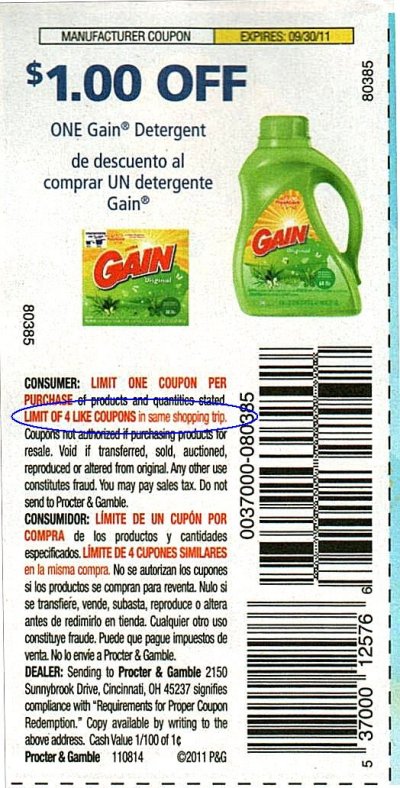
Here the manufacturer is imposing a limit of four identical coupons that can be used when buying the same product. But now some retailers are getting in on the action too.

*MOUSE PRINT:

“Rite Aid may accept up to 4 identical coupons for the same number of qualifying items as long as there is sufficient stock to satisfy other customers within the store manager’s sole discretion.” – Rite Aid Coupon Acceptance Policy, May 2011

“You may double a maximum of 4 identical manufacturers’ coupons. For example: if a customer purchased five boxes of Cheerios and presented 5 manufacturers’ coupons for 50¢, the first four coupons would be doubled to $1. The fifth coupon would only be redeemed for 50¢. Up to an additional 12 identical manufacturers’ coupons/items will be redeemed at face value for a total of 16 identical manufacturers’ coupons.” — Stop & Shop and Giant coupon acceptance policy.

If these practices are actually enforced, and other companies jump on the bandwagon, extreme couponing may become a thing of the past.

Share this story:


ADV
Updated every Monday!   Subscribe to free weekly newsletter.

The Limits of T-Mobile’s “Unlimited” Plan + Surprise Charges

The word “unlimited” is probably the most abused word in the English language when it comes to the marketing of telecommunications and Internet services. Some companies claim “unlimited” calling, when in fact there are limits. Others claim “unlimited” Internet useage, when in fact there are limits.

The latest example of an “unlimited” claim comes from T-Mobile. They are offering a family plan with “unlimited” data, talk, and text for only $49.99 per line, when you get two lines. Here is part of their TV ad:

Unfortunately for TV viewers, the fine print is virtually unreadable because of the busy background over which it appears.

*MOUSE PRINT:

“Includes 2GB of full speed data. After 2 gigabytes speeds reduced up to 2G speeds.”

In essence, the company is saying they won’t cut off your data connection or charge you more if you exceed two gigs of downloading during a month, but they will make the experience unpleasantly slow (“throttling”) beyond that. They have placed a limit on the amount of data delivered at 4G speed you can have. Period.

Too bad they are not a little more upfront about the limit because the $49.99 price is one of the best deals out there for 4G service (even with the limit)… except for one thing:

*MOUSE PRINT:

As noted by Michael L., our first commenter, if you don’t already have a T-Mobile phone, you have to buy one from them at the full, unsubsidized price. That could mean spending as much as $500 for the fanciest phones. A T-Mobile salesperson told Mouse Print* that they spread the cost of over 20 months after making a down payment. The fact that you have to buy a full price phone is not disclosed anywhere in the company’s television advertising, and you have to dig into their website to learn the catch.

Share this story:


ADV
Updated every Monday!   Subscribe to free weekly newsletter.

Bucking the Trend, This Company Upsized its Products

Since Mouse Print* began in 2006, we have featured product after product that has been downsized. Manufacturers remove an ounce here and there, and for paper products, they shave off fractions of an inch in width or length, or reduce the number of sheets provided.

Now comes Ken’s Steak House salad dressing. Looking at the picture on the left, the bottle on the left appears bigger than the one on the right, and one might conclude that they too have just downsized. Surprise, the opposite is true.

*MOUSE PRINT:

Ken’s actually added an ounce of dressing to their traditional eight ounce bottle when they made the switch from glass to plastic bottles. This was a deliberate move by this family-run company to buck the downsizing trend.

Too bad they missed the opportunity to tout the fact on the bottle that they are now giving the consumer more at the same old price. (They had limited space, and couldn’t figure out how to best communicate that fact according to a spokesperson for the company.) In the comments below, feel free to offer your suggestions.

Share this story:


ADV