Updated every Monday!   Subscribe to free weekly newsletter.

Who Knew Cookies Could be Nutritious?

Last week a commercial for a new product Whonu? cookies began airing nationally. It basically contends that its cookies are a healthy choice for consumers.

On their website, but a little less so in the commercial, the company makes an array of nutrition claims comparing itself not only to oatmeal and milk, but also to the vitamins in blueberries, spinach, carrot juice, tomato juice, cottage cheese, and fruit:


*MOUSE PRINT: Those little asterisks lead to a fine print disclosure on the website, and a similar one in the TV commercial, which is visible for only three seconds:

So, you have to eat three cookies to get the nutrition they claim. However, when looking at the nutrition label for their Oreo-like cookies, one discovers that it contains only three grams of fiber, not four, as one would find in a serving of Quaker Old Fashioned Oats. And all the other vitamins and minerals are mostly in the 10% range (with a few up to 30%) of one’s daily requirement.

The bigger problem in our view is not quibbling over the claims referring to one cookie or three cookies, or the amount of fiber. Rather, it would be an unfortunate result to have people think they could eat these cookies as a substitute for all the healthy foods they compared them to, which obviously, as a whole, provide much more nutrition than these vitamin-spiked snacks.


Share this story:


ADV
Updated every Monday!   Subscribe to free weekly newsletter.

Where’s the Juice?

At a recent consumer meeting where breakfast was served, the only orange juice offered were bottles of an orange/mango combination from Nantucket Nectars.

MrConsumer noticed a number of other attendees and consumer advocates grabbing this drink, which was also labeled “all natural”. Upon closer inspection, the label contained several inconspicuous surprises:

*MOUSE PRINT:

The words “juice cocktail” are in tiny, tiny print on the front lower left of the bottle, and the fact the product only contains 20% juice is on the back. Using the terms “all natural” and “nectar” may also lead many people to conclude this is a 100% juice product.

In fact, the first two ingredients listed on the back of the label are water and sugar, and indeed they are “all natural”. Just how much sugar is in each bottle? An unbelievable 66 grams — which is roughly equivalent to over 16 teaspoons of sugar!

How sweet (and healthy) it isn’t. Many “juices” on the market are not pure juice, but this one seemed particularly surprising.

Under federal law, if a product is not 100% juice, it must be called “juice drink, juice cocktail or juice beverage.” There appears to be no minimum type size requirement for those terms in most cases.

Share this story:


ADV
Updated every Monday!   Subscribe to free weekly newsletter.

Is a 15% Discount Worth the Loss of Your Privacy?

X-10, a seller of electronic gizmos, offers customers a 15% discount if you “like” them on Facebook.

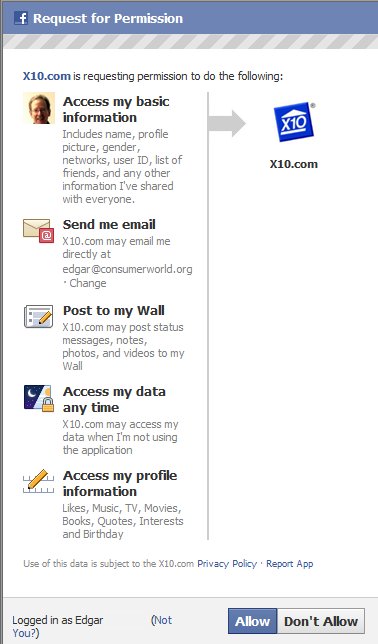
Once you click the “like” button, a pop-up is revealed indicating what X-10 wants in return for giving you a 15% discount:

*MOUSE PRINT:

So, if you click “allow”, you are agreeing to give them your name, username, picture, list of friends, access to all your profile information, along with permission to write on your Facebook wall, send you junk mail, and review your data even when you are not online.

Seems like a pretty serious invasion of privacy for a lousy 15% off. I say, no deal.

Share this story:


ADV