Updated every Monday!   Subscribe to free weekly newsletter.

You Can’t Judge a Cereal by its Cover

An alert consumer recently called into a radio program wondering why the Post Raisin Bran he bought at Costco tasted so different from the Post Raisin Bran purchased at a conventional supermarket. Was Post making a cheaper version of its Raisin Bran to sell at the discount warehouse he wondered?

Here’s the scoop, so to speak.

The product on the left is the latest version carried in supermarkets, while the one on the right is available only at Costco. You’ll note at the top of the box on the right is the Costco store brand “Kirkland”. A look at the ingredients labels sheds light on what’s going on here.

*MOUSE PRINT:

The recipes look nothing alike. A notable difference is that the Costco version might have more raisins since it is listed first in the ingredients list, while the original Post version has wheat flour first. If in fact it has more raisins that would make it more expensive, not cheaper.

*MOUSE PRINT:

With respect to nutrition, they both contain 190 calories a cup, but Post contains over double the salt, and a little more fiber and sugar. Costco has a bit more fat. Each brand has a different array of vitamins and percentages.

So what is the story behind the story here? According to a customer service representative at Post, Costco asked Post to develop a recipe for a private brand of raisin bran to be sold under the joint Kirkland/Post label. The Kirkland version uses different raisins and different flakes. The product is not manufactured by Post for Costco, according to the representative. He could not speak to the economics behind the two recipes.

So that solves the mystery of the tale of two raisin brans.

Share this story:


ADV
Updated every Monday!   Subscribe to free weekly newsletter.

Dentyne Pure: Endorsed by Whom?

Dentyne has just begun an advertising campaign for its new gum called Dentyne Pure. It claims to be the only gum that is “able to neutralize — not mask — the odors that cause bad breath.”

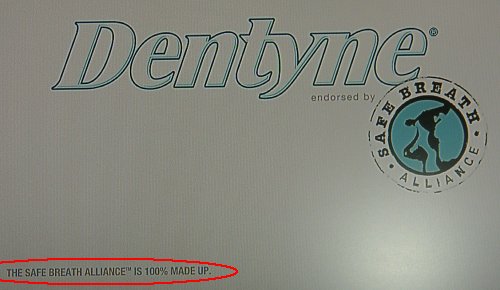
They also advertise on TV and on their website that they have even received an important endorsement:

The endorsement comes from “The Safe Breath Alliance”. The “what”, you may ask? Is there really an association dedicated to fighting bad breath?

*MOUSE PRINT — From their television commercial:

Sounds like the new Dentyne gum will not only sweeten your breath, but also comes with an April Fool’s joke in its advertising. (We just don’t know if the FTC is laughing or not, however.)

Share this story:


ADV
Updated every Monday!   Subscribe to free weekly newsletter.

When a Lightbulb’s Promised Life is Unrealistic

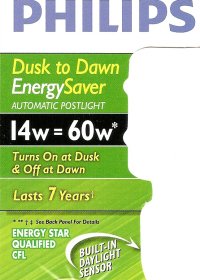
Philips manufacturers compact fluorescent lightbulbs some of which come with a very generous warranty and a promise of a long life. Mouse Print* reader Chet M. sent us the packaging on one such bulb with a seven year life expectancy that he thought was misleading.

That little dagger symbol leads to a tiny disclosure on the back of the package.

*MOUSE PRINT:

The problem with basing this bulb’s life on only three hours of use daily is that this is a special purpose bulb, with a built-in light sensor.  It is meant to go on automatically when it gets dark, and then turn off at daybreak. In most parts in the world, the night is always longer than three hours.   Typically, it might be nine hours or longer, meaning the actual life of the bulb might be just over two years — not the seven promised.

Mouse Print* brought this issue to the attention of Philips.  A senior manager of the lighting division replied:

“The company was by no means trying to be misleading, just following accepted industry practices, and as soon as we were made aware the issue, we quickly updated the packaging.  Philips stands by its products and services and we take all consumer inquiries/feedback seriously, using it as an opportunity to improve our offerings.”

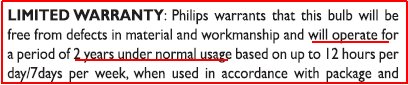
True to their word, the company sent us a picture of their new package which removed the seven year claim on the front, and incorporated into their warranty that under normal usage, the bulb was guaranteed to last for two years.

In this instance, Philips is a shining example of a company fixing a legitimate consumer issue in record time.  We salute them.

Share this story:


ADV