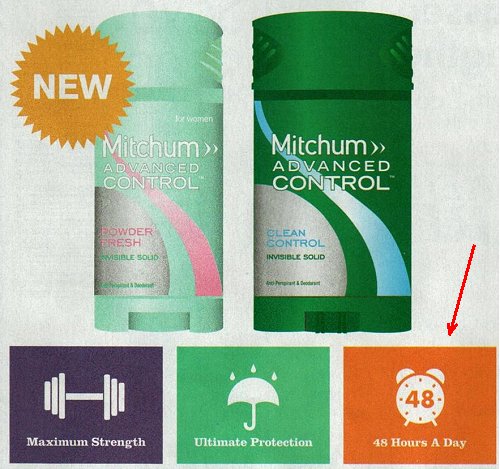
How long does your deodorant/anti-perspirant last before you begin to sweat? Five minutes? Two hours? Twenty-four hours?
Unilever, the maker of Dove Men + Care, claims on its website that its products last 48 hours!

Wow… two whole days. This must have an industrial-strength anti-perspirant in it.
Coincidentally, MrConsumer received a free sample of Dove for men just two days earlier, and it was marked “24 Hour” protection on it. Had they already improved the product since sending out the sample? Nah. Did they come up with 48 hours by adding together 24 hours for the left armpit and 24 hours for the right? Let’s hope not.
A trip to the drugstore surely would clear up the confusion. So MrConsumer applied the sample product, and off to CVS he walked.
*MOUSE PRINT:

There they were, the 24-hour version and 48-hour version, side by side, same UPC code, and same price. Maybe the back of the product would provide answers.
*MOUSE PRINT:

Did the new one have twice the anti-perspirant? Nope. It had the exact same amount. And the rest of the ingredients were identical too.
So how in the world can a company all of sudden claim that its deodorant lasts twice as long as before — an unrealistic sounding 48 hours — when no apparent changes have been made to it? Mouse Print* asked Unilever and their PR firm.
1. How do you justify claiming the new Men + Care antiperspirants and deodorants now offer 48 hour protection, without adding any additional active ingredient or changing the formula, particularly when competitors’ products with 30% MORE of the same active ingredient (19%) only claim 24 hour protection?
“Our Dove Men + Care deodorant and anti-perspirant products are tough on sweat, not on skin and we are proud to be able make the claim that they offer 48-hour protection. The foundation of our success is built on consumer insight and world class innovation and our specific formulas have been clinically tested following FDA guidelines yielding results that show they are able to provide 48-hours of protection. We stand behind our product claims and are unable to comment on our competitors. ”
2. Why did you change the claim to 48 hours?
“In December 2010, we launched Dove Men + Care Deodorants and Antiperspirants with a 24-hour protection claim on pack and a 48 hour protection claim pending. In February 2011 we received approval of the 48 hour protection claim against odor and wetness and have changed the claim language on all of our packaging to communicate this new level of protection.” — Unilever spokesperson, Unilever Research & Development, Deodorants.
You can judge how well the company responded to the questions posed versus how much spin they provided. Without going into great additional detail, the PR spokesperson admitted in a phone call that the product had not changed at all, and that is was not the FDA who gave them the “approval” of the 48 hour claim.
The FDA does in fact publish guidelines on how to test the effectiveness of antiperspirant products. While the particular procedures are suggested rather than required, the relevant section of the guidelines provides that for extra efficacy products for claims of enhanced duration:
The test will demonstrate that, with high probability, at least 50 percent of the target population will obtain a sweat reduction of at least 30 percent.
Mouse Print* had asked the company a third question — whether a majority of the men testing the product agreed that it lasted 48 hours — but the company did not respond to that in its email.
Back at CVS, MrConsumer became very excited having found that some products on display were marked 24 hours, while others were marked 48 hours, but the ingredients were identical. He rushed home, walking briskly, but his armpits began to drip with sweat, not two hours after application of the sample stick he had received. So much for the anti-wetness claims, he thought.
And as to its deodorizing efficacy, nothing on the label indicates this product is effective at covering up the fishy smell of its own advertising claims.