Updated every Monday!   Subscribe to free weekly newsletter.

Just $19.99 — “Don’t Let the [Low] Price Fool You”

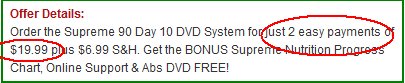
January is the time when many people resolve to lose some of the holiday pounds, and get back in shape. Mouse Print* reader Ronald O. saw a commercial offering a cheap solution –  a set of workout DVDs for “just $19.99”.

The announcer said this is a set of 10 DVDs for “just $19.99” … “but don’t the price fool you.”

When our consumer checked the order form online, he got a big surprise.

*MOUSE PRINT:

Sure, it is $19.99 … times two!

In some spots of the website it says the price is $19.99, and in other spots it says the price is “two easy payments of $19.99.”

When the company was asked the question… so what’s the real price… they said $19.99 plus $6.99 shipping. And several days after this call was made, the website appeared to drop the “two easy payments” language.

You can decide whether to exercise your right to deal with these people or not.

Share this story:


ADV
Updated every Monday!   Subscribe to free weekly newsletter.

Supermarket Surprise: The Price You See is Not the Price You Pay

We are used to seeing airline ads that promise a roundtrip fare of say, $199, but have come to understand (unfortunately) that we really don’t pay $199. Rather, we are charged some higher price like $249 after all fees and taxes are added on. Rental car firms are also guilty of advertising an artificially low price that is boosted significantly by junk fees and taxes. And let’s not forget your cable, Internet and telephone bills — you never pay the advertised $99 triple play package price.

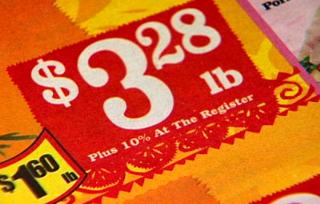
Can you image if other types of sellers, like retailers, did that too? Stop imagining. A couple of years ago, a midwest supermarket chain that caters to a primarily Hispanic audience did just that. They advertised one price on the shelf, but customers had to pay a higher price at cash register!

*MOUSE PRINT:

Huh? Pay 10% more than the advertised price? The company called this “shelf plus pricing”. Sometime after introducing this concept, the chain became the subject of a local TV news exposé. The store made all the usual arguments: our advertising and pricing is clear, customers are not being deceived, etc.

What a crock.

They did eventually drop the surcharge.

Avanza is owned by the Nash Finch Company. Like many companies, they subscribe to set a corporate values, the first one of which says:

Integrity:
We are honest and open with one another and with our customers.

UPDATE: Mouse Print* reader Bryan A. says a supermarket in his area uses the same technique of adding a 10% surcharge. Here is a sample ad from Food Depot (“a new way to save”).

Share this story:


ADV
Updated every Monday!   Subscribe to free weekly newsletter.

90% Off Groceries at Amazon? Ho, Ho, No!

[Note: the next Mouse Print* posting will be January 3.]

MrConsumer recently came across a website that helps people find deeply discounted items on Amazon. What a great idea.

When checking what items in Amazon’s grocery department were supposedly 90% off, Mouse Print* found some startling savings claims.
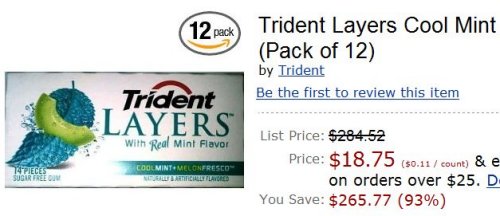
They claim savings of 93%, yet they are still charging over $1.50 for each regular size pack of gum. How is that possible?

*MOUSE PRINT:

Amazon claims the list price for those 12 packs of gum is a whopping $284.52 — that’s $23.71 for a single package! Was this gum previously chewed by Elvis, thus accounting for its premium price? The full price for one pack of Trident Layers is $1.49 (at Kmart), so 12 packs should be about $17.88 full price, not almost $285. Clearly something is not right here. Is this an isolated incident? Unfortunately no. Item after item listed in the 90% off section had grossly exaggerated list prices that bear no relation to real world regular prices.

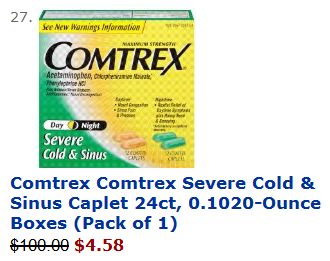
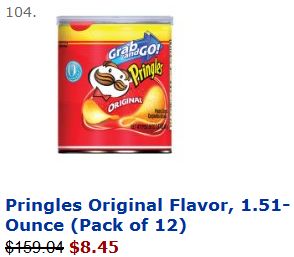
Twelve packages of gummy bears marked right on the package “2 for $1” list for $6, not $95 as Amazon claims. A two pound can of Folgers coffee is not $146 anywhere, just over a pound of Pringles doesn’t list for the $159 the site claimed, and less than six pounds of Twizzlers doesn’t have a value of over $271.

How could Amazon put such exaggerated list prices on its site in order to claim savings of over 90%? We asked Amazon’s PR department to comment, but no response was received. Miraculously, however, two weeks after contacting them, the exaggerated regular prices of most of these and other groceries disappeared.

Of course, this doesn’t explain why Amazon’s 90% off page for groceries still shows more than 300 items most of which are not actually 90% off.

============

If you find examples of hard goods, such as electronics, cameras, or appliances with a stated list price on Amazon that is higher than the actual suggested list price, please send those examples to Mouse Print* ( edgar [at symbol] mouseprint.org ). Thanks.


Share this story:


ADV