Updated every Monday!   Subscribe to free weekly newsletter.

The Catch in Verizon’s $84.99 Triple Play Deal

Verizon FiOS has been advertising a great package price online for Internet, telephone, and FiOS TV — just $84.99 a month for a year. That is less than most competitors, and many consumers rave about FiOS.

Here is their online animated ad (for which you need Adobe Flash player to view). Click the replay button if the animation has ended.

Did you catch that pop-up disclaimer at the end that was on the screen for less than two seconds? (You can hover over the “legal” button with your mouse to freeze it in place — something we guess most consumers probably wouldn’t know to do.)

*MOUSE PRINT:

$109.99/month for months 13-24, two-yr agrmt req’d plus taxes and fees.

We would venture to say that most consumers didn’t catch the fact that you must sign a two year contract to get this deal, and that the bargain $84.99 price only lasts for the first year. The price then jumps up $25 a month to regular price (apparently) for the second year.

Imagine the customers’ shock when they open their Verizon bill in month 13! And, if they want to cancel at that point, they are in for a second expensive surprise. Also not disclosed in the ad is Verizon’s new $360 early termination penalty (which is evenly pro-rated over the life of the contract).

Mouse Print* invited Verizon to comment on this story, but as of publication time, they had not yet done so. This post will be updated should they respond this week.

As we have repeatedly said, companies need to be more upfront about their pricing in their advertising, so their customers are not hit with unexpected charges.

IMPORTANT DISCLOSURE: The editor of Mouse Print* is a compensated member of Verizon’s Consumer Advisory Board, which advises the company on policy and public issues.
Share this story:


ADV
Updated every Monday!   Subscribe to free weekly newsletter.

Tide: Why You Get Fewer Loads than Promised

Detergents are sold in bottles that note the number of ounces inside as well as the number of loads of wash the bottle will do.  It turns out that manufacturers have a few tricks up their sleeve to virtually ensure that you don’t get the number of loads the bottles promise.
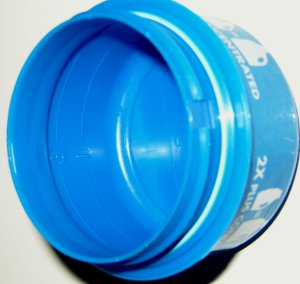
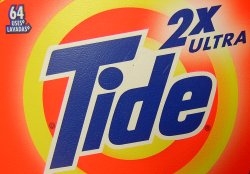
Trick #1: In the case of 100 ounce Tide, the front of the bottle indicates that you get 64 uses from this product.

 *MOUSE PRINT:

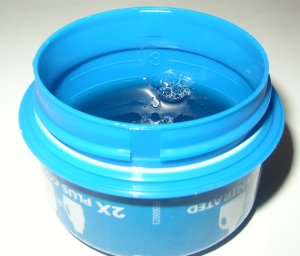
The 64 uses is based on a “medium load”, that is only filling the cap up to line 1, which is roughly one-third full:

Most consumers have big capacity washers and probably don’t do “medium loads” as their normal load, and thus will never get the claimed number of washes for the typical-size loads. Large loads require filling the cap to line 2, and who knows what line 3 is for. Filling the cap to line 2 will only yield approximately 50 uses, rather than 64. Interestingly, line three is the only line that goes completely around the entire inside of the cap, so it is the most visible from any angle, and possibly the one that most people might use.

Trick #2: Related to this, the cap is larger than any load size, so unthinking users who may have been used to products that required you to use a capful of product, will really deplete the bottle quickly. In fact, you will get fewer than 25 loads from the 64 load bottle if you do so. Think this is an accident?

“Take a cap and look at where the lines are—nowhere near the top,” says Adam Lowry, co-founder of San Francisco-based Method. “That’s not accidental. In an extremely mature market like laundry, for established players to grow they have to either steal share or get people to use more,” Mr. Lowry says. “They are trying to dupe people into using more product than they need.” — Wall Street Journal, January 25, 2010

P&G of course denies that its caps are designed to trick users.

Trick #3: Tide defines “load” differently depending on what they are trying to accomplish. Sample packages of Tide Ultra when it first came out were marked “1 Load” and probably did a good job on the average person’s large washload. Large washload? Yes, the amount of detergent in the packet was enough to almost fill their cap to line 2 (see picture below) — for large washloads. So P&G seems to say that one load should be enough to do a large wash when they are trying to impress their customers with a free sample, but they are not putting the equivalent amount of detergent per load in the bottles they sell.

According to the Wall Street Journal, P&G is about to introduce new caps on their various brands of liquid detergent, to make the markings clearer.

For now, just don’t expect to get the promised number of loads if you do normal-sized washes.

Share this story:


ADV
Updated every Monday!   Subscribe to free weekly newsletter.

Trader Joe’s (Not) “Simply Almonds, Cashews & Cranberries”

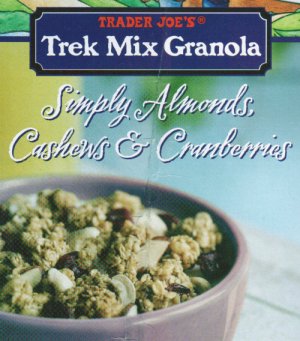
You cannot judge a book by its cover, and you cannot judge a granola by its name. That’s the lesson one learns when looking at a box of Trader Joe’s Trek Mix Granola called “Simply Almonds, Cashews & Cranberries.”

traderjoegranola1

Based on the product’s name, one would think this was more of a trail mix, containing only almonds, cashews and cranberries. Yum.

*MOUSE PRINT:

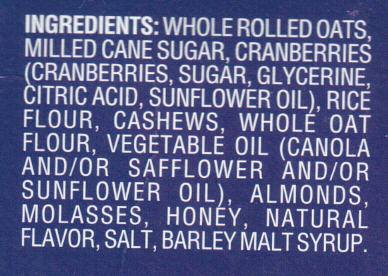
traderjoegranola2

It really has more oats and sugar than any other ingredient, as well as flour and oil. The key ingredients — almonds, cashews, and cranberries — are not even in the order of predominance suggested by the product’s name. In fact, they are in the opposite order, with more cranberries present than almonds.

Just as those old Freezer Queen two pound frozen entries used to be named “Gravy and Turkey” because there was more gravy than turkey in product, Trader Joe’s should simply rename their product more accurately.

Thanks to Willie L. for this submission.

Share this story:


ADV