Updated every Monday!   Subscribe to free weekly newsletter.

Honey, They Shrunk the Costco King Size Pillows

costcopillowpackCertain items come in standard sizes, whether it is mattresses or gallons of milk. At Costco, however, one particular brand of “king size” bed pillows is significantly smaller than standard size.

In the bedding industry, a “king size” pillow is typically 36 inches long by 20 inches wide. And that is exactly what most consumers would expect when buying this twin pack of king pillows, particularly since the bag is labeled KING KING KING and the exact dimensions are right there on the package:

costco20x36

Upon taking the pillows home from Costco, MrConsumer noticed that these king size pillows seemed noticeably smaller than the old ones they were replacing.  And checking the manufacturer’s “do not remove on penalty of death” Tyvek tag that was sewn onto the pillow itself confirmed the observation and revealed a surprise:

*MOUSE PRINT:

costcopillowlegal

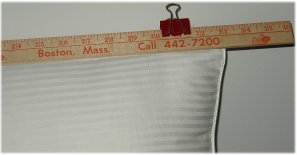
The pillow was indeed two inches shorter than standard king size length and two inches shorter in width. Worse, when actually measuring the length of the pillow, it wasn’t even the 34 inches represented on the legal tag, it was even shorter — 33 inches (and that was stretching the material as taut as physically possible):
costcopillowruler

Mouse Print* contacted Costco’s PR department for an explanation. Shortly thereafter, a representative from the pillow’s manufacturer responded, in part:

The pillows you are referencing are not sub standard size but rather the top of the line and one of the best values in the market. The law tag you are referring to should have stated the size as 18”x34”x2”. The 2” refers to the size of the gusset on this pillow and as is our industries practice included in the total dimensions. As a company we felt it would be more confusing to the customer stating the dimensions as 18”x34”x2” on the polybag. This type of pillow has been sold by us for years and this is the first complaint we have ever received regarding the size.

The fact that the pillow had a side gusset didn’t seem relevant to the issue of the pillow’s shorter length and width, so further inquiry was made of the manufacturer. The representative responded:

In order for the pillows to fit in standardized pillow cases, US manufacturers have to use the total square inches of a pillow in order to size the shell. Once the pillow is placed in a case and the product is compressed (while sleeping), the pillow will expand to the proper dimensions. If not, the product will be too large to fit properly. The US government has also regulated that the actual shell dimensions are to be used on the law tag (a legal document) for compliance. I understand the confusion of conflicting information and maybe we will need to correct the bag moving forward. When measuring the dimensions, they equal, what you are calling a standard size pillow when you include the gusset.

So if you add in the extra height of the pillow, that makes up for the shorter length and width? I don’t think so. Not satisfied that Costco had said nothing about what it was going to do about pillows on its shelves that were in bags marked with dimensions larger than the actual pillows they contained, Mouse Print* prompted the company again for a comment. Their assistant buyer in home textiles responded:

We appreciate your feedback and are indeed reviewing our packaging verbiage addressing the dimensions of our gusseted pillows. Once approved, the revised packaging will be utilized as the current inventory of bags is depleted by our supplier.

One would have expected them to say that in the meantime, they were at least going to put up a sign notifying customers of the discrepancy. Nope.

Now to be fair to Costco and Hollander (the manufacturer), king pillows on the market with gussets are all over the place on sizes. Some say 20 inches by 36 inches on the package and on the sewn-in label. Others put no dimensions on the package and only the word “king”, then show dimensions smaller than 20 x 36 on the label. Still others put 20 x 36 on the package, and a variety of smaller sizes on the label, including 20 x 34 and 18.5 x 34.5.

The best advice if you want a full length king size pillow is to take a tape measure to the store with you because you cannot always trust what the product says.

Share this story:


ADV
Updated every Monday!   Subscribe to free weekly newsletter.

When Written Permission Can be Oral!

There is good news this week for everyone who has been annoyed by receiving prerecorded telemarketing sales calls (“robocalls”) at dinnertime, even if you are on the “do not call” list. Starting September first, an amendment to the FTC’s Telemarketing Sales Rule requires telemarketers to get your express written permission before they can make such calls. This even applies to people who are not on the “do not call” list.

Sounds great, right? Who is going to fill out a form, sign it, and mail it back indicating they want to get junk phone calls? Very few people. But leave it to lawmakers to be hip and allow “electronic signatures” to substitute for ones on paper under the so-called E-Sign act.

*MOUSE PRINT: What is an electronic signature?

The E–SIGN Act defines an ‘‘electronic signature’’ as ‘‘an electronic sound, symbol, or process attached to or logically associated with a contract or other record and executed or adopted by a person with the intent to sign the record.’’ 15 USC 7006(5). The Act further defines an ‘‘electronic record’’ as ‘‘a contract or other record created, generated, sent, communicated, received, or stored by electronic means.’’ 15 USC 7006(4).

So one might think that typing “John Doe” on a website is an electronic signature, and you would be correct. But things you would never expect to constitute a “written signature” qualify also.

*MOUSE PRINT: The following types of things would also qualify as an electronic signature, depending on the wording:

  • Clicking a link in an email
  • Clicking a “yes” button on a website
  • Pressing a key on a touchtone telephone
  • Orally saying “yes” in a telephone call that is recorded
  • So, getting you to agree “in writing” to receive robocalls may be easier for a telemarketer to accomplish than you originally thought.

    One method that would not comply with the law is to bury a statement of your agreement to receive such calls in a contract, such as in the terms and conditions of a credit card agreement. For example, last week, Chase sent some card holders a notice of change in terms, but it is not an acceptable method of gaining your written consent to receive robocalls:

    *MOUSE PRINT:

    “You authorize us, or anyone acting on our behalf, to call or send a text message to any number you provide or to any number where we reasonably believe we can contact you, including calls to mobile, cellular, or similar devices, and calls using automatic telephone dialing systems and/or prerecorded messages,or to send an email to any address where we reasonably believe we can contact you.”

    Chase and most others, however, are allowed to call you using a prerecorded message that is informational in nature (rather than sales-oriented), such as providing a balance update or a reminder that a payment is due soon.

    Share this story:


    ADV
    Updated every Monday!   Subscribe to free weekly newsletter.

    T-Mobile to Charge for Paper Bills

    If you are a T-Mobile cell customer, you better check your August bill for an announcement about a costly new fee.  It will now cost you $1.50 a month for a paper “summary” bill.  And should you want a detailed paper bill, that will be $3.49 a month.

    *MOUSE PRINT:

    “After considering a number of factors including rising costs for paper, printing, and postage, as well as environmental impacts associated with printing paper bills, T-Mobile has started to charge customers who would like to receive a paper bill. The charge does not directly reflect our costs of printing and distributing bills. The company has provided alternative options for our customers to receive the information on their bills and continues to promote paperless billing as a “free” option (www.my.t-mobile.com or www.t-mobile.com/billingupdate)

    Beginning with August bills, current T-Mobile customers will receive notification that provides them with instructions on how to “opt out” of the paper bill charge by receiving a paperless, electronic bill. If customers do not sign up for paperless billing, then those receiving “summary” paper bills will begin to see a charge of $1.50 on their bills after September 12. Customers who currently receive “detailed” paper bills will see a $1.50 charge for the paper bill, in addition to the existing $1.99 charge for detailed billing information (totaling $3.49). 

    Most new customers will see a $1.50 paper bill charge on their first bill — this charge will be credited for their first month, allowing customers time to opt out if they wish to receive paperless bills free of charge.

    Certain T-Mobile customers are exempt from this charge, including prepaid and government customers, among others.”  [As reported by PhoneScoop.com]

    So, if you are in the habit of tossing out bill stuffers, or not reading the notices printed on your bill, you could be in for an expensive surprise unless you opt-out of paper billing and opt-in for online billing.

    While other carriers like Verizon and AT&T already charge $1.99 a month for an itemized cell bill, their summary bills are apparently still free. T-Mobile appears to be the first to charge a fee for a paper bill, no matter the type.

    WARNING: This blog is NOT the way to communicate with T-Mobile. It is not related to T-Mobile. If you are trying to elect the free billing option or complain about the new charges for paper bills, call the customer service number on your latest bill. Do NOT post your phone number here.

    Share this story:


    ADV