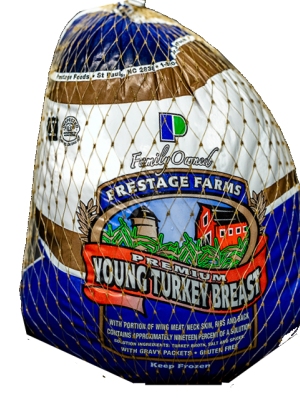
 We received a complaint from a consumer, Joan D., who had purchased a frozen turkey breast and says she got much less than she bargained for.
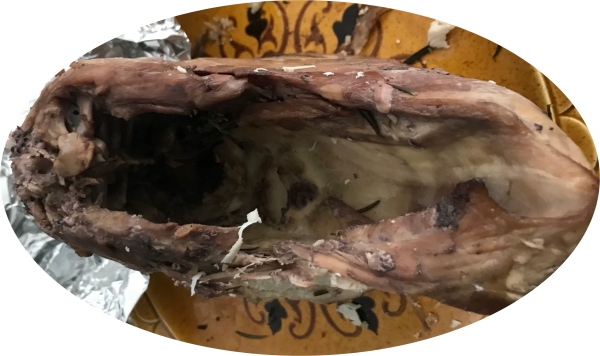
Upon opening the package, which weighed 6.28 pounds, she found three large gravy packets tucked in the breast cavity that weighed-one-and-one-quarter pounds. Her family commented how “puny” the cooked turkey looked — barely enough to serve everyone — weighing in at about four-and-half pounds.
There was a large densely worded disclosure on the package that forewarned about what was inside the wrapper:
*MOUSE PRINT:
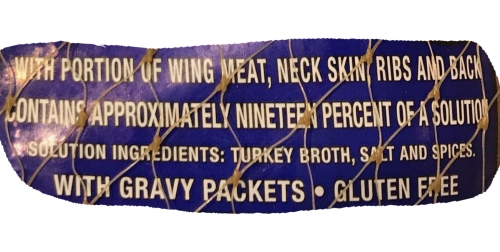
Our consumer didn’t notice that “gravy packets” were included, nor that the turkey had almost 20-percent added basting broth injected into the breast.
We checked with the United States Department of Agriculture’s Food Safety and Inspection Service (FSIS) about labeling regulations and the limits on added fluids to turkey products like this.
Believe it or not, there is no maximum amount of “solution” that can be injected into these birdies (see regulation) to bulk-up the weight as long as the percentage is stated in numerals on the package in a clear disclosure suggested to be in upper and lower case lettering.
There is also no requirement to list the weight of the gravy packets separately. According to an FSIS spokesperson:
For example, if the package includes a 6-pound turkey breast with added solution and 4 ounces of gravy mix in a separate packet, then the minimum total net weight required on the label is , “NET WT. 6 LB 4 OZ;†however, the label may also include the weight of the individual components as voluntary information, for example, “NET WT. 6 LB 4 OZ (turkey with up to 10% solution 6 LB, gravy packet 4 OZ)  [Emphasis added]
In this case, where the three packets add so much weight to the product, we can certainly understand why that information if provided in advance might better inform shoppers as to what they were really getting for their money.
We asked the company how it defended its practice of including so many heavy gravy packets without making a clear disclosure of their weight on the package, and whether they would consider listing the weight of the various components separately. We also inquired as to why they didn’t follow the law and state the amount of solution as “19%” using numerals.
They responded:
We offer different options to our various retailers when it comes to our turkey breasts so that consumers may have choices to pick one of their own preference.
Some of those options include gravy packets – a single packet or multiple packets. The packaging states if the product is a turkey breast, a turkey breast with a gravy packet, or a turkey breast with gravy packets.
We operate under USDA inspection and everything we produce is approved by FSIS officials.
So what do you think? Should purchasers of this product feel hoodwinked about the presence of so many gravy packets and the amount of broth injected into the turkey breast?