Last Friday (the 13th) was MrConsumer’s lucky day. He got an email from Chipotle, the Mexican fast-food chain, congratulating him on winning “free Chipotle for a year.” Opening the message revealed a celebratory animated graphic raining down burritos.
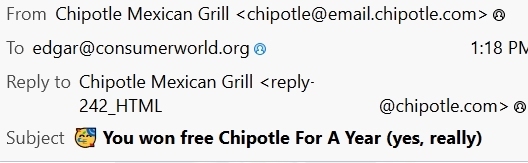

There was no fine print. Clicking the link in the email brought me to my Chipotle rewards account, but the only things there were two offers to get free guacamole or a side and chips if I made separate $5 purchases.

That’s it? That’s their idea of free Chipotle for a year, a promotion they launched last week?
To claim my prize, I looked for and found the sweepstakes official rules online. It appeared to have two parts. In one part, over 3000 rewards members would be chosen to win free Chipotle for a year, and in the other, the company would spin some type of wheel of fortune and select members to win the free year’s worth of food. I assumed that that must have been how I won.
In reading the rules further, the company defined exactly what they meant by the “Chipotle for a Year Prize” — and it wasn’t just free guac and chips.
*MOUSE PRINT:

So, how do I collect the prize? Going to Instagram and sending a message to @Chipotle seemed to do nothing. So, I sent a message via Twitter to the company and they quickly replied.
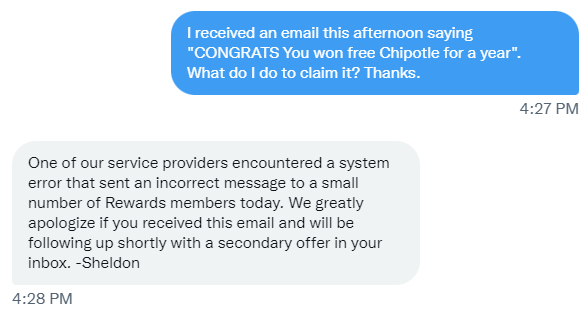
That’s it? We goofed. We’re sorry?
So we wrote to the PR folks and the chief marketing officer at Chipotle asking what happened, how many customers were affected, and what they were going to do for those people to make up for misleading them into thinking they had won the big prize. The company did not respond despite multiple inquiries.
Online buzz, however, suggests what actually happened. It appears that Chipotle mixed up their mailing lists and offers. On January 13, those reward members whose birthday was January 12 were slated to receive a birthday message offering free chips and a side, but instead they were sent the free Chipotle for a year winners’ notification.
Some five hours after the errant email was sent, a new one from the company arrived apologizing for the error and offering one free entrée as a goodwill gesture.
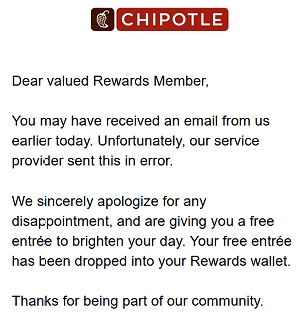
What do you think? Should Chipotle provide a little more than a single burrito to these disappointed customers or was that really enough?