Updated every Monday!   Subscribe to free weekly newsletter.

Candy Box Slack-Fill Case Dismissed

Judges are not looking favorably on consumer cases against candy manufacturers who only fill their boxes halfway.

When manufacturers over-package a product creating empty space inside that has no function other than to make consumers think they are getting more for their money than they really are, that is called slack fill, and it’s illegal under federal law (and the law of some states). It is not illegal if the empty space is needed because of settling of the product, or because the machinery to fill the package requires it, or the space is needed to protect the product (such as the cushioning pillow created by large potato chips bags).

A federal court judge just let Tootsie Roll off hook for its five-and-a-half inch high boxes of Junior Mints that are close to half empty inside.

*MOUSE PRINT:

Junior MintsJunior Mints inside

Note that the illustration with a ruler is of a revised box introduced after the lawsuit ended that states on the front the minimum number of mints inside.

In ruling against the consumer who brought the case, the judge said in part in his opinion:

To begin, the Products contain a disclosure that the Products are sold by weight, and not volume, which addresses the very information that Plaintiff alleges was misrepresented.

Furthermore, the net weight of the candy, both in metric and standard measurements, is displayed on the front of the Products’ boxes in easily discernable font.

And citing some other related cases, the judge adopted their conclusions:

“the slack-fill enclosed in [a box of Junior Mints] would not mislead a reasonable consumer” because the Junior Mints’ boxes included the net weight of the candy and consumers have come to expect some slack-fill in certain products…

…a consumer “can easily calculate the number of candies contained in the Product boxes simply by multiplying the serving size by the number of servings in each box, information displayed in the nutritional facts section on the back of each box.”

What’s troubling is the judge’s reasoning that since the net weight is stated on the package (as all packaged food products are required to) that somehow makes irrelevant that the product is packaged in a box that makes it look like it contains more content than it really does. What is the point of the slack-fill law if over-packaging like this is continued to be allowed?

Share this story:


ADV
Updated every Monday!   Subscribe to free weekly newsletter.

At Target, The Price is  Right  Variable

Nothing is easy anymore. You go shopping in a real store, you see the price on the shelf, and you expect that is the price you will pay. But then reality intervenes.

MrConsumer had a $5 coupon from Target that he got when getting his COVID booster and it was about to expire. He finally found something he wanted to buy by checking Target.com on his home computer — four bottles of Market Pantry honey mustard dressing for $1.39 each.

Target honey mustard

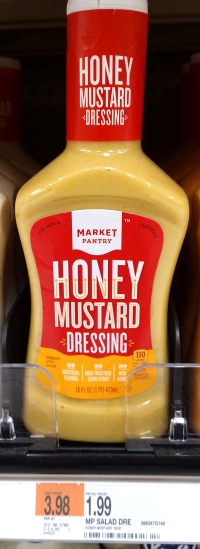
So he went to his local Target, and found the salad dressing on the shelf, but it was $1.99!

Target Honey Mustard 1.99

Distressed, he went up to the aisle scanner to double-check the price.

Target honey mustard scanner

It said $1.79. So now we have three different prices: $1.39, $1.79, and $1.99. We know the middle price is what will be actually charged at the register, but that would allow MrConsumer to only get three of the dressing bottles instead of his planned four with his coupon. Grrr.

MrConsumer asked the checkout clerk to price match the $1.39 Target.com price, and he gladly did. (Here is Target’s price match policy.)

But the story doesn’t end there. Did the online price for this salad dressing vary depending on what store you chose as “your” store on the website?

Checking the online price at over a dozen different Target store locations within a 10-mile radius of Boston yielded shocking results.

*MOUSE PRINT:

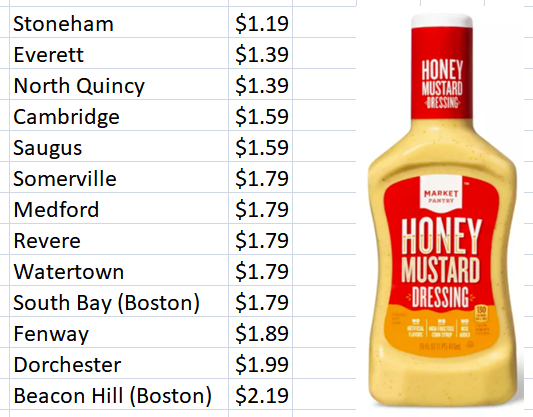
Target Price Comparison

Target price comparison

The prices ranged from a low of $1.19 to a full dollar more — $2.19. How crazy is that? Supermarkets and drugstores are known for “zone pricing” (charging different prices in different neighborhoods factoring in local competition) but who knew that Target apparently engaged in that practice too? Of course, a sample size of one item says nothing about how Target prices all its other groceries and other merchandise. So we asked the company for details and an explanation.

A Target spokesperson sidestepped most of our questions but acknowledged:

Like many retailers, overall prices and promotions may vary by location and channel.

In further checking, we also learned that not all the Target locations in the chart above actually carry that item, but a shopper could order that product for delivery at the stated web price.

The bottom line is this. Target’s prices for at least some groceries vary store to store, as perhaps other categories of goods do. And since Target maintains a price match policy, including to the prices on its own website, it behooves shoppers to check there to see if the price is lower. Savvy shoppers might discover this is a new way to save money.

Please share your thoughts about the dramatic price differences brought to light in this story.

Share this story:


ADV
Updated every Monday!   Subscribe to free weekly newsletter.

Does Spectrum Capture Your Voice Then Secretly Use It for ID Purposes?

Biometric Voice PatternA regular Consumer World reader from Florida who we’ll call N.W. recently wrote to us about a disturbing discovery when she called the technical support department of Spectrum, her cable provider.

Rather than ask a whole series of verification questions when first connected, N.W. explained that the representative immediately identified her by her voice. She asked how this was possible, and was told that customers’ voices are recorded for Spectrum’s use. One of the newest uses is to digitize a person’s voice and speech pattern to create a unique digital identity or voiceprint that can act like an automatic password when they call again.

According to our consumer, Spectrum claimed they had notified her about their new Voice ID security system via email, but when she inquired what email address they had on record for her, they admitted they had none.

N.W. is a very privacy- and security-sensitive person and was distressed by Spectrum’s use of this technology without her knowledge or affirmative consent.

According to a press release and a fact sheet that Spectrum issued last May at the launch of the feature, Voice ID was supposed to be an “optional” and “completely voluntary” service.

*MOUSE PRINT:

Spectrum optional

Spectrum voluntary

Obviously, their Voice ID system only works if the company can hear or record the customer’s voice and then analyze it. Most companies’ customer service lines announce that “your call may be monitored or recorded for training or quality control purposes.” Anecdotally, Spectrum may not always do this in all cases, but it has a disclosure in its terms of service:

*MOUSE PRINT:

a. Recording of Communications. Subscriber acknowledges and agrees that all communications between Subscriber and Spectrum may be recorded or monitored by Spectrum for quality assurance or other purposes [emphasis added] subject to applicable law.

To get a straight answer as to what happened in N.W.’s case (and perhaps to others), we asked the PR folks at Charter Communications, the cable operator that provides Spectrum service. It has over 31 million customers in 41 states.

After doing their research, N.W. got a call from Spectrum. According to her, the Spectrum rep admitted that the company had recorded voices for Voice ID without customers’ knowledge and consent, they were very apologetic, and said there was no excuse for what happened.

So could N.W. be the only customer they did this to? We asked the company how widespread the problem was, why it was done without consent, whether reps were incentivized to enroll customers in Voice ID, and what were they going to do now to remedy the situation. They issued this short statement but declined to comment further:

“We take customer security and privacy very seriously and our policy is, and always has been, to obtain customer consent prior to enrollment in Voice ID. In the event the enrollment is disputed, we will remediate the situation immediately by unenrolling the customer and deleting their voice file, as has been done in this instance.”

From a legal standpoint, there are two key issues. Does Spectrum properly alert callers when they are recording or monitoring customer conversations and the reasons for doing so? And did Spectrum enroll other customers in Voice ID without permission? The strongest biometric protection laws (that govern a third party’s use of your fingerprint, iris scan, voice, face, etc.) prohibit collecting and using such identifiers without first notifying the subjects and getting their affirmative consent. And remember that in Spectrum’s case, they explicitly told customers they would not enable Voice ID without permission.

As of mid-2021, five states (Illinois, Arkansas, California, Texas, and Washington) had specific laws governing biometrics. Some other states apply their generic privacy laws to biometric issues, while still others have pending legislation on the subject. (See state list.)

So how do you feel about a company recording your voice, and creating and using a voiceprint to identify you? Should you have to give your permission for them to do this? And do you think that N.W. was the only customer who was involuntarily opted into Voice ID? Enter your comments below.

And, as an experiment, if you have Spectrum service, considering calling customer service and asking if Voice ID is or is not enabled on your account. You can report your results here.

For an interesting article on the commercial use of your voice, check out Professor Joseph Turow’s opinion piece recently published in the New York Times.

Share this story:


ADV