Updated every Monday!   Subscribe to free weekly newsletter.

Starbucks Accused of Underfilling Lattes

Starbucks cupA few weeks ago, two consumers sued Starbucks alleging that the company routinely and deliberately underfills their cups of latte.

The lawyers contend that in 2009 the company adopted a money-saving move that would force Starbucks’ baristas to make lattes in a uniform way. They were required to use a pitcher that contained “fill to” lines like those on detergent bottle caps so they would know how much milk to add. They then had to add a certain number of one-ounce shots of espresso, a certain number of pumps of flavored syrup, and 1/4-inch of foam on top, leaving 1/4-inch of space.

Starbucks recipe

The lawyers say that based on this recipe plus the actual physical capacity of Starbucks’ cups, their lattes can’t possibly be the full size they claim.

What are Starbucks’ size claims?

*MOUSE PRINT:

Starbucks menu

Starbucks represents that their hot lattes are 12, 16, and 20 fluid ounces in tiny letters right on their menu boards. When the lawyers tested the capacity of their cups, they found that only when filling them all the way to the brim did they hold the claimed capacity. But since they interpret the official instructions as requiring that 1/4-inch of space be left at the top, right off the bat all their lattes are short-weighted, they contend. Note: a test by Mouse Print* of a 16-ounce Starbucks cup reveals that it actually holds about 17 ounces when filled to the brim.

Even if the cups are only one-ounce short when served, multiply that by millions of cups sold a week, and that means huge savings for the company and a huge loss in the aggregate for customers. But the lawyers offer more proof based on actual store inspections. They say they “purchased and measured Starbucks Lattes at different stores, in different states, in different sizes, and in different flavors. However, each Latte was underfilled by approximately 25%.”

On the face of it, that is a rather shocking allegation.

Yet, in the very next paragraph of the complaint, the lawyers present conflicting evidence when they recount what happened when they followed the company recipe using one of the Starbucks pitchers that they had obtained.

*MOUSE PRINT:

For a [16-oz] Grande beverage, the “fill to” line comprises less than 12 fluid ounces of milk. After adding 2 shots of espresso (2 fluid ounces), the resulting beverage measures less than 14 fluid ounces at most. This falls far short of Starbucks’ “16 fl. oz.” representation.

Haven’t they just contradicted their claim that drinks were all underfilled by about 25% in their tests? In this example, for a 16-oz drink to be 25% short, it would have to be 12 ounces, not the almost 14 ounces they found. And did they really follow the recipe? Where’s the four pumps of flavored syrup? Where’s the foam? If these ingredients were added, what would be the total number of ounces in the cup?

And if cups were all 25% short, wouldn’t consumers across the country have been yelling bloody murder about the practice for years? Well, maybe not, since Starbucks puts an opaque cover on hot lattes and you drink it through a hole on the cover.

Mouse Print* emailed two of the lawyers raising some of these very issues, but we have not yet received a response.

Starbucks has been relatively circumspect in their response to the lawsuit.

“We are aware of the plaintiffs’ claims, which we fully believe to be without merit. We are proud to serve our customers high-quality, handcrafted and customized beverages, and we inform customers of the likelihood of variations.”

We have a sneaking suspicion this case may turn on two points. The first is what is the proper way to measure foam (and maybe the aerated milk) — do you just measure its height/volume and count that as part of the total fluid ounces, or do you have to wait until it settles to see how much liquid is actually contained in the foam? According to Handbook 133 of the National Institute of Standards and Technology, you have to dissipate the foam, and then you measure the quantity of liquid in the cup.

Secondly, there is an issue related to the syrup, which we won’t detail here. But, according to weights and measures rules, since both flavored and unflavored lattes are represented on the menu board to be a certain number of ounces, they must in fact meet that standard –and not by adding a whole bunch of extra foam to fill the cup.

Look for MrConsumer on the Today Show commenting on Starbucks’ practices:

Starbucks Today Show
Click picture to view video

Updated every Monday!   Subscribe to free weekly newsletter.

Thanks for Nothing #2:
Dollar General Found Selling Obsolete Motor Oil

Many of us shop at dollar stores because of bargains you can often find there. Sometimes, however, the bargain is no deal.

For example, Dollar General sells quarts of its own brand of motor oil, DG, for $2.50 to $2.75. That is cheaper than the big name brands.

Dollar General oil

What could be bad?

*MOUSE PRINT:

Dollar General Oil back of label

The back of the label provides an unexpected shock. This oil is not for use in cars built after 1988?! Who would ever expect a common oil like 10W-30 sold by a major general merchandise chain to be inappropriate for the expected use for most customers?

While the label says it meets a particular automotive specification, that spec is outdated, and has been updated six times since then according to the Petroleum Quality Institute of America.

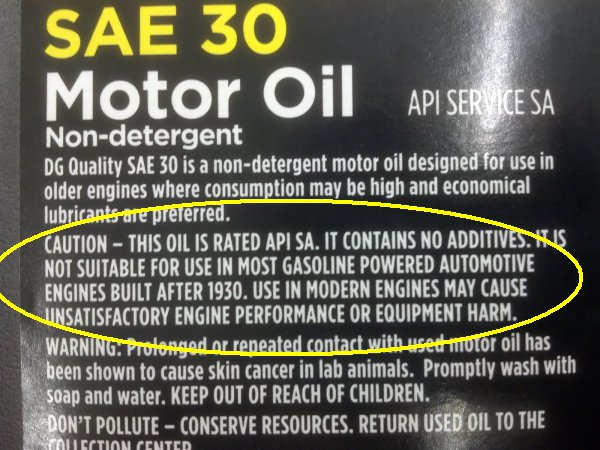
Another product the company sells, an oil called SAE 30, has an even more astonishing disclaimer on the back of the bottle:

SAE 30

This one is not for cars built after 1930! So for everyone with a Model T, go grab some.

But for everyone else, thanks for nothing, Dollar General.

Now, consumers in 14 states have filed lawsuits against Dollar General for selling obsolete motor oil: CA (see lawsuit), CO, FL, MD (see lawsuit), KS, MI, MN, MO, NE, NJ, NY (see lawsuit), VT, OK, and TX.

And our friends at ABC’s Good Morning America, with a little help from Mouse Print*, just completed an undercover investigation of these motor oils:

Good Morning America story
Click to view

We asked the company to explain why they even sell these products that are inappropriate for most of their customers, whether they would put up more prominent warnings for shoppers, and what their reaction was to the lawsuit. They responded as follows in relevant part:

We are confident that our DG-branded motor oil products meet not only our standards for quality and value, but also all applicable federal and state labeling requirements where they are sold. In addition, the labeling on these products contains obvious and unambiguous language regarding the products’ intended and appropriate use.

Dollar General intends to vigorously defend against the claims raised in the recently-filed lawsuits regarding these products, including the filing of motions seeking their dismissal. — Dollar General Corporate Communications

Few shoppers know that there is more to buying motor oil than looking for the proper viscosity, such as 10W-30 or 10W-40. You need to make sure that you are choosing the one specified in your owner’s manual, including the appropriate service category. This is an industry specification, noted on the label, relating to the additives put in the oil to help prevent corrosion, sludge build up, and engine damage.

The most current service category is API “SN”. The oils shown above have obsolete service category designations such as “SA” or “SF,” meaning they are missing more modern additives.

Here is a chart from the Petroleum Quality Institute of America (an organization that tests motor oils for compliance with the labeled standard) showing which car model years are covered by each service category designation. Each category is backwards compatible.

oil chart

=======

We welcome your submissions of other great “thanks for nothing” examples. Just email them to edgar(at symbol)mouseprint.org .

Updated every Monday!   Subscribe to free weekly newsletter.

Kohl’s Sued Over Fake Sales

This is the final part (for now) in our series of stories about retailers that are alleged to inflate their regular prices as a means of offering fictitious discounts during “sales.”

In 2010, a California consumer sued Kohl’s for just that, but the lower court threw out his case saying that he did not suffer a loss of money. A federal appeals court last week, however, overturned that decision. Here is the case decision.

Antonio Hinojos, the consumer in the case, made a whole bunch of purchases at Kohl’s of items that he thought were great bargains:

Samsonite luggage that was advertised as 50% off its “original” price of $299.99, Chaps Solid Pique polo shirts that were marked down 39% from their “original” price of $36.00, Chaps Solid Pique polo shirts that were marked down 32% from their “original” price of $39.50, Chaps t-shirts that were marked down 40% from their “original” price of $26.00, and Sonoma Life & Style Henley Tops that were marked down 40% from their “original” price of $22.00.

He later found out (not clear how) that he had been taken — presumably learning that those goods rarely if ever sold for the so-called “original” or “regular” price.

Kohl’s defended itself by arguing that Hinojos lost neither money nor property because he acquired the merchandise he wanted at the price that was advertised, even if the advertised price was falsely represented as a “sale.” And therefore, under California law, they said, absent a loss of money or property, the consumer had no case.

The consumer’s key argument was that he did have a loss of money because he “would not have purchased [these] products at Kohl’s in the absence of Kohl’s misrepresentations.”

The judge agreed, ruling:

*MOUSE PRINT:

“Most consumers have, at some point, purchased merchandise that was marketed as being “on sale” because the proffered discount seemed too good to pass up. Retailers, well aware of consumers’ susceptibility to a bargain, therefore have an incentive to lie to their customers by falsely claiming that their products have previously sold at a far higher “original” price in order to induce customers to purchase merchandise at a purportedly marked-down “sale” price.

In sum, price advertisements matter. Applying Kwikset [a related court case] in a straightforward manner, we hold that when a consumer purchases merchandise on the basis of false price information, and when the consumer alleges that he would not have made the purchase but for the misrepresentation, he has standing to sue under the UCL and FAL because he has suffered an economic injury.” — Judge Reinhardt

The case now heads back for trial.

The FTC has guidelines about deceptive price advertising:

§ 233.1 Former price comparisons.

(a) … If, on the other hand, the former price being advertised is not bona fide but fictitious—for example, where an artificial, inflated price was established for the purpose of enabling the subsequent offer of a large reduction—the “bargain” being advertised is a false one; the purchaser is not receiving the unusual value he expects. In such a case, the “reduced” price is, in reality, probably just the seller’s regular price.

(b) … The advertiser should be especially careful, however, in such a case, that the price is one at which the product was openly and actively offered for sale, for a reasonably substantial period of time, in the recent, regular course of his business, honestly and in good faith—and, of course, not for the purpose of establishing a fictitious higher price on which a deceptive comparison might be based.

MrConsumer investigated Kohl’s a decade ago, tracking prices of 20 items for 103 consecutive days. The result: the average item was on sale 86 percent of the time, and one-in-four items never sold for the so-called “regular” or “original” price at any time in that three and half month period. Looks like little has changed.