 Saving money on major appliance purchases is no longer easy. You cannot simply look at a sale circular and be assured you are getting the lowest price. You now have to combine savings offers and strategies, and then fight to get what you were promised.
MrConsumer finally broke down and decided to order a new refrigerator he had been eyeing at Sears. The one he selected was the only non-water/non-ice model available and the only side-by-side that could fit through his back door. (Most online specs ignore protrusions on the back of refrigerators like water pipes and metal jutting out that can add up to an extra inch to the stated width.)
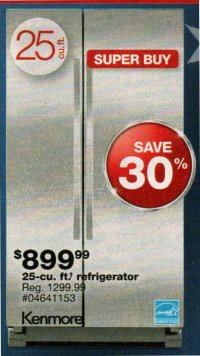
The model was regularly $1299.99 (an inflated price because the list price for the Whirlpool version is only $1199.99), advertised on sale for $899.99 in Sears’ weekly flyer. This was the lowest price it had been advertised for in the recent past. There was, however, a small print footnote.
*MOUSE PRINT:
“Advertised savings are valid in-store only.”
Good thing, as it turns out, because the online Sears.com price was $809.99! The website was offering an extra 10% off appliances $499.99 and up.
MrConsumer remembered that there had a been a high-value dollars-off coupon floating around the Internet, and sure enough he found it: $35 off a $300 or more purchase. When that was factored in, the price dropped to $774.99.
Sears had just begun offering free delivery for online customers, so that saved another $69.99.
Since Sears has been heavily promoting its “Shop Your Way” rewards program, MrConsumer checked the list of available coupons, and lo and behold found this way to get $50 back:

And as Ron Popeil always says, “but wait, there’s more.” When it comes time to pay for the item, the question is whether to use a 2% cash back reward credit card, or use the Sears MasterCard. After assuring that the Sears card doubled the manufacturer’s warranty, thus adding an extra year of coverage for free, the choice was simple because:

*MOUSE PRINT:
The footnote did not say “in-store only” so the offer should be good for an online purchase to save an extra 5%.
Lastly, knowing that websites like ebates.com and FatWallet.com offer cash back rebates when you shop using their links to merchants, MrConsumer checked how much they were giving back. Both were offering a generous six-percent rebate. Ca-ching.
All these savings are great in theory if you really get them. And that’s the problem. Other than getting the refrigerator for the $774.99 price after deducting the $35 coupon, no other savings were realized automatically as promised.
The extra 5% off for using the Sears card never materialized. Only after two calls to customer service, and then requesting a supervisor, did Sears provide a credit of $41.67. The 6% back from FatWallet didn’t get credited in full because Sears appears to have manipulated the sale price to be close to $200 below the actual sale price. That will be another fight. And the $50 back in points that were promised took two phone calls to get. It was, however, mouseprint that prevented this rebate from properly being added to MrConsumer’s order.
*MOUSE PRINT:

So despite electronically clipping the $50 in points coupon and adding it to one’s Shop Your Way account, Sears provides an additional fine print link that also has to be clicked to “apply” the coupon to your order. Who knew? And would most people catch that inconspicuous link?
Adding insult to injury, of course, two days after the sale was consummated, Sears offered a $50 off a $300 appliance purchase coupon. Under the Sears price adjustment policy, MrConsumer should get the extra $15 off (the difference between his $35 off coupon and this one). That only took two additional phone calls to square away.
So, to recount all the promised savings:
Discount off regular price:     $400.00
Online only discount:           $90.00
Online only free delivery:      $69.99
$50 off a $300 purchase coupon: $50.00
5% discount using Sears card:   $41.67
50,000 ($50) points credit:     $50.00
1% in regular points:           $7.75
6% FatWallet rebate:            $45.60
=======================================
Total savings:                  $755.01
Is all this worth it, you ask? For veteran bargain hunters, it is all part of the game. For regular folks, few would have the patience to deal with all this detail, the problems, and the follow-up.
Finally, from the “too-good-to-be-true” department, only after MrConsumer made the purchase of the refrigerator, did he decide to check Consumer Reports’ ratings. Of the 74 side-by-side models tested, the sister model to his came in 73rd place. Grrrr.


 All three major drugstore chains (CVS, Rite Aid, and Walgreens) now advertise sale items only for loyalty cardholders. No card, no savings. Unlike the old days, when you saw Bufferin on sale for $1.99 and actually paid $1.99 for it, now you pay maybe $2.99 (at CVS and Rite Aid) but a get a $1 coupon on your register receipt good only toward a future purchase. It is like getting an IOU for the savings they promised, rather than them giving it to you on the spot. Some would say it is almost like a pyramid scheme.