Updated every Monday!   Subscribe to free weekly newsletter.

No, Amazon is Not Sending You a $100 Gift Card

Last week, MrConsumer received an email seemingly from Amazon saying it was sending along a $100 gift card as a thank you. How nice of them. But on closer inspection, this was a scam.


*MOUSE PRINT:

Amazon gift card scam

First, the email was addressed to “abuse@consumerworld.org” which is not a personal email. Secondly, when hovering over the “view details” button with the mouse, you see that clicking it would take you to “woo-brands.com” and not to Amazon. Visiting that site could well have infected my computer with malware, trigger whatever trap the sender intended.

And checking the IP addresses in the header information of this email (under source in most email programs), you see that the email appears to have originated in China and had a lovely journey through Italy on the way to Boston.

*MOUSE PRINT:

Amazon gift card scam source

So, the lesson here is that no matter how legitimate an email looks, double-check any links or buttons, no matter what they say, before clicking on them.

Updated every Monday!   Subscribe to free weekly newsletter.

That Computer Tablet From China May Not Be Up to Spec

This is the story of a guy who bought a couple of computer tablets on eBay from China and got less than he bargained for.

Phil S. wasn’t a stranger to buying on eBay, and had purchased many computer items from sellers in the USA, China, and other countries around the globe. Phil was also a “power user” and adept at resolving just about any problem that he came across since he used to run a computer store.

Last month, he saw a tablet being offered by a highly-rated seller with excellent specifications like Android 9, a ten-core very fast processor, and tons of ram and storage. So, he bought two of them.

Phil ad pic

The tablets arrived from China a few weeks after ordering them. A quick double-check of the specs according to the “about” section of settings revealed he got exactly what he paid for, an even got an Android upgrade to version 10.

Phil tablet fake specs

However, when he started using the tablet, he noticed problems immediately. There was something off. The specs claimed that the unit was running Android 10, but the screen had the exact appearance of Android 4.4. The units seemed slow. After running a few tests, he found that they were old units hacked to appear like new, high capacity fast tablets. In other words, the seller or his henchmen went into the “about” page on the tablet (shown above in the black picture) and actually changed the wording that it displayed.

Using some sophisticated sniffing tools, Phil found some of the real specs of his tablets.

*Mouse Print:

phil actual specs

The fraud pervaded every specification that the seller had listed, speed, resolution, capacity, processor, and software version. For example, the resolution was not the 2560 x 1600 promised, but only 1280 x 720; and the processor only had four cores and not 10.

When Phil complained to eBay, they refunded his money. But he wanted to warn others about this scam. If you see ads online for no name computers with great specs but at ridiculously low prices (Phil’s tablets were only $69), you might want to think twice before hitting the buy button.

Updated every Monday!   Subscribe to free weekly newsletter.

A $2-Million Coupon Surprise

Have you read any good coupons lately? If not, you are in for a surprise courtesy of the folks at Kimberly Clark, makers of paper products like Kleenex, ScotTissue, and Viva paper towels.

Most people don’t read the fine print of anything, let alone cents-off coupons. But maybe they should, particularly if they are trying to pull off some coupon monkey business.

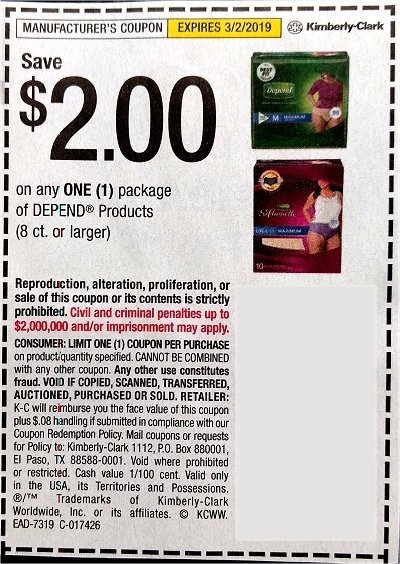
*MOUSE PRINT:

$2-mil penalty

That’s right. Kimberly Clark is threatening those who commit coupon fraud with up to $2-million in criminal or civil penalties or jail if you try to rip them off. This addition to coupons was instituted four years ago but has gone largely unnoticed.

According to the Coupon Information Corporation, the industry group that fights coupon fraud, losses from counterfeit coupons and coupon misuse cost manufacturers (and in turn consumers) millions of dollars a year. In the largest case to date, the head of a coupon clearinghouse was sentenced to 10 years in jail and ordered to pay $65 million in restitution to companies, including Kimberly Clark, after being convicted in a massive coupon fraud case.

The warning on coupons is meant as a deterrent. But for those who ignore it and get busted by the feds by surprise, they may have wished they had actually used this Kimberly Clark coupon:

Depends