
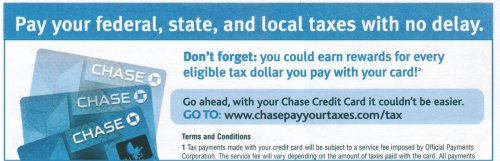
With tax day less than a month away, cash-strapped consumers may be tempted to charge the balance they owe to a credit card, such as through the offer above (or via the electronic payment services approved by the IRS that accept credit cards).
The promotion says you could earn rewards for every dollar you charge. The fine print, however, says:
*MOUSE PRINT: “Tax payments made with your credit card will be subject to a service fee…” How much of a service fee? It is 2.49 percent, or about $25 per $1000 charged.
But what about the rewards they promised? Most reward credit cards only offer 1% back, so that would reduce your service fee to 1.49 percent or about $15 per $1000 charged. The good news is that most credit card companies will treat this tax payment as a purchase rather than a cash advance (thus giving you a 20-25 days grace period with no finance charges or cash advance charges if you pay in full every month). If you don’t pay it in full, regular finances charges will accrue on top of the 2.49 percent fee.
Some credit cards like Citi’s CashReturns card offer 5% back on everything for the first three months. Were you to use this card, you would actually make 2.5% on your tax payment.
A little known alternative to charging your taxes to your credit card is to put that charge on your debit card through a company called Link2Gov.
*MOUSE PRINT:Â The fee is only $2.95, but your card must be a member of the NYCE, Star or Pulse networks.
Don’t charge more than is your bank account, or that will trigger overdraft fees, and/or finance charges from your bank.
Most experts, however, suggest paying your taxes the old fashioned way — by check. You will enjoy a week or two of float, and not pay a penny extra in fees or finance charges.
Very wise advice for those of us who haven’t overpaid the government and aren’t expecting a refund.
Apparently you have finally hit a topic that people do not even feel is worth commenting on, congratulations!
On a related topic, I find it disturbing that there is an IRS charge to use electronic filing, which (in theory) should save them huge amounts in labor costs.)
With credit card payments, I’m pretty sure the IRS does not allow the CC companies to charge THEM a fee (as is typical with other businesses that allow credit card payments) so the CC companies simply transfer that fee back to the consumer.
Checks will still save you money at the expense of higher labor costs which get added to the IRS budget.
For anyone who might be considering filing for bankruptcy any time soon, it should also be noted that tax debts that are charged on a credit card (or any other financing source) are not dischargeable in bankruptcy. In other words, don’t make the mistake of thinking that you can pay off your taxes with your credit card or with a convenience check and then turn around and file bankruptcy to get rid of that debt. See 11 U.S.C. 523(a)(13).
I say whatever you have to do to get that tax bill paid on time, you should do it. I’ve been on a payment plan with the IRS before and trust me, it’s not worth it. The interest they charge is a killer and way higher than anything you’d likely pay on your credit card.